EthicsGS 2: GovernanceGS 2: PolityPrelimsGS 4: Accountability and Ethical Governance
A split verdict, faltering remedies and people’s power, Pg6
Split Supreme Court verdict on EC appointment law sparks debate over executive control, judicial ethics, and electoral integrity, delaying crucial constitutional decision.
Practice MCQs
898 Students attempted
Key Highlights:
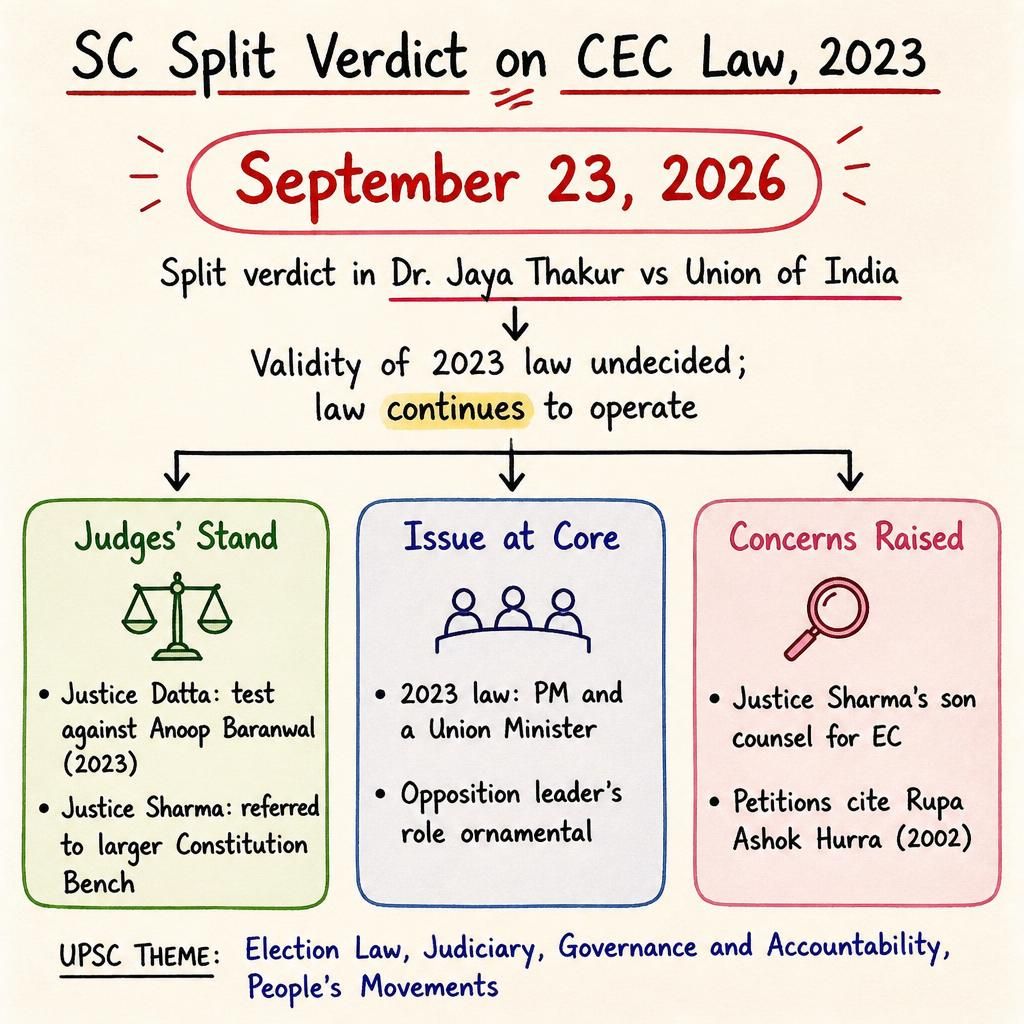
- The Supreme Court of India delivered a split verdict on September 23, 2026, in Dr. Jaya Thakur vs Union of India, challenging the Chief Election Commissioner and Other Election Commissioners (Appointment, Conditions of Service and Term of Office) Act, 2023.
- Justice Dipankar Datta held that the 2023 law should be examined against the principles of the Anoop Baranwal (2023) judgment, which opposed executive dominance in the selection of CEC and ECs.
- Justice Satish Chandra Sharma referred the matter to a larger Constitution Bench due to the importance of the issues involved.
- The 2023 law establishes a selection committee with the Prime Minister and a Union Minister, leading to executive predominance, making the Opposition leader's role ornamental.
CEC Verdict.jpg
Detailed Insights:
- The split verdict delays a decision on the validity of the Chief Election Commissioner and Other Election Commissioners (Appointment, Conditions of Service and Term of Office) Act, 2023, allowing its continued operation.
- The Anoop Baranwal (2023) judgment had previously mandated a selection committee comprising the Prime Minister, Leader of Opposition, and the Chief Justice of India.
- Public protests are mounting, questioning the legitimacy of the 2023 law and decisions of the Election Commission, with calls for the resignation of CEC Gyanesh Kumar.
- Justice Satish Chandra Sharma's son served as counsel for the Election Commission, raising concerns about a potential conflict of interest and impartiality.
- The non-disclosure of this association by Justice Sharma has led to petitions for recalling his order, citing precedents like Rupa Ashok Hurra vs Ashok Hurra (2002).
- Bangalore Principles of Judicial Conduct and Restatement of Values of Judicial Life prohibit judges from adjudicating cases where family members are involved or where there is an appearance of impropriety.
- The article highlights that political struggles and people's movements have historically led to the repeal of controversial laws like TADA, POTA, and the farm laws, even when upheld by courts.
Key Concepts Involved:
- Chief Election Commissioner (CEC) and Election Commissioners (ECs): Constitutional authorities responsible for overseeing and conducting elections in India.
- Constitution Bench: A bench of five or more judges of the Supreme Court of India that hears cases involving a substantial question of law regarding constitutional interpretation.
- Anoop Baranwal (2023) Judgment: A Supreme Court ruling that established a selection committee for CEC and ECs including the Chief Justice of India to ensure independence.
- Chief Election Commissioner and Other Election Commissioners (Appointment, Conditions of Service and Term of Office) Act, 2023: The law enacted by Parliament that changed the selection committee for CEC and ECs, replacing the Chief Justice of India with a Union Minister.

SuperKalam is your personal mentor for UPSC preparation, guiding you at every step of the exam journey.
Download the App


STUDY RESOURCES
CONTACT US
ⓒ Snapstack Technologies Private Limited