GS 2: GovernanceGS 2: Social JusticeGS 3: EconomyPrelimsGS 2: Government policies and interventions for development in various sectors
How Govt Plans To Rein In Prices Of Expensive Cancer Drugs, Pg6
Union government moves to cap trade margins on 110 expensive cancer medicines, aiming to slash prices by up to 70% for patients.
Practice MCQs
898 Students attempted
Key Highlights:
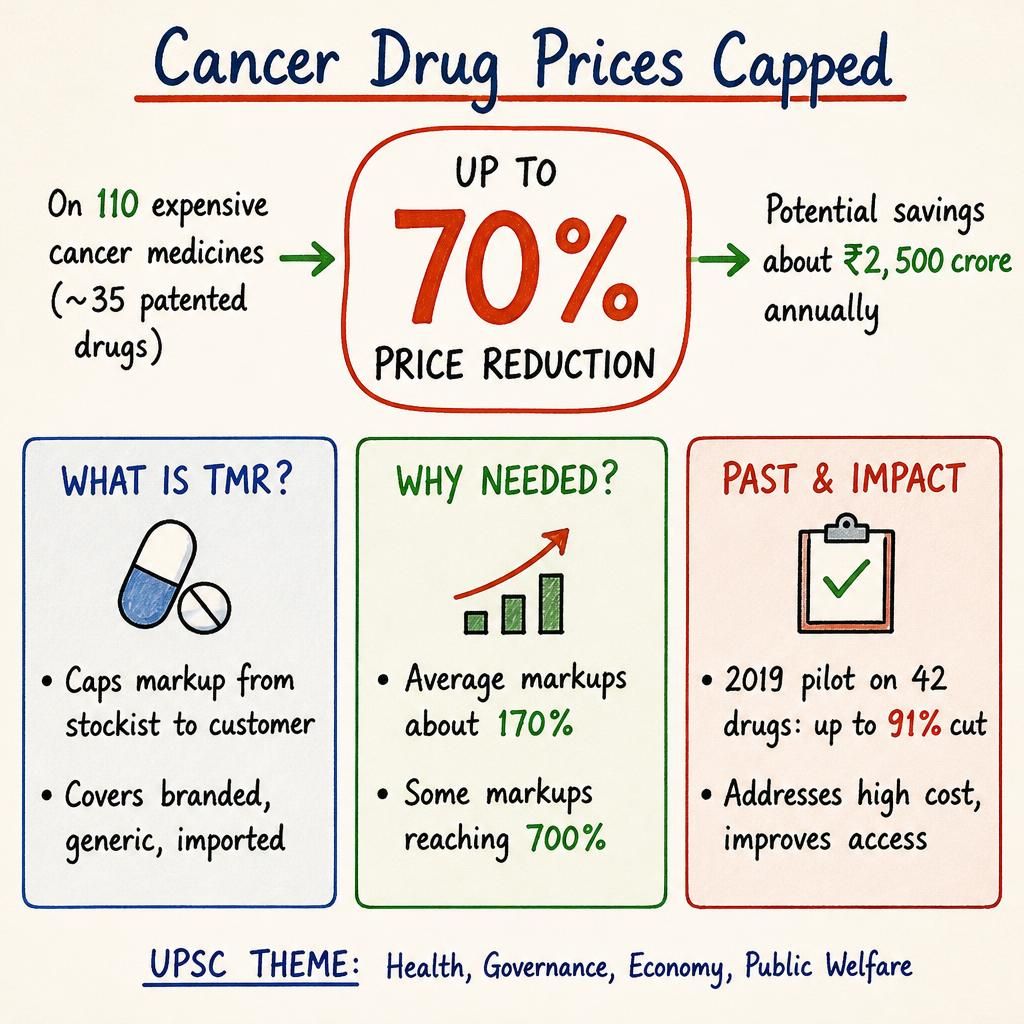
- The Union government recently decided to cap trade margins on 110 expensive cancer medicines, including approximately 35 patented drugs.
- This initiative aims to reduce the marked prices of selected cancer drugs by up to 70%, potentially saving around ₹2,500 crore annually.
- A 2019 pilot project on 42 cancer medicines demonstrated price reductions of up to 91% through similar measures.
- The move addresses the high cost of cancer treatment, which limits access for many patients, as highlighted by a Supreme Court inquiry into tenfold markups.
Drug Price Capping.jpg
Detailed Insights:
- The list of drugs for Trade Margin Rationalisation (TMR) is being finalized and will cover branded, generic, domestically manufactured, and imported versions.
- Trade Margin Rationalisation caps the percentage markup at which a medicine can be sold from the stockist to the customer, rather than capping the price of each formulation.
- The National Pharmaceutical Pricing Authority (NPPA) noted that non-scheduled anti-cancer drugs currently have average markups of about 170%, with some reaching 700%.
- The annual turnover for cancer drugs in India is approximately ₹12,500 crore, with scheduled cancer drugs (price-regulated) accounting for only about ₹2,250 crore.
- Experts suggest that while TMR is beneficial, it may not fully address affordability issues for patented drugs due to lack of competition and potential for companies to inflate prices to stockists.
- The Director General of Health Services will consider a drug's expensiveness and its frequent use in cancer treatment in India for inclusion in the TMR list.
Key Concepts Involved:
- Trade Margin Rationalisation (TMR): A government policy to cap the percentage difference between the price at which a medicine is sold to stockists and its Maximum Retail Price (MRP).
- National Pharmaceutical Pricing Authority (NPPA): A government regulatory body responsible for fixing and revising the prices of controlled bulk drugs and formulations, and enforcing drug price control orders.
- Scheduled Drugs: Medicines whose prices are directly controlled and regulated by the government under the Drugs (Prices Control) Order.

SuperKalam is your personal mentor for UPSC preparation, guiding you at every step of the exam journey.
Download the App


STUDY RESOURCES
CONTACT US
ⓒ Snapstack Technologies Private Limited