GS 1: Indian GeographyGS 1: Physical GeographyGS 2: International RelationsGS 3: EconomyPrelims
Pressure on food prices: El Nino effect, geopolitical tensions, Pg1
El Nino, erratic monsoon, and escalating geopolitical tensions threaten India's food security, driving up prices and signaling potential inflation ahead.
Practice MCQs
891 Students attempted
Key Highlights:
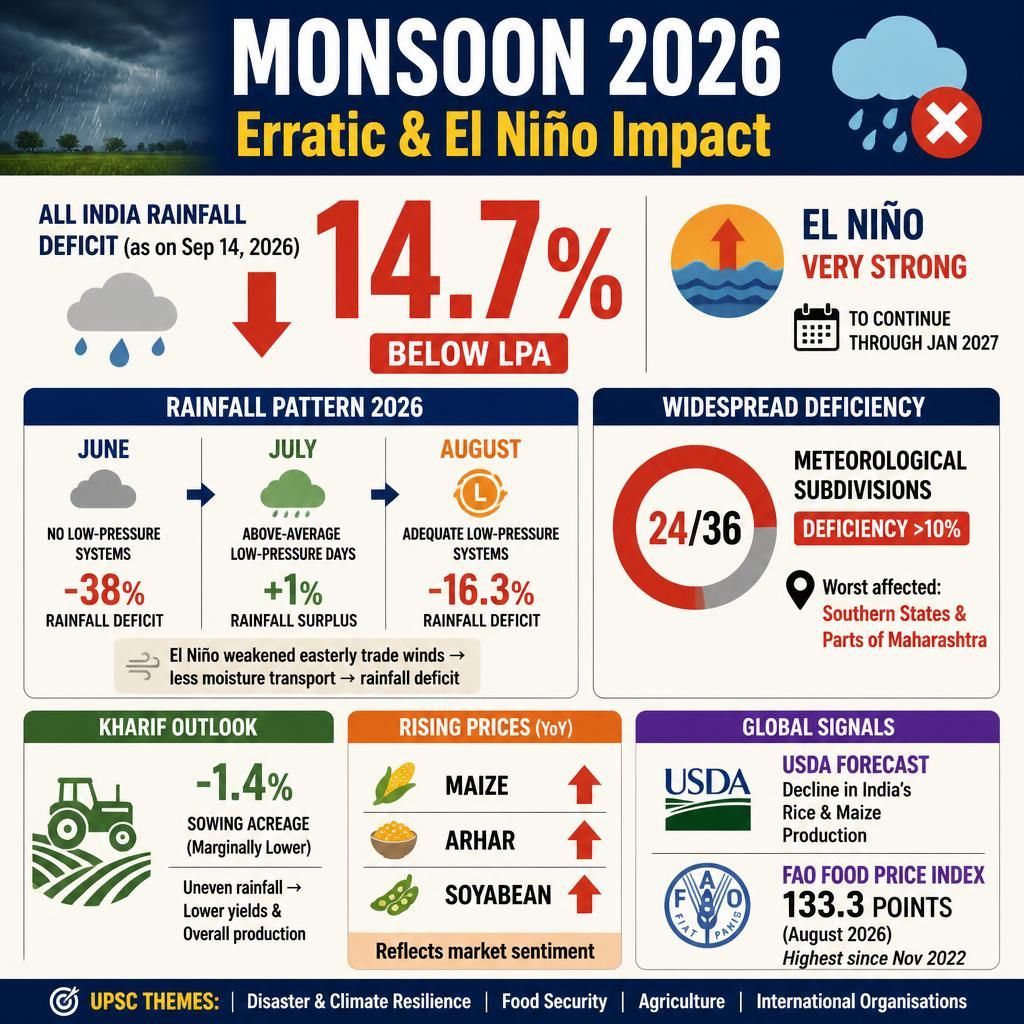
- The Southwest Monsoon of 2026 has been erratic, with an overall rainfall deficit of 14.7% below the Long Period Average (LPA) as of September 14.
- El Nino conditions significantly impacted August rainfall, leading to a 16.3% deficit despite adequate low-pressure system formations.
- Domestic prices for key kharif crops like maize, arhar, and soyabean have risen significantly compared to the previous year, reflecting market sentiment.
- The United States Department of Agriculture (USDA) forecasts a decline in India's rice and maize production for the current year.
- A "very strong" El Nino is projected to continue through January, potentially affecting the upcoming rabi season crops and leading to a shorter, warmer winter.
- The UN Food and Agricultural Organisation's (FAO) food price index reached 133.3 points in August, its highest since November 2022, driven by rising vegetable oil and cereal prices.
Monsoon Impact.jpg
Detailed Insights:
- June 2026 saw no low-pressure systems, resulting in a 38% rainfall deficit, while July experienced above-average low-pressure days and 1% surplus rainfall.
- The August rainfall deficit occurred because El Nino weakened easterly trade winds, reducing moisture transport despite sufficient low-pressure systems.
- 24 out of 36 meteorological subdivisions recorded rainfall deficiencies exceeding 10%, with southern states and parts of Maharashtra being the worst affected.
- While kharif sowing acreage is only marginally lower (1.4%), uneven rainfall distribution is expected to lead to reduced yields and overall production.
- Fertilizer sales, including di-ammonium phosphate (DAP), muriate of potash (MOP), and urea, declined in April-July 2026 compared to the previous year, indicating agricultural stress.
- El Nino is currently in a "strong" state, with equatorial Pacific sea surface temperatures 1.8 degrees Celsius above normal, and is expected to intensify.
- Global food prices are rising due to diminishing stocks, disrupted trade logistics from geopolitical tensions in West Asia and Russia-Ukraine, and the strengthening El Nino.
- International prices for wheat and corn have firmed up, contributing to global food inflation, particularly in vegetable oils and cereals.
Key Concepts Involved:
- El Nino: A climate pattern characterized by the unusual warming of surface waters in the central and eastern equatorial Pacific Ocean, impacting global weather.
- Low-Pressure System (LPS): An area where atmospheric pressure is lower than surrounding air, causing warm, moist air to rise, cool, condense, and form clouds, often leading to rain.
- Kharif Crops: Monsoon crops sown at the onset of the southwest monsoon (June-July) and harvested in autumn (September-October), requiring warm, humid conditions.
- Rabi Crops: Winter crops sown after the monsoon (October-November) and harvested in spring (April-June), thriving in cooler temperatures and often requiring irrigation.
- FAO Food Price Index: A measure of the monthly change in international prices of a basket of five major food commodity groups, published by the Food and Agriculture Organization of the United Nations.

SuperKalam is your personal mentor for UPSC preparation, guiding you at every step of the exam journey.
Download the App


STUDY RESOURCES
CONTACT US
ⓒ Snapstack Technologies Private Limited