Financial democracy, the Jan Dhan transformation, Pg10
Jan Dhan Yojana completes 12 years, revolutionizing financial inclusion for millions through zero-balance accounts, direct benefit transfers, and digital public infrastructure.
Practice MCQs
883 Students attempted
Key Highlights:
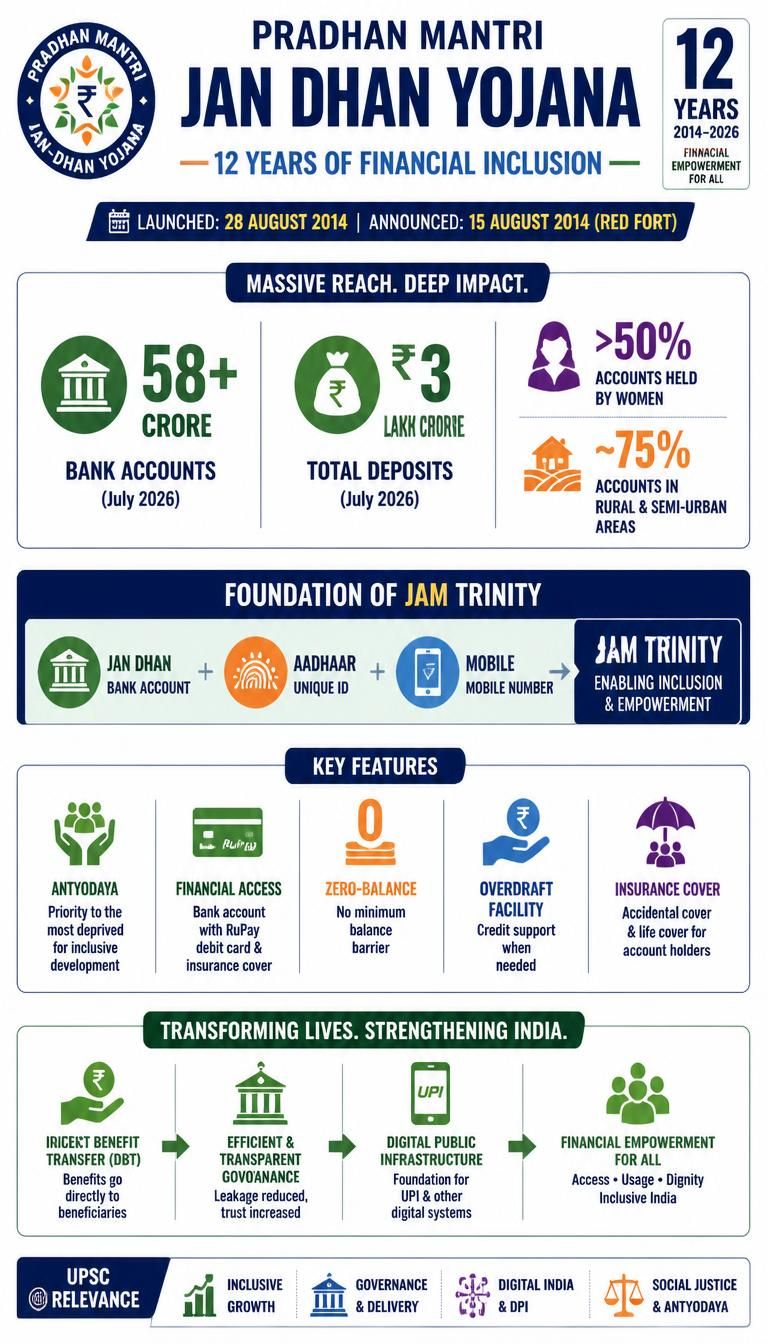
- The Pradhan Mantri Jan Dhan Yojana (PMJDY), launched on August 28, 2014, marks 12 years this Independence Day, promoting financial inclusion.
- The scheme aims to provide every household with access to a bank account, a RuPay debit card, and insurance cover.
- By July 2026, PMJDY had facilitated over 58 crore bank accounts with deposits totaling ₹3 lakh crore.
- More than half of these accounts are held by women, and approximately three-fourths are in rural and semi-urban areas.
- PMJDY serves as the foundational layer for the broader JAM Trinity architecture, connecting bank accounts with Aadhaar and mobile numbers.
Jan Dhan Yojana.jpg
Detailed Insights:
- The initiative aligns with the philosophy of Antyodaya, prioritizing the most deprived for developmental benefits.
- The launch of PMJDY was announced by Prime Minister Narendra Modi on August 15, 2014, from the Red Fort.
- A key feature of PMJDY is the provision of zero-balance accounts, removing financial barriers to banking access.
- Accounts also include an overdraft facility, enhancing their utility for beneficiaries.
- PMJDY has enabled the transformation of Direct Benefit Transfer (DBT), ensuring government support reaches recipients directly.
- This financial infrastructure has become integral to India's digital public infrastructure, alongside systems like Unified Payments Interface (UPI).
- The scheme has provided a formal identity and recognition to marginalized sections, fostering financial democracy.
- The tagline "Mera khaata, bhagya vidhata" (My account, the destiny maker) encapsulates the scheme's empowering vision for individuals and for Viksit Bharat 2047.
Key Concepts Involved:
- Pradhan Mantri Jan Dhan Yojana (PMJDY): A national mission for financial inclusion to ensure access to financial services like banking, savings, credit, insurance, and pensions.
- Antyodaya: A socio-economic philosophy advocating for the upliftment of the weakest and most marginalized sections of society.
- JAM Trinity: An acronym for Jan Dhan, Aadhaar, and Mobile, representing the convergence of these three platforms to streamline welfare delivery.
- Direct Benefit Transfer (DBT): A system where government subsidies and benefits are transferred directly to beneficiaries' bank accounts, reducing leakages.
- Unified Payments Interface (UPI): An instant real-time payment system developed by National Payments Corporation of India (NPCI), facilitating inter-bank transactions.

SuperKalam is your personal mentor for UPSC preparation, guiding you at every step of the exam journey.
Download the App


STUDY RESOURCES
CONTACT US
ⓒ Snapstack Technologies Private Limited