GS 3: Science & TechnologyGS 2: International RelationsGS 3: EconomyPrelimsGS 3: Infrastructure: Energy, Ports, Roads, Airports, Railways etc.
Steady in turbulence, Pg8
PM Modi's Australia, New Zealand visits bolster Indo-Pacific strategy, deepening defense, trade, and clean energy cooperation, securing uranium access.
Practice MCQs
876 Students attempted
Key Highlights:
- Prime Minister Narendra Modi recently visited Australia and New Zealand to strengthen Indo-Pacific partnerships.
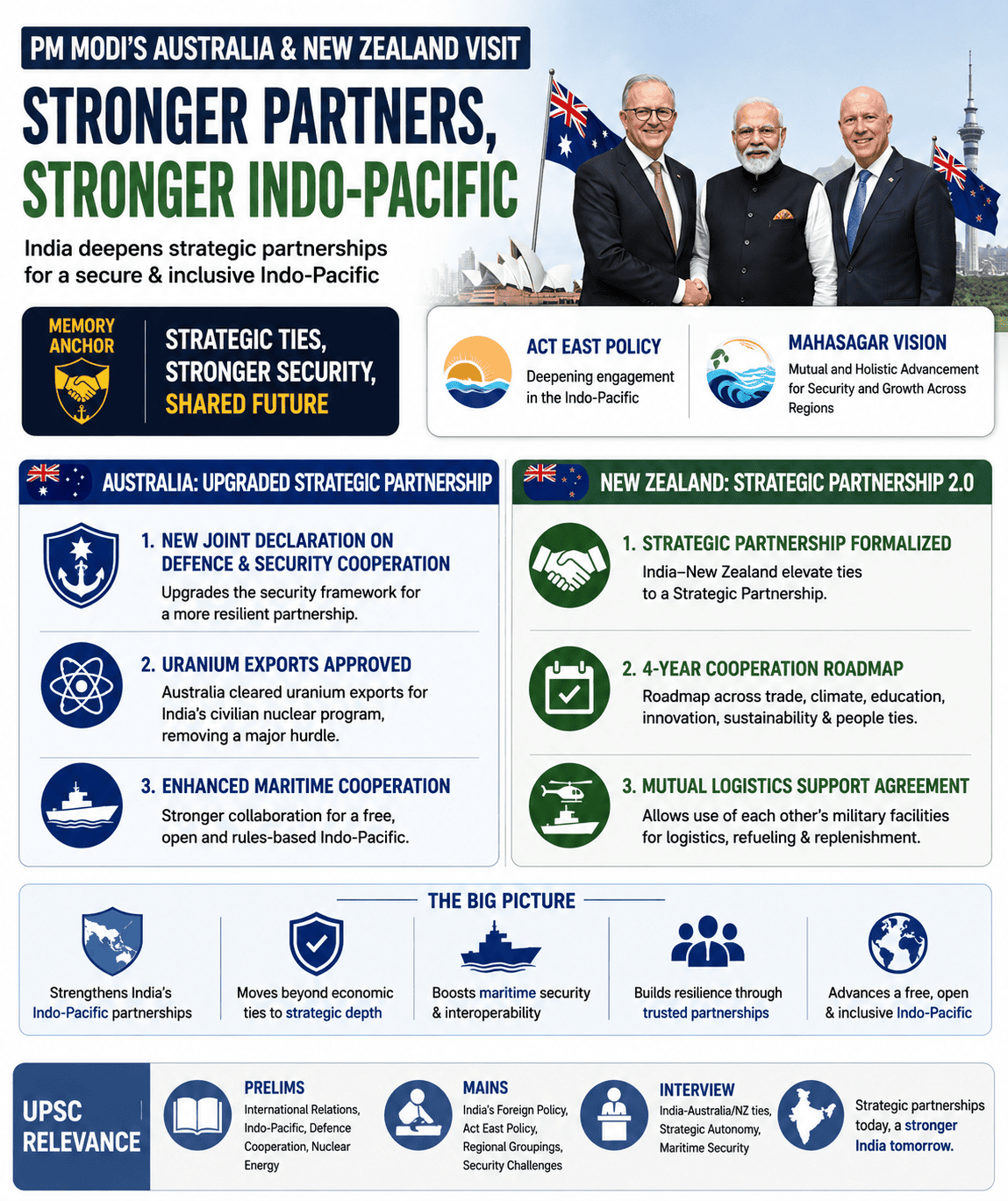
- India and Australia adopted a new Joint Declaration on Defence and Security Cooperation, upgrading their security framework.
- Australia approved uranium exports for India’s civilian nuclear program, removing a significant obstacle.
- India and New Zealand formalized a strategic partnership with a four-year cooperation roadmap.
- Key agreements included enhanced maritime cooperation and mutual logistics support between their armed forces.
Indo-Pacific.png
Detailed Insights:
- The visits emphasized strategic aspects, moving beyond traditional economic and people-centric ties with both nations.
- These efforts align with India's Act East Policy and MAHASAGAR vision for a free, open, and inclusive Indo-Pacific.
- The Joint Declaration on Defence and Security Cooperation aims to enhance interoperability, expand military exercises, and establish an Annual Defence Ministers’ Dialogue.
- An India-Australia Maritime Security Collaboration Roadmap was unveiled to deepen information sharing and operational coordination.
- Both countries will explore new avenues of cooperation on critical minerals, addressing global supply chain uncertainties.
- The India-New Zealand strategic partnership includes maritime cooperation in the Indo-Pacific and mutual logistics support for their defense forces.
- Building on the India-New Zealand Free Trade Agreement, both nations aim for substantial bilateral trade expansion by 2030.
- India seeks to protect its strategic autonomy amidst global volatility by building a network of partnerships.
Key Concepts Involved:
- Indo-Pacific: A geopolitical concept referring to the interconnected region of the Indian and Pacific Oceans, crucial for global trade and security.
- Act East Policy: India's foreign policy initiative to strengthen economic, strategic, and cultural relations with countries in the Asia-Pacific region.
- MAHASAGAR: An acronym for "Mutual and Holistic Advancement for Security and Growth Across Regions," a vision for maritime cooperation and security.
- Strategic Autonomy: A nation's ability to pursue its national interests and make independent foreign policy decisions without being constrained by other powers.
- Critical Minerals: Minerals essential for modern technologies and economies, whose supply chains are vulnerable to disruption.

SuperKalam is your personal mentor for UPSC preparation, guiding you at every step of the exam journey.
Download the App


STUDY RESOURCES
CONTACT US
ⓒ Snapstack Technologies Private Limited