GS 2: GovernanceGS 3: Science & TechnologyGS 2: International RelationsGS 3: EconomyGS 3: Changes in Industrial Policy and Effects on Industrial Growth
India-U.S. defence tech ties — big ambitions, little delivery, Pg8
India-U.S. defence tech ties face significant hurdles, with ambitious political announcements failing to deliver industrial outcomes, exemplified by the stalled GE F414 engine deal.
Practice MCQs
876 Students attempted
Key Highlights:
- India-U.S. defense cooperation has consistently seen ambitious political announcements fail to translate into industrial outcomes.
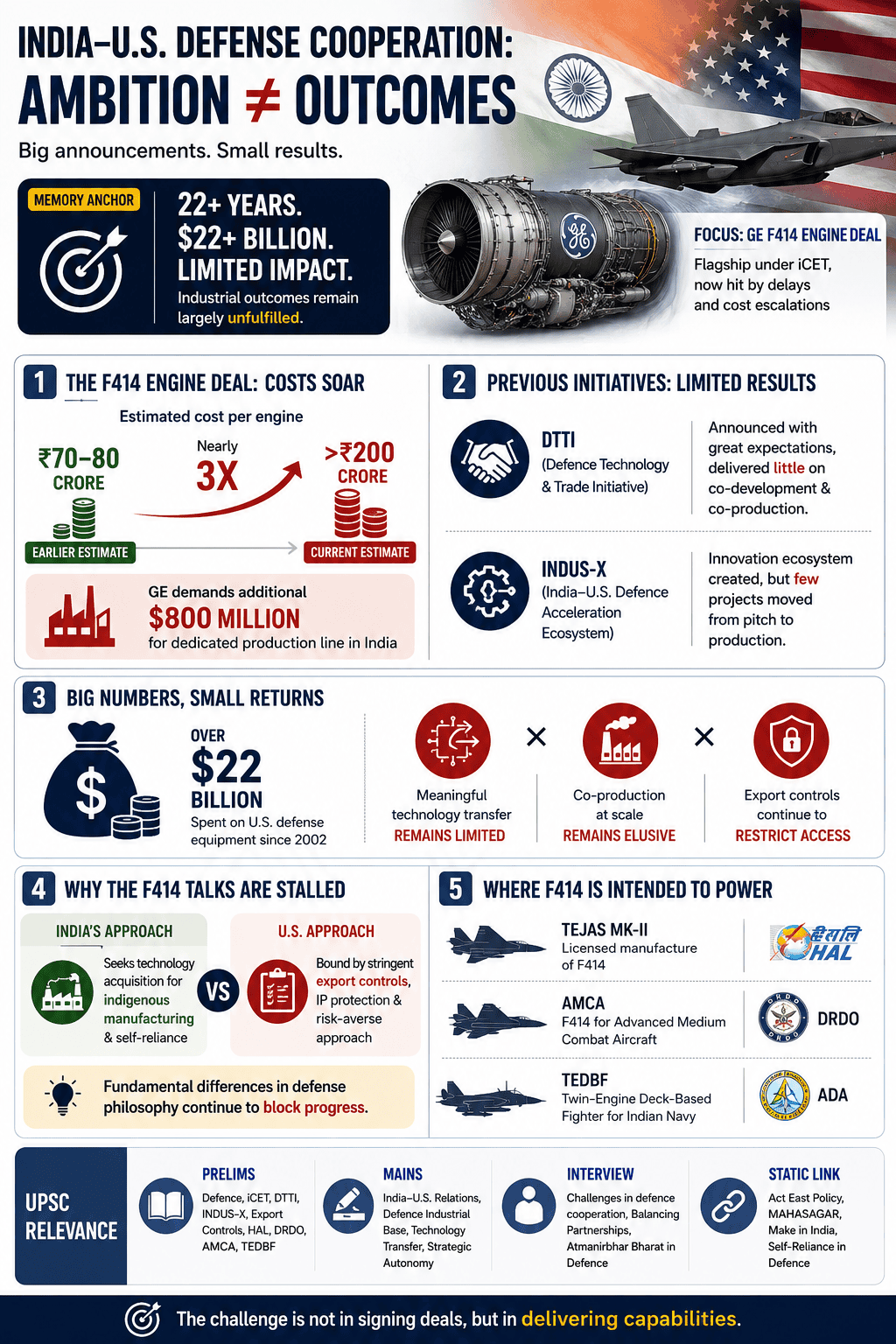
- The General Electric (GE) F414 fighter engine deal, intended as a flagship under the Initiative on Critical and Emerging Technologies (iCET), faces significant delays and cost escalations.
- The estimated cost of each F414 engine has reportedly nearly tripled, rising from ₹70-80 crore to over ₹200 crore, with GE seeking an additional $800 million investment for a dedicated production line in India.
- Previous initiatives like the Defence Technology and Trade Initiative (DTTI) and the India-United States Defence Acceleration Ecosystem (INDUS-X) have also yielded limited co-development and co-production results.
- Despite India acquiring over $22 billion in U.S. defense equipment since 2002, meaningful technology transfer and co-production remain largely unfulfilled.
Ind-USA.png
Detailed Insights:
- The stalled F414 engine negotiations highlight fundamental differences in defense philosophies, with India prioritizing technology acquisition for indigenous manufacturing and the U.S. adhering to stringent export controls.
- Hindustan Aeronautics Limited (HAL) is negotiating for licensed manufacture of the F414 for the Tejas Mk-II, while the Defence Research and Development Organisation (DRDO) and Aeronautical Development Agency (ADA) are pursuing it for the Advanced Medium Combat Aircraft (AMCA) and the Indian Navy’s Twin-Engine Deck-Based Fighter.
- The DTTI, launched in 2012, aimed to promote co-development and co-production but did not deliver significant military capabilities.
- The iCET, launched in January 2023, expanded the agenda to critical technologies like semiconductors, AI, and quantum computing, with the GE F414 program as a key defense initiative.
- INDUS-X, launched in 2023, was designed to connect defense start-ups, academia, and industry but has yet to produce noteworthy co-development outcomes.
- Other prospective collaborations, such as co-producing the Javelin anti-tank guided missile and the General Dynamics Stryker infantry combat vehicle, have remained unresolved for over a decade.
- India's 2024 acquisition of 31 MQ-9B SkyGuardian and SeaGuardian remotely piloted aircraft for $3.5 billion was primarily a purchase, with promised local assembly and maintenance yet to materialize.
- The U.S. views advanced defense technologies as strategic assets governed by regulations like the International Traffic in Arms Regulations (ITAR), which restricts the release of technical data and manufacturing know-how.
- The proposed Reciprocal Defence Procurement Agreement (RDPA) is seen as the next test for industrial cooperation, potentially granting reciprocal access to procurement markets but also exposing India's nascent defense manufacturers to competition.
Key Concepts Involved:
- Defence Technology and Trade Initiative (DTTI): A 2012 framework between India and the U.S. to promote co-development and co-production in defense.
- Initiative on Critical and Emerging Technologies (iCET): A framework launched in January 2023 for India-U.S. cooperation in advanced technologies, including defense.
- International Traffic in Arms Regulations (ITAR): U.S. government regulations controlling the export and import of defense-related articles and services to safeguard national security.
- Atmanirbharta: India's policy of self-reliance, particularly in defense manufacturing, aimed at reducing import dependence and strengthening indigenous capabilities.

SuperKalam is your personal mentor for UPSC preparation, guiding you at every step of the exam journey.
Download the App


STUDY RESOURCES
CONTACT US
ⓒ Snapstack Technologies Private Limited