GS 3: Science & TechnologyGS 2: Social JusticeGS 2: International RelationsPrelimsGS 2: Government policies and interventions for development in various sectors
WHO flags funding gaps in prevention, treatment of TB, Pg12
WHO flags critical $22 billion annual funding gap for global TB prevention and treatment, threatening 2027 eradication targets, especially in South-East Asia.
Practice MCQs
898 Students attempted
Key Highlights:
- The World Health Organization (WHO)'s Global Tuberculosis Report 2026 identifies significant funding shortfalls in global efforts against tuberculosis (TB).
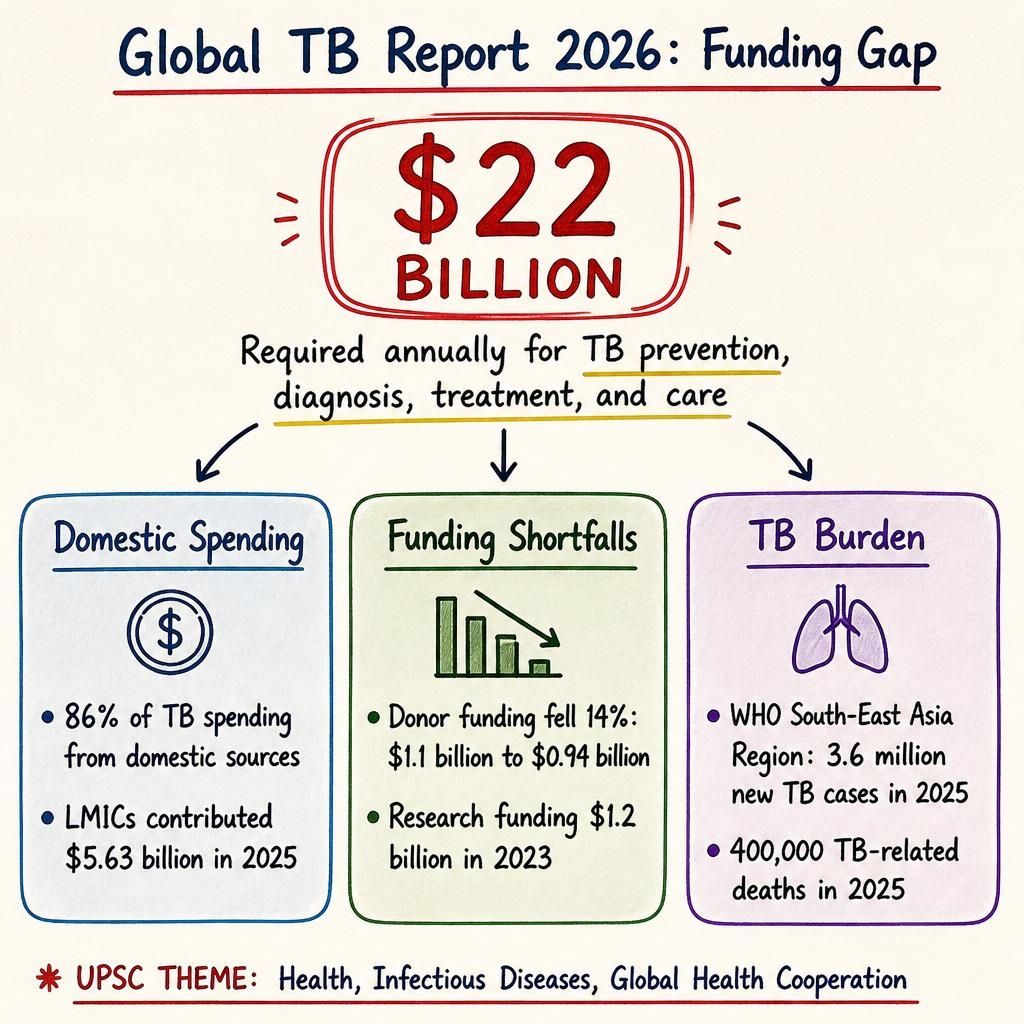
- In 2025, 86% of TB spending originated from domestic sources, with Brazil, China, India, the Russian Federation, and South Africa contributing 65% ($3.7 billion) of the $5.63 billion from low- and middle-income countries (LMICs).
- International donor funding for TB decreased by 14%, from $1.1 billion in 2024 to $0.94 billion in 2025.
- Funding for TB research and innovation reached $1.2 billion in 2023, falling considerably short of the $5 billion annual global target.
- The WHO South-East Asia Region recorded 3.6 million new TB cases in 2025, representing 34% of the global total, and 400,000 TB-related deaths, or 35% of the global total.
Global TB Report.jpg
Detailed Insights:
- An estimated $22 billion is required annually for TB prevention, diagnosis, treatment, and care to achieve the global targets established at the 2023 United Nations high-level TB meeting by 2027.
- The 2023 United Nations high-level TB meeting adopted a Political Declaration on Tuberculosis, aiming to end the disease by 2030 and provide treatment to 45 million people between 2023 and 2027.
- Despite some progress, the overall decline in TB cases and deaths is slower than anticipated, with persistent gaps in diagnosis, treatment, prevention, and financial resources.
- India, a prominent member of the WHO South-East Asia Region, accounts for approximately one-fourth of the global TB burden.
- India has set an ambitious national goal to eliminate TB by 2025, preceding the global target of 2030.
- The Global Tuberculosis Report 2026 provides a comprehensive assessment of the TB epidemic, drawing on data submitted by 187 countries.
Key Concepts Involved:
- Tuberculosis (TB): An infectious airborne bacterial disease caused by Mycobacterium tuberculosis, primarily affecting the lungs, which is both preventable and curable.
- World Health Organization (WHO): A specialized agency of the United Nations dedicated to international public health.
- United Nations high-level TB meeting: A global summit held in September 2023 to accelerate worldwide efforts to combat the TB epidemic.
- WHO South-East Asia Region: One of the six geographical regions of the WHO, comprising 10 member states, including India.

SuperKalam is your personal mentor for UPSC preparation, guiding you at every step of the exam journey.
Download the App


STUDY RESOURCES
CONTACT US
ⓒ Snapstack Technologies Private Limited