GS 2: GovernanceGS 3: Science & TechnologyPrelimsGS 2: Government policies and interventions for development in various sectorsGS 3: Achievements of Indians in Science and Technology
‘Deep-ocean submersible to undergo trial in early 2027’, Pg12
India's Matsya-6000 deep-ocean submersible to begin 500-meter trial dive in early 2027, advancing Samudrayaan Project for 6,000-meter human exploration.
Practice MCQs
898 Students attempted
Key Highlights:
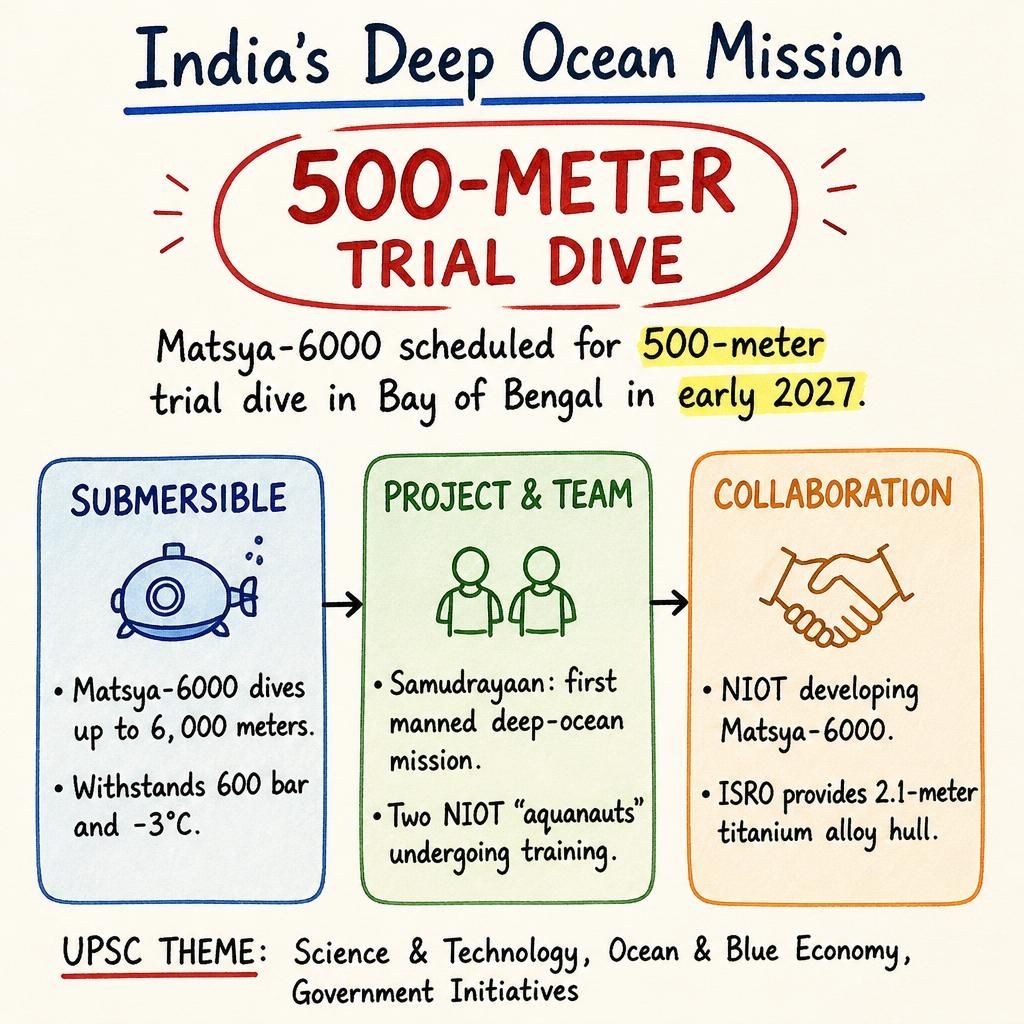
- India's deep-ocean submersible, Matsya-6000, is scheduled for a 500-meter trial dive in the Bay of Bengal in early 2027.
- This trial is a crucial step for the Samudrayaan Project, which aims to send a three-person crew to a depth of 6,000 meters.
- The project is a key component of India's broader Deep Ocean Mission, overseen by the Ministry of Earth Sciences (MoES).
- The National Institute of Ocean Technology (NIOT) is developing Matsya-6000 in collaboration with the Indian Space Research Organisation (ISRO) for its 2.1-meter diameter titanium alloy hull.
- Two "aquanauts" from NIOT are currently undergoing training for the mission.
Deep Ocean Mission.jpg
Detailed Insights:
- The Samudrayaan Project is India's first manned deep-ocean mission, designed to enhance the nation's capabilities in deep-sea exploration and resource assessment.
- The Deep Ocean Mission (DOM), launched in 2021 with a budget of ₹4,077 crore over five years, focuses on developing technologies for deep-sea mining, human submersibles, ocean climate change advisory services, and biodiversity studies.
- Matsya-6000 is engineered to withstand extreme pressures of up to 600 bar and temperatures as low as -3°C at 6,000 meters depth.
- The submersible has an operational endurance of 12 hours, with an emergency life support system capable of sustaining the crew for up to 96 hours.
- ISRO's Vikram Sarabhai Space Centre (VSSC) and Liquid Propulsion Systems Centre (LPSC) played a critical role in designing and fabricating the high-strength titanium alloy personnel sphere, including developing advanced electron beam welding techniques.
- The use of titanium for the hull is vital due to its high strength-to-weight ratio, exceptional corrosion resistance, and fatigue endurance, which are essential for surviving the harsh deep-sea environment.
- Successful completion of the mission will place India among an elite group of nations, including the US, Russia, China, Japan, and France, with manned deep-sea exploration capabilities.
- This initiative is crucial for India's Blue Economy strategy, aiming to explore vast reserves of critical minerals like polymetallic nodules and rare earth elements in areas such as the Central Indian Ocean Basin (CIOB), thereby reducing import dependence and strengthening technological sovereignty.
Key Concepts Involved:
- Samudrayaan Project: India's first manned deep-ocean mission to send humans in a submersible to 6,000 meters for scientific exploration.
- Deep Ocean Mission (DOM): A flagship government initiative launched in 2021 to explore and sustainably utilize deep-sea resources and develop related technologies.
- Blue Economy: Sustainable use of ocean resources for economic growth, improved livelihoods, and ocean ecosystem health.
- Polymetallic Nodules: Potato-sized mineral concretions found on the seabed, rich in metals like manganese, nickel, cobalt, and copper.

SuperKalam is your personal mentor for UPSC preparation, guiding you at every step of the exam journey.
Download the App


STUDY RESOURCES
CONTACT US
ⓒ Snapstack Technologies Private Limited