GS 2: GovernanceGS 3: EconomyPrelimsGS 3: Indian Economy, Planning, Mobilization of Resources, Growth, Development and EmploymentGS 2: Statutory, Regulatory and Quasi Judicial Bodies
Inflation generalisation: Why economists gauge the 'spreading' of price pressures, Pg12
Household inflation jumps to 5.54% in September, prompting RBI to acknowledge 'generalisation of price pressures' and potential interest rate hikes.
Practice MCQs
891 Students attempted
Key Highlights:
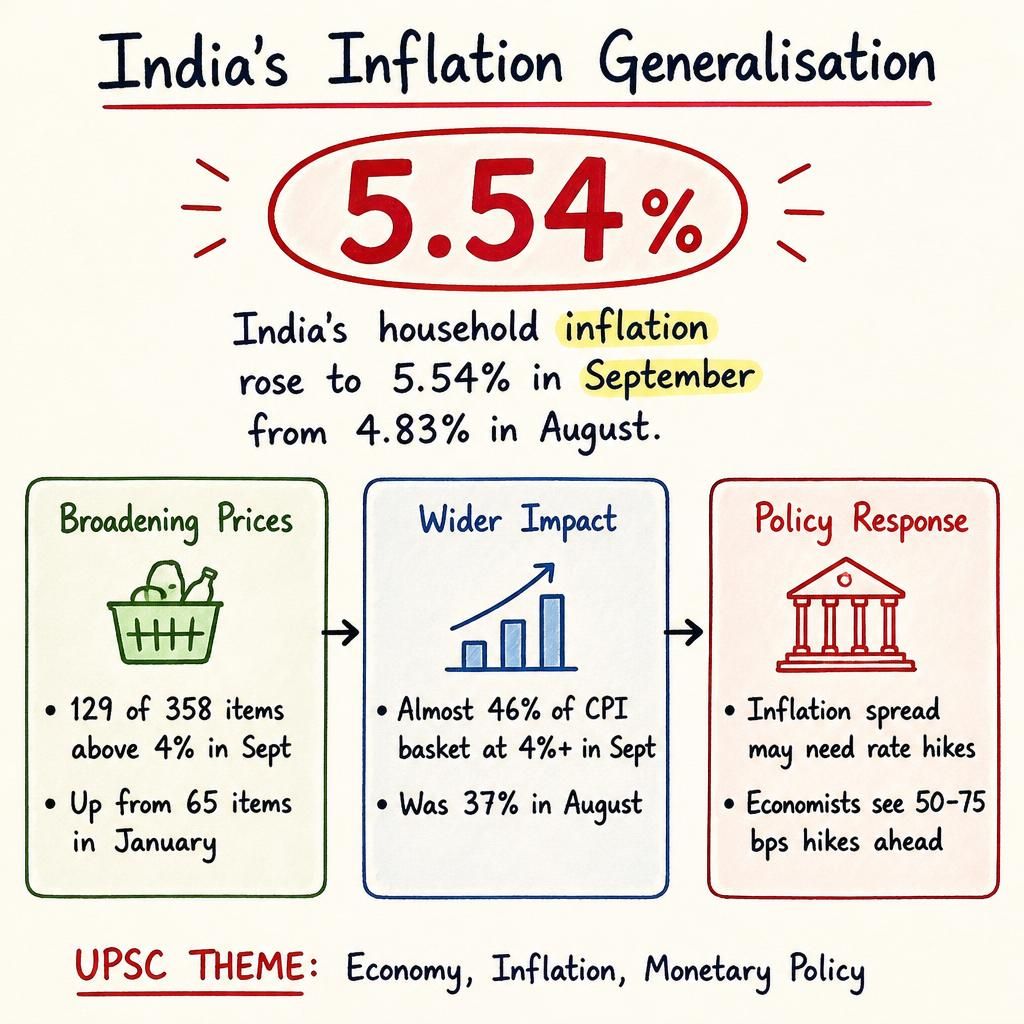
- India's household inflation rose to 5.54% in September from 4.83% in August.
- The Reserve Bank of India (RBI) acknowledged "some evidence of elevated inflation expectations and generalisation of inflation," marking a shift from its previous stance.
- Inflation generalisation occurs when price increases spread across a broad range of household consumption items beyond typically volatile categories like food and fuel.
- In September, 129 out of 358 items in India's Consumer Price Index (CPI) basket recorded inflation above the RBI's 4% target, up from 65 items in January.
- The RBI's diffusion index indicated that almost 46% of the CPI basket experienced 4%-plus inflation in September, compared to 37% in August.
Inflation Generation.jpg
Detailed Insights:
- The RBI had previously stated in August that there were "little signs of generalisation of price pressures," a view that some economists had questioned.
- The CPI measures the year-on-year change in retail prices of selected goods and services consumed by households.
- Inflation generalisation is identified by observing if price rises move from volatile categories (food, fuel) to other consumer goods and services in a sustained manner.
- Price momentum, which tracks month-on-month price changes, showed 319 out of 358 CPI items with rising prices in September, an increase from 236 in February.
- Diffusion indices are used by economists to map the breadth of price increases, accounting for the weight of each item in the CPI basket.
- The weights for CPI items are determined by the Ministry of Statistics and Programme Implementation's Household Consumption Expenditure Survey.
- The current CPI basket and its weights are based on the survey conducted from August 2023 to July 2024.
- The spreading of price pressures suggests a need for the RBI to potentially increase interest rates, such as the Repo Rate, to control inflation.
- Following the latest data, there is a consensus among economists for further rate hikes of 50-75 basis points in the coming months.
Key Concepts Involved:
- Inflation Generalisation: The sustained spread of price increases across a wide range of goods and services in an economy.
- Consumer Price Index (CPI): A measure that tracks the average change over time in prices paid by urban and rural consumers for a basket of goods and services.
- Diffusion Indices: Economic indicators derived from surveys that measure the breadth or prevalence of change in economic activity, rather than the magnitude.
- Repo Rate: The interest rate at which the Reserve Bank of India lends money to commercial banks to meet their short-term liquidity needs.

SuperKalam is your personal mentor for UPSC preparation, guiding you at every step of the exam journey.
Download the App


STUDY RESOURCES
CONTACT US
ⓒ Snapstack Technologies Private Limited