GS 3: Science & TechnologyGS 3: Internal SecurityPrelimsGS 2: Government policies and interventions for development in various sectorsGS 3: Security Challenges and Management in Border Areas
How INS Mangrol Plugs Gaps In Anti-Submarine Operations, Pg12
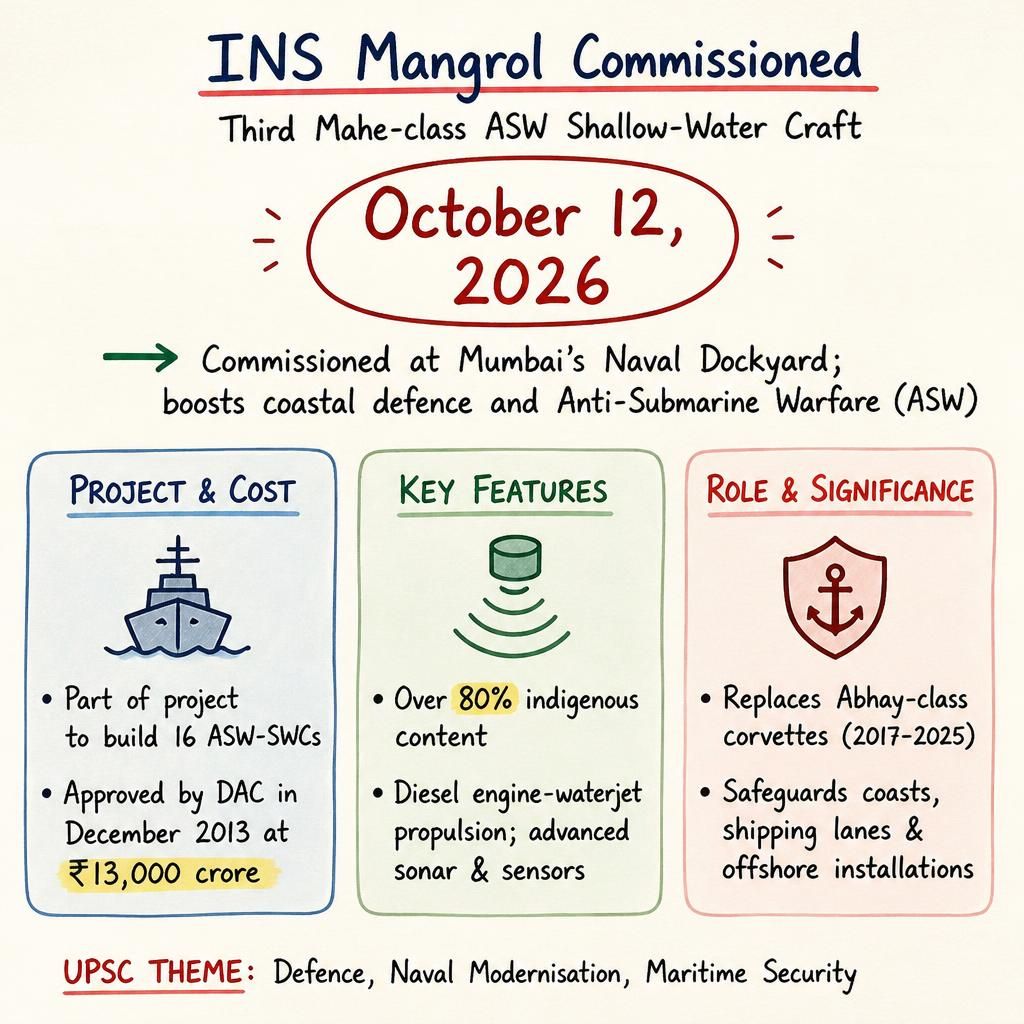
Indian Navy commissions INS Mangrol, third Mahe-class ASW-SWC, significantly boosting anti-submarine warfare capabilities and coastal defence with over 80% indigenous content.
Practice MCQs
891 Students attempted
Key Highlights:
- INS Mangrol, the third Mahe-class ASW Shallow-Water Craft (SWC), was commissioned by the Indian Navy on October 12, 2026, at Mumbai's Naval Dockyard.
- The vessel significantly boosts India's coastal defence and Anti-Submarine Warfare (ASW) capabilities, particularly in shallow and near-shore maritime zones.
- It is part of a larger project to build 16 ASW-SWCs, with eight each being constructed by Cochin Shipyard Ltd (CSL) and Garden Reach Shipbuilders and Engineers (GRSE).
- The Mahe-class vessels feature over 80% indigenous content, aligning with India's self-reliance in defence manufacturing.
- The procurement of these 16 ASW-SWCs was approved by the Defence Acquisition Council (DAC) in December 2013 at a cost of approximately ₹13,000 crore.
INS Mangrol.jpg
Detailed Insights:
- The Mahe-class vessels are designed for multi-role operations including anti-submarine warfare, underwater surveillance, search and rescue, and mine-laying in coastal waters.
- They are the Indian Navy's largest warships to utilize a diesel engine-waterjet propulsion system, enhancing manoeuvrability and reducing underwater noise.
- Equipped with indigenously developed sonar systems, advanced sensors, and communication suites, they can effectively detect, track, and engage underwater threats.
- This new fleet replaces the aging Abhay-class corvettes, which were decommissioned between 2017 and 2025 after decades of service.
- CSL is building the Mahe-class vessels, while GRSE is constructing the Arnala-class, with the lead ship INS Arnala commissioned in June 2025.
- These shallow-draught vessels are crucial for safeguarding harbour approaches, shipping lanes, and offshore energy installations from stealthy diesel-electric submarines.
- Their induction allows larger warships to focus on missions in deeper waters, thereby strengthening India's maritime security posture in the Indian Ocean Region.
Key Concepts Involved:
- Anti-Submarine Warfare (ASW): A branch of naval warfare focused on detecting, tracking, and destroying enemy submarines.
- Littoral Zone: The shallow and near-shore maritime area, strategically and economically critical for coastal nations.
- Indigenous Content: The percentage of components, materials, and services for a product sourced from within the country.
- Defence Acquisition Council (DAC): India's highest decision-making body for defence procurement, chaired by the Defence Minister.

SuperKalam is your personal mentor for UPSC preparation, guiding you at every step of the exam journey.
Download the App


STUDY RESOURCES
CONTACT US
ⓒ Snapstack Technologies Private Limited