GS 2: PolityGS 3: Environment & EcologyPrelimsGS2: Indian Constitutional Evolution, Features, Amendments, Basic Structure DoctrineGS2: Structure and Functioning of Executive and Judiciary
SC has nurtured environmental law. Do its decisions look distant today?, Pg12
Supreme Court's historical role in nurturing environmental law through landmark judgments faces scrutiny amidst concerns over inconsistent application in infrastructure projects.
Practice MCQs
876 Students attempted
Key Highlights:
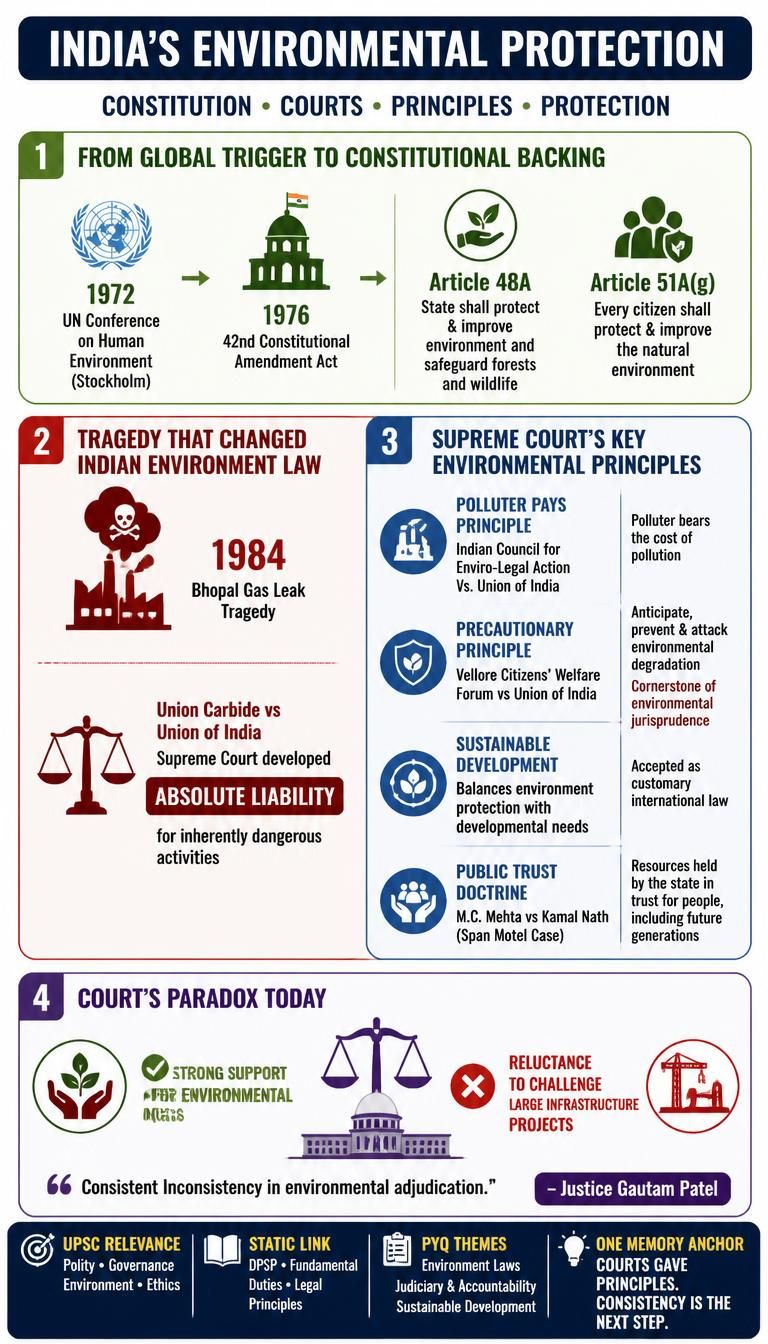
- India's environmental policy gained constitutional backing after the UN Conference on Human Environment (Stockholm, 1972) and the 42nd Constitutional Amendment Act, 1976.
- The 42nd Amendment introduced Article 48A (Directive Principle of State Policy) and Article 51A(g) (Fundamental Duty) for environmental protection.
- The Bhopal Gas Leak Tragedy (1984) prompted the Supreme Court to develop the doctrine of absolute liability.
- The Supreme Court has established key environmental principles including polluter pays principle, precautionary principle, sustainable development, and public trust doctrine.
- Despite its foundational role, the Supreme Court's recent judgments on infrastructure projects show "consistent inconsistency," as noted by Justice Gautam Patel.
Environment Protection.jpg
Detailed Insights:
- The Indian Constitution initially lacked explicit environmental provisions, with the 42nd Amendment Act, 1976, filling this gap.
- Article 48A directs the state to protect and improve the environment and safeguard forests and wildlife.
- Article 51A(g) mandates every citizen to protect and improve the natural environment.
- In Union Carbide vs Union of India, the Supreme Court developed absolute liability for enterprises engaged in inherently dangerous activities.
- The polluter pays principle, originating from the Rio Summit (1992), was first applied in India in Indian Council for Enviro-Legal Action Vs. Union of India.
- The Vellore Citizens’ Welfare Forum vs Union of India case defined the precautionary principle as anticipating, preventing, and attacking environmental degradation.
- The precautionary principle is considered the cornerstone of environmental jurisprudence, ranking above the polluter pays principle.
- Sustainable development balances environmental protection with developmental needs and is accepted as customary international law.
- The M.C. Mehta vs Kamal Nath (Span Motel case) introduced the public trust doctrine and emphasized inter-generational equity.
- Justice Gautam Patel highlighted the Supreme Court's strong support for environmental NGOs but a reluctance to challenge large infrastructure projects.
- The Supreme Court in the Vellore Citizens case rejected the false narrative that environment and development are opposing forces.
- Courts should ensure all projects, regardless of size, comply with environmental norms rather than dismissing challenges.
Key Concepts Involved:
- Absolute Liability: Strict liability for harm caused by inherently dangerous activities, irrespective of fault.
- Polluter Pays Principle: The polluter bears the costs of preventing, controlling, and remedying pollution.
- Precautionary Principle: Taking preventive action against environmental harm even without full scientific certainty.
- Sustainable Development: Development that meets present needs without compromising future generations' ability to meet their own.
- Public Trust Doctrine: Natural resources are held by the state in trust for the public and cannot be alienated for private use.
- Inter-generational Equity: The present generation's duty to protect the environment for future generations.
- Directive Principles of State Policy (DPSP): Non-justiciable guidelines for the state in policy-making, including Article 48A.
- Fundamental Duties: Moral obligations of citizens, including Article 51A(g) to protect the natural environment.

SuperKalam is your personal mentor for UPSC preparation, guiding you at every step of the exam journey.
Download the App


STUDY RESOURCES
CONTACT US
ⓒ Snapstack Technologies Private Limited