GS 2: PolityGS 3: EconomyPrelimsGS2: Union State Relations and Federal StructureGS2: Parliament and State Legislatures
RS passes mining Bill, minister says won't affect states' revenue, Pg8
Rajya Sabha passes controversial mining Bill, prohibiting states from imposing levies on major minerals, despite Supreme Court upholding state powers, raising federalism concerns.
Practice MCQs
876 Students attempted
Key Highlights:
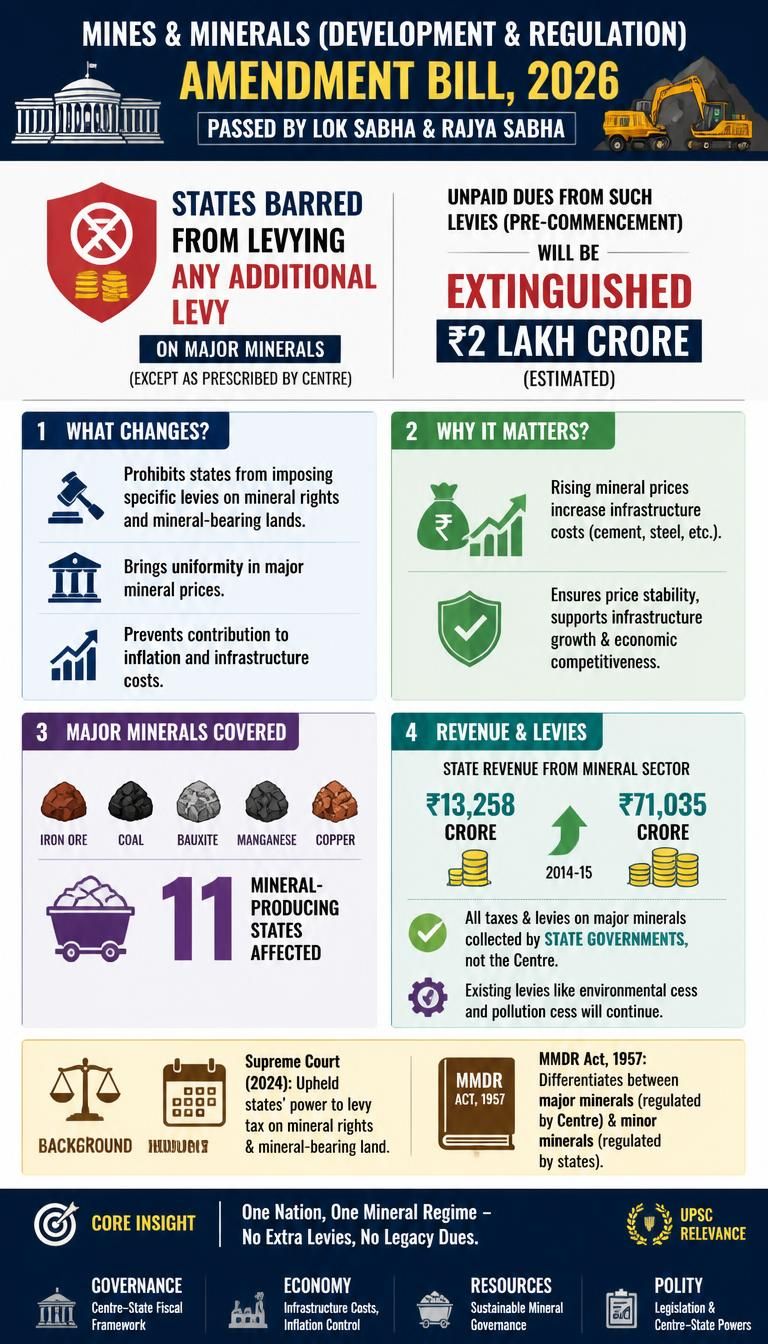
- The Mines and Minerals (Development and Regulation) Amendment Bill, 2026 has been passed by both Lok Sabha and Rajya Sabha.
- The Bill prohibits states from imposing specific levies on mineral rights and mineral-bearing lands, except as prescribed by the Centre.
- Union Mines Minister G Kishan Reddy stated the legislation would not lead to revenue loss for states.
- The Supreme Court in 2024 had upheld states' power to levy tax on mineral rights and mineral-bearing land.
- The amendment will extinguish unpaid dues from such levies imposed before its commencement, estimated at around Rs 2 lakh crore.
- The Bill primarily targets major minerals like iron ore, coal, bauxite, manganese, and copper, affecting about 11 mineral-producing states.
MMDR.jpg
Detailed Insights:
- The amendment aims to bring greater uniformity in major mineral prices and prevent their contribution to inflation and infrastructure costs.
- The Mines and Minerals (Development and Regulation) Act, 1957 (MMDR Act) differentiates between major minerals, regulated by the Centre, and minor minerals, largely regulated by states.
- Rising prices of major minerals directly impact infrastructure activities, such as cement costs due to limestone or steel rates due to iron ore.
- The Minister clarified that all taxes and levies on major minerals are collected by state governments, not the Centre.
- State revenue from the mineral sector increased from Rs 13,258 crore in 2014-15 to Rs 71,035 crore in 2024-25.
- Existing levies in the mineral sector, including environmental cess and pollution cess, will continue to be in place.
Key Concepts Involved:
- Mines and Minerals (Development and Regulation) Act, 1957 (MMDR Act): Principal legislation governing mining and mineral development in India.
- Major Minerals: Minerals specified in the First Schedule of the MMDR Act, primarily regulated by the Central government.
- Minor Minerals: Building stones, ordinary clay, ordinary sand, etc., whose regulation is largely entrusted to state governments.
- Cess/Levies: Additional taxes or fees imposed by the government for specific purposes, often on top of existing taxes.

SuperKalam is your personal mentor for UPSC preparation, guiding you at every step of the exam journey.
Download the App


STUDY RESOURCES
CONTACT US
ⓒ Snapstack Technologies Private Limited