GS 2: GovernanceGS 3: Science & TechnologyGS 2: International RelationsGS 3: EconomyPrelims
The right path for India’s nuclear power development, Pg6
India's indigenous nuclear technology delivers world's cheapest power plants, targeting 100 GW by 2047, prioritizing self-reliance and safety amidst rapid expansion.
Practice MCQs
869 Students attempted
Key Highlights:
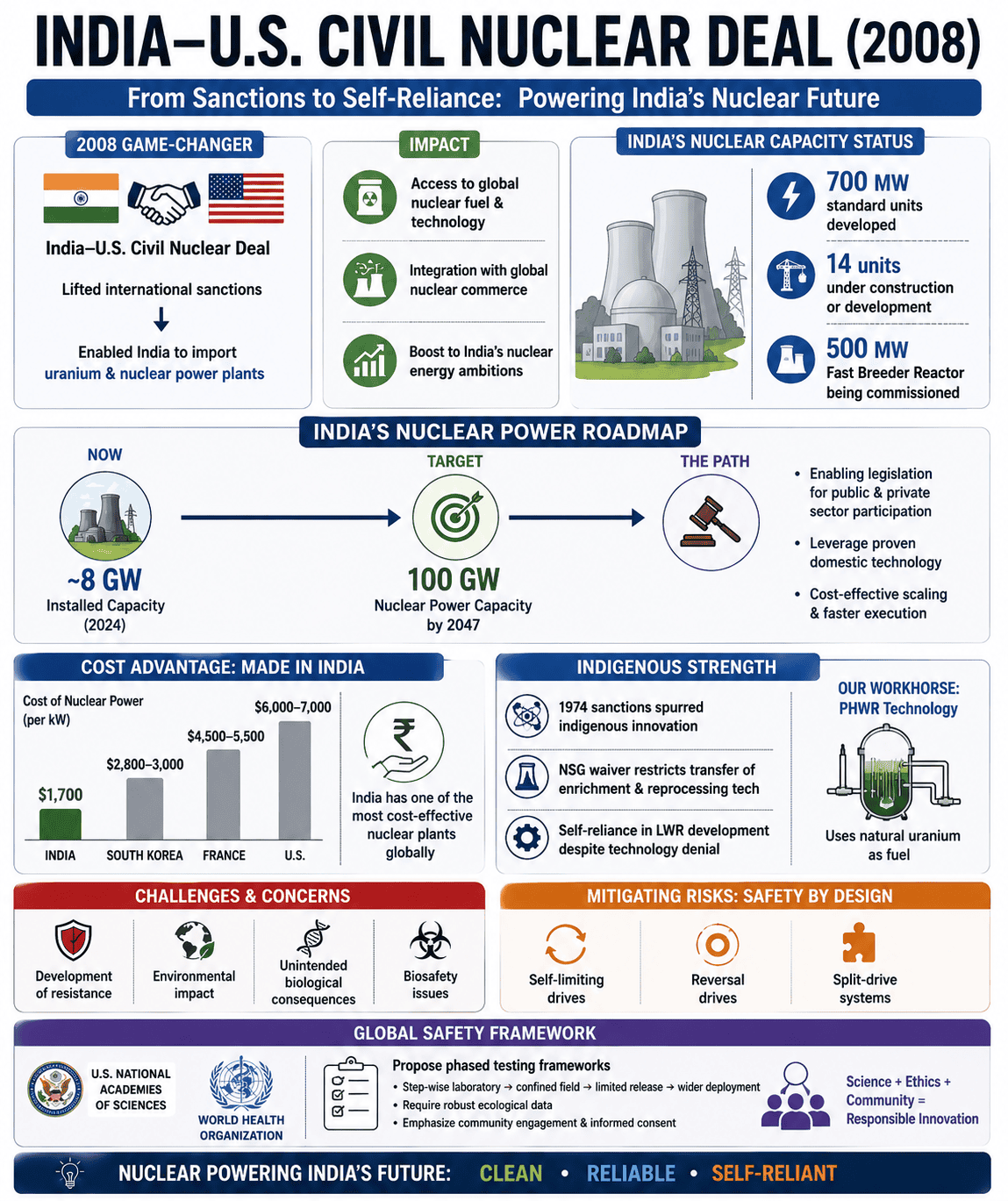
- The India-United States civil nuclear deal in 2008 lifted international sanctions, enabling India to import uranium and nuclear power plants.
- India has indigenously developed nuclear power plants, with 700 MW units now developed and 14 units under construction or development.
- Indian nuclear power plants are the most cost-effective globally, priced at approximately $1,700 per Kw.
- India aims to achieve 100 GW of nuclear power capacity by 2047 through enabling legislation for public and private sector participation.
- India's 500 MW commercial fast breeder reactor is currently being commissioned.
Civil Nuclear deal.png
Detailed Insights:
- International sanctions following India's 1974 peaceful nuclear test spurred indigenous innovation in nuclear technology development.
- India's self-reliance has led to a significant cost advantage, making its nuclear plants considerably cheaper than those from South Korea, France, and the U.S.
- The Nuclear Suppliers Group (NSG) waiver prohibits the transfer of enrichment and reprocessing technology to India, necessitating indigenous development of Light Water Reactors (LWRs).
- India primarily uses Pressurised Heavy Water Reactors (PHWRs), which utilize natural uranium as fuel.
- Opening the nuclear sector to new entrants is intended to leverage proven domestic technology for cost-effective scaling and potentially reduce project execution timelines.
- Small Modular Reactors (SMRs) are being explored globally for specific power demands, but their commercial deployment is still in early stages.
- The Atomic Energy Commission (AEC) has offered its 200 MW plant technology to new entrants, with potential for domestic development of smaller units.
- Maintaining India's exemplary nuclear safety record is crucial, requiring new entrants to establish a rigorous internal safety culture and undergo continuous external auditing before rapid expansion.
- A single nuclear mishap could trigger significant public backlash, similar to the impact of Chernobyl (1986) on Western nuclear power development.
Key Concepts Involved:
- India-United States Civil Nuclear Deal: A 2008 agreement that ended international restrictions on India's nuclear program, facilitating imports of uranium and nuclear technology.
- Pressurised Heavy Water Reactor (PHWR): A nuclear reactor type that uses heavy water as both coolant and moderator, fueled by natural uranium.
- Light Water Reactor (LWR): A nuclear reactor type that uses ordinary water as coolant and moderator, typically fueled by enriched uranium.
- Fast Breeder Reactor (FBR): A nuclear reactor that generates more fissile material than it consumes, operating with a fast neutron spectrum.
- Nuclear Suppliers Group (NSG): A multinational body that controls the export of nuclear and nuclear-related dual-use items to prevent proliferation.
- Small Modular Reactors (SMRs): Advanced, compact nuclear reactors designed for modular construction and deployment, offering flexibility in power generation.

SuperKalam is your personal mentor for UPSC preparation, guiding you at every step of the exam journey.
Download the App


STUDY RESOURCES
CONTACT US
ⓒ Snapstack Technologies Private Limited