GS 2: GovernanceGS 3: Science & TechnologyGS 3: Environment & EcologyGS 3: EconomyPrelims
Can biogas aid India’s energy security?, Pg8
India's biogas mission faces hurdles, with only 132 of 5,000 plants completed, risking energy security and 'corn mania' amid West Asia tensions.
Practice MCQs
869 Students attempted
Key Highlights:
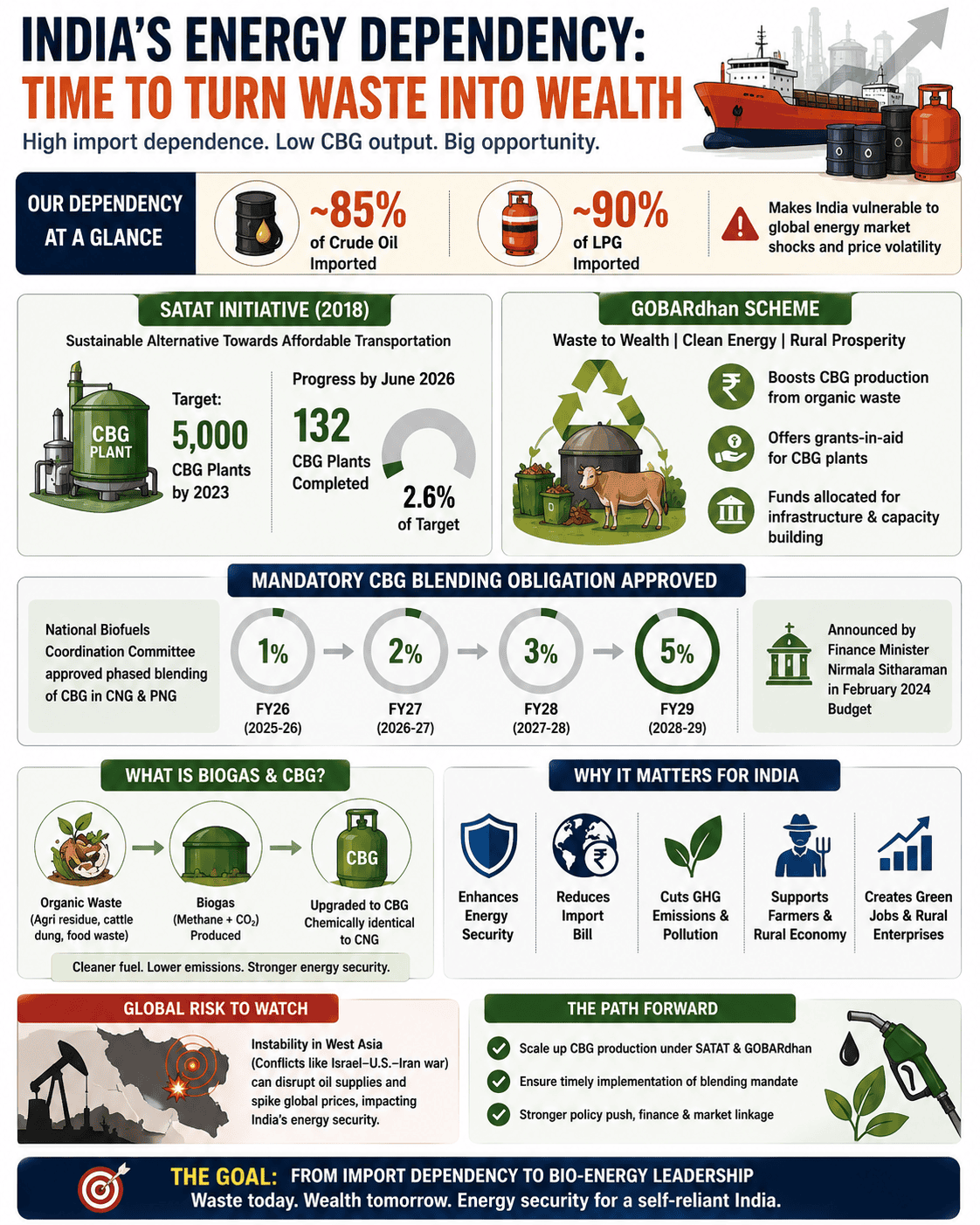
- India imports nearly 85% of its crude oil and 90% of its LPG needs, making it vulnerable to global energy market disruptions.
- The Sustainable Alternative Towards Affordable Transportation (SATAT) initiative, launched in 2018, aimed for 5,000 Compressed Biogas (CBG) plants by 2023, but only 132 were completed by June 2026.
- The GOBARdhan scheme was introduced to boost CBG production through a 'waste to wealth' program, offering grants and allocating funds for infrastructure.
- The National Biofuels Coordination Committee approved a mandatory blending obligation for CBG, starting at 1% in FY26 and rising to 5% by FY29.
- Finance Minister Nirmala Sitharaman announced in the February 2024 Budget that phased blending of CBG in CNG and Piped Natural Gas would be mandated.
CBG.png
Detailed Insights:
- Instability in West Asia, particularly due to conflicts like the Israel-U.S.-Iran war, poses a significant risk to India's energy security.
- Biogas, a mixture of methane and CO2 from organic matter, can be processed into Compressed Biogas (CBG), which is chemically identical to CNG.
- Despite policy support, progress in India's biogas sector is hindered by lack of infrastructure, poor private investment, and high upfront technology costs.
- Government financial support, including incentives like accelerated depreciation and tax holidays, is crucial to attract private players.
- The global biogas production is concentrated, with Europe, China, and the United States accounting for 90% of the output.
- Germany's experience with biogas led to a "corn mania," where maize cultivation for feedstock replaced food crops, necessitating government intervention.
- India's Economic Survey 2026 noted a sharp increase in maize cultivation, potentially impacting crop diversity and food security.
- Higher administered prices for maize-based ethanol have made maize cultivation more lucrative for farmers, potentially disincentivizing other crops.
- This trend could increase India's dependence on imports for pulses and edible oils, exposing domestic food prices to volatility.
- Denmark's model, which discourages crop use and relies on livestock manure and agricultural waste for biomethane, offers a sustainable alternative.
- India aims to replicate the success of its ethanol blending program, which achieved a 20% blend in petrol by December 2025, five years ahead of target.
Key Concepts Involved:
- Energy Security: The uninterrupted availability of energy sources at an affordable price.
- Compressed Biogas (CBG): A renewable, carbon-neutral fuel produced from organic waste, chemically identical to natural gas.
- Anaerobic Digestion: A biological process where microorganisms break down organic matter in the absence of oxygen, producing biogas.
- Sustainable Alternative Towards Affordable Transportation (SATAT): An initiative by the Indian government to promote CBG as an alternative fuel.
- GOBARdhan Scheme: A government initiative focused on managing cattle and organic waste to produce biogas and bio-fertilizers, promoting a 'waste to wealth' approach.

SuperKalam is your personal mentor for UPSC preparation, guiding you at every step of the exam journey.
Download the App


STUDY RESOURCES
CONTACT US
ⓒ Snapstack Technologies Private Limited