GS 3: EconomyPrelimsGS 3: Indian Economy, Planning, Mobilization of Resources, Growth, Development and EmploymentGS 2: Government policies and interventions for development in various sectors
U.S. Professors Win Nobel Prize In Economics, Pg1
U.S. economists Robert Hall and Michael Woodford win Nobel for empirical formula on macroeconomic stabilization policies, integrating household and firm behavior.
Practice MCQs
883 Students attempted
Key Highlights:
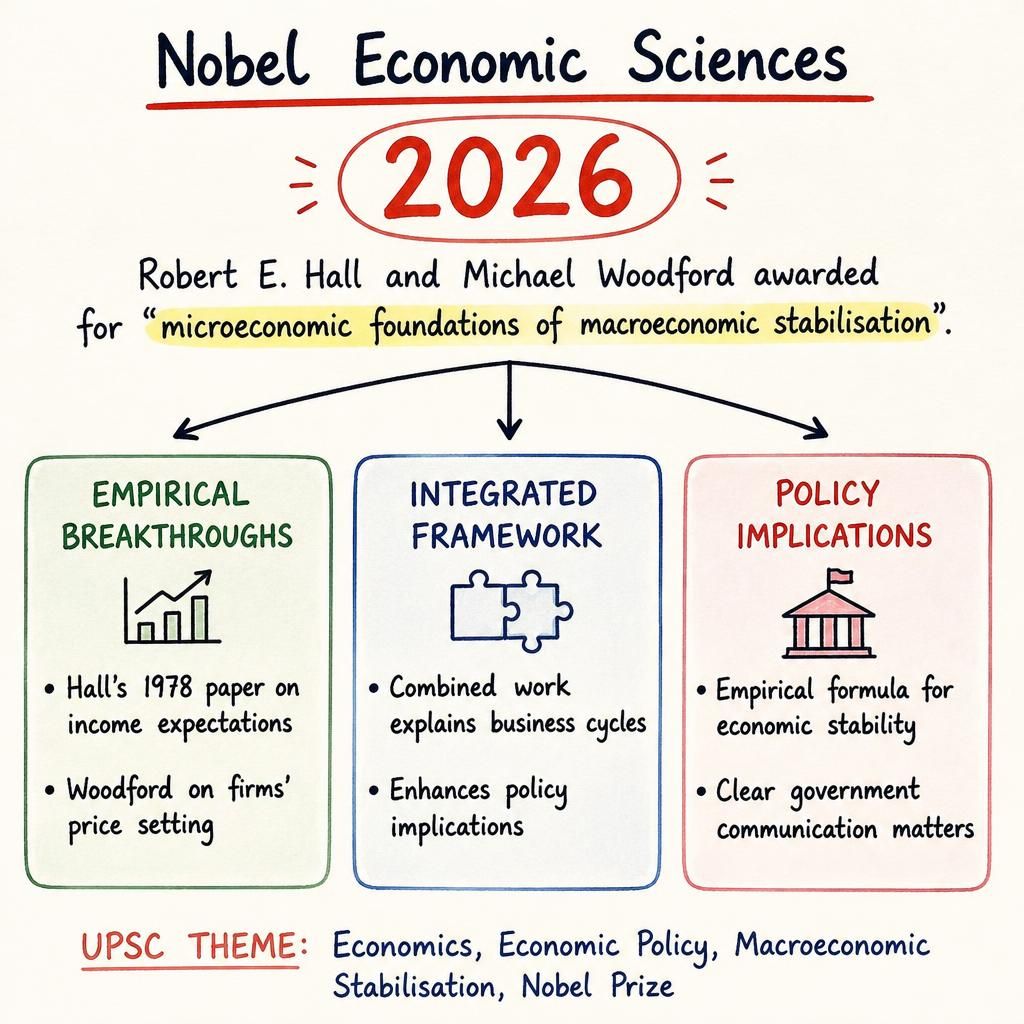
- American economists Robert E. Hall and Michael Woodford were awarded the 2026 Nobel Prize in Economic Sciences.
- They received the prize for establishing the "microeconomic foundations of macroeconomic stabilisation".
- Their work provides an empirical formula to help governments frame policies for economic stability.
- The formula incorporates household demand behavior and the supply behavior of companies.
Nobel Prize in Economics.jpg
Detailed Insights:
- The official name of the award is the Sveriges Riksbank Prize in Economic Sciences in Memory of Alfred Nobel.
- Professor Hall's 1978 paper empirically showed that future disposable income expectations significantly influence current household spending.
- Professor Woodford focused on how firms set prices and integrated his work with Hall's into a comprehensive framework.
- Their combined research enhanced the understanding of business cycles, their causes, progression, and policy implications.
- The laureates' work suggests that effective economic policy also depends on clear government communication regarding policy implementation.
- Robert E. Hall is a professor at Stanford University, and Michael Woodford is a professor at Columbia University.
Key Concepts Involved:
- Macroeconomic Stabilisation: Government policies aimed at reducing economic fluctuations and maintaining stable growth, employment, and prices.
- Microeconomic Foundations: The use of individual economic behavior (households, firms) to explain aggregate economic phenomena.
- Business Cycles: Recurring fluctuations in overall economic activity, such as employment, production, and income, over time.

SuperKalam is your personal mentor for UPSC preparation, guiding you at every step of the exam journey.
Download the App


STUDY RESOURCES
CONTACT US
ⓒ Snapstack Technologies Private Limited