GS 2: GovernanceGS 2: Social JusticeGS 3: EconomyPrelimsGS 3: Infrastructure: Energy, Ports, Roads, Airports, Railways etc.
The internet in a sachet — this idea's time has come, Pg8
PM-WANI's potential for affordable public Wi-Fi remains unfulfilled due to backhaul costs and regulatory hurdles, despite BharatNet's existing infrastructure, hindering digital inclusion.
Practice MCQs
883 Students attempted
Key Highlights:
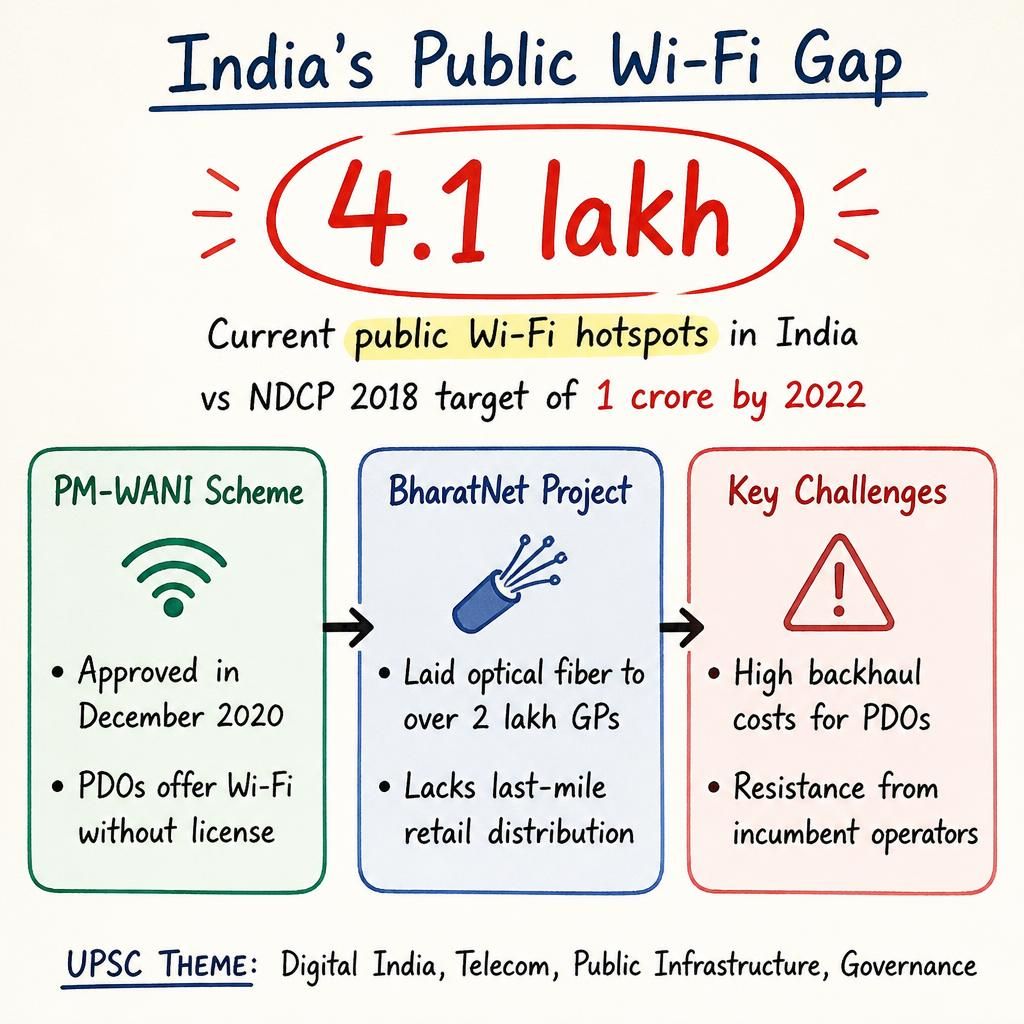
- India has approximately 4.1 lakh public Wi-Fi hotspots, significantly short of the National Digital Communications Policy (NDCP) 2018 target of 1 crore by 2022.
- The Prime Minister’s Wi-Fi Access Network Interface (PM-WANI) scheme, approved in December 2020, aims to proliferate public Wi-Fi through a decentralized model.
- PM-WANI enables local entities, called Public Data Offices (PDOs), to offer Wi-Fi services without requiring a license or registration.
- The BharatNet project, launched in 2011, has laid optical fiber to over 2 lakh Gram Panchayats but lacks last-mile retail distribution.
- Key challenges include high backhaul costs for PDOs and resistance from incumbent telecom operators.
Public Wifi.jpg
Detailed Insights:
- The concept of public Wi-Fi in India was first proposed by Nandan Nilekani in 2016, aiming for single-click access and micro-payments.
- TRAI developed an open, interoperable architecture for public Wi-Fi, piloting it successfully before the PM-WANI framework was approved.
- PM-WANI envisions PDOs as modern-day Public Call Offices (PCOs), selling internet connectivity in small, affordable sachets.
- The scheme's components include PDOs, Public Data Office Aggregators (PDOAs), App Providers, and a Central Registry.
- BharatNet, executed by Bharat Broadband Network Limited (BBNL), is one of the world's largest rural telecom projects, designed to bridge the digital divide.
- The proposed solution involves converging BharatNet and PM-WANI, with BharatNet acting as a common carrier providing affordable wholesale bandwidth to PDOs.
- TRAI released a consultation paper in April 2026 to address challenges and explore ways to scale up public Wi-Fi networks in India.
- Public Wi-Fi utilizes unlicensed spectrum, which can offload traffic from congested mobile networks and reduce dependence on a telecom duopoly.
Key Concepts Involved:
- PM-WANI (Prime Minister’s Wi-Fi Access Network Interface): A framework by the Department of Telecommunications to establish public Wi-Fi hotspots without licensing.
- BharatNet: A government project to provide high-speed broadband connectivity to all Gram Panchayats in India using optical fiber.
- Public Data Office (PDO): A local entity (e.g., shop, tea stall) that operates a Wi-Fi hotspot and sells internet access to the public.
- Backhaul: The part of a network that connects the local network (like a Wi-Fi hotspot) to the main network or the internet.## Key Highlights:
- India has approximately 4.1 lakh public Wi-Fi hotspots, significantly short of the National Digital Communications Policy (NDCP) 2018 target of 1 crore by 2022.
- The Prime Minister’s Wi-Fi Access Network Interface (PM-WANI) scheme, approved in December 2020, aims to proliferate public Wi-Fi through a decentralized model.
- PM-WANI enables local entities, called Public Data Offices (PDOs), to offer Wi-Fi services without requiring a license or registration.
- The BharatNet project, launched in 2011, has laid optical fiber to over 2 lakh Gram Panchayats but lacks last-mile retail distribution.
- Key challenges include high backhaul costs for PDOs and resistance from incumbent telecom operators.
Detailed Insights:
- The concept of public Wi-Fi in India was first proposed by Nandan Nilekani in 2016, aiming for single-click access and micro-payments.
- TRAI developed an open, interoperable architecture for public Wi-Fi, piloting it successfully before the PM-WANI framework was approved.
- PM-WANI envisions PDOs as modern-day Public Call Offices (PCOs), selling internet connectivity in small, affordable sachets.
- The scheme's components include PDOs, Public Data Office Aggregators (PDOAs), App Providers, and a Central Registry.
- BharatNet, executed by Bharat Broadband Network Limited (BBNL), is one of the world's largest rural telecom projects, designed to bridge the digital divide.
- The proposed solution involves converging BharatNet and PM-WANI, with BharatNet acting as a common carrier providing affordable wholesale bandwidth to PDOs.
- TRAI released a consultation paper in April 2026 to address challenges and explore ways to scale up public Wi-Fi networks in India.
- Public Wi-Fi utilizes unlicensed spectrum, which can offload traffic from congested mobile networks and reduce dependence on a telecom duopoly.
Key Concepts Involved:
- PM-WANI (Prime Minister’s Wi-Fi Access Network Interface): A framework by the Department of Telecommunications to establish public Wi-Fi hotspots without licensing.
- BharatNet: A government project to provide high-speed broadband connectivity to all Gram Panchayats in India using optical fiber.
- Public Data Office (PDO): A local entity (e.g., shop, tea stall) that operates a Wi-Fi hotspot and sells internet access to the public.
- Backhaul: The part of a network that connects the local network (like a Wi-Fi hotspot) to the main network or the internet.

SuperKalam is your personal mentor for UPSC preparation, guiding you at every step of the exam journey.
Download the App


STUDY RESOURCES
CONTACT US
ⓒ Snapstack Technologies Private Limited