GS 2: GovernanceGS 3: Science & TechnologyGS 2: Social JusticeGS 3: EconomyPrelims
A decade of placing research and innovation at the centre, Pg9
India's decade-long focus on research and innovation, driven by 'Jai Anusandhan,' significantly boosts global innovation ranking, R&D expenditure, and startup ecosystem.
Practice MCQs
883 Students attempted
Key Highlights:
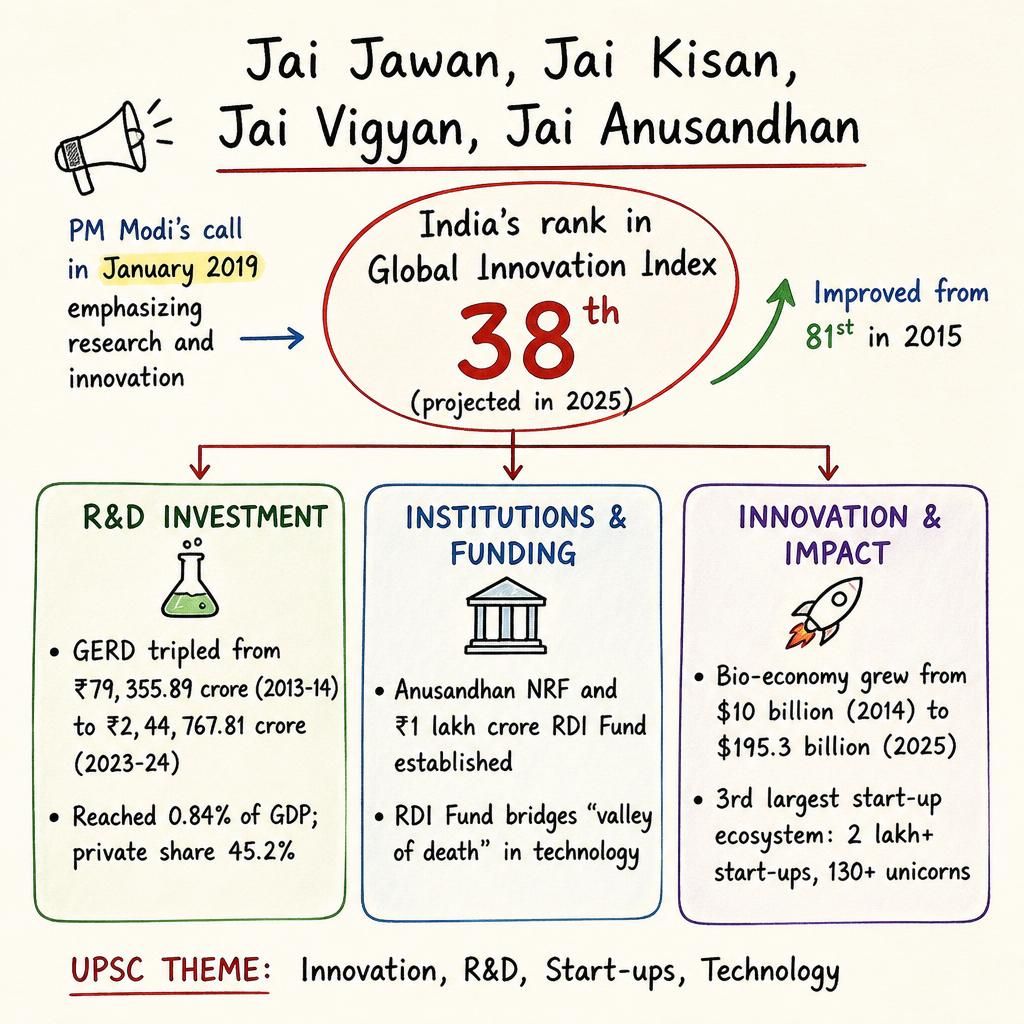
- Prime Minister Narendra Modi gave the call for “Jai Jawan, Jai Kisan, Jai Vigyan, Jai Anusandhan” in January 2019, emphasizing research and innovation.
- India's rank in the Global Innovation Index improved from 81st in 2015 to a projected 38th in 2025.
- Gross Expenditure on Research and Development (GERD) tripled from ₹79,355.89 crore in 2013-14 to ₹2,44,767.81 crore in 2023-24, reaching 0.84% of GDP.
- The private sector's share of GERD increased from 32.2% to 45.2% over the last decade.
- The Anusandhan National Research Foundation and the ₹1 lakh crore Research, Development and Innovation (RDI) Fund were established to bolster research funding.
- India's bio-economy grew from $10 billion in 2014 to $195.3 billion in 2025, with a projection to reach $300 billion by 2030.
- India is now the world's third-largest start-up ecosystem, boasting over 2 lakh registered start-ups and more than 130 unicorns.
Innovation Index.jpg
Detailed Insights:
- The vision articulated by PM Modi positions research and innovation as central to economic growth, strategic security, industrial development, entrepreneurship, and citizen services.
- India ranks third globally in the volume of scientific and engineering publications.
- The Anusandhan National Research Foundation funds new research and promotes collaboration among academia, industry, and government.
- The RDI Fund addresses the "valley of death" in technology development by providing patient, risk-tolerant capital for pilot-scale demonstration and productization.
- Initiatives like Women in Science and Engineering (WISE)-KIRAN, Gender Advancement for Transforming Institutions (GATI), and Vigyan Jyoti aim to increase opportunities for women in STEM.
- Mission-mode capabilities are being developed through programs such as the National Quantum Mission, IndiaAI Mission, and Indian Semiconductor Mission.
- The BioE3 Policy provides a foundation for biotechnology, while the Deep Ocean Mission and Mission Mausam focus on resource and climate security.
- The Indian Space Policy, 2023 and IN-SPACe have opened the space sector to private participation, leading to over 400 space start-ups.
- The SHAKTI Act provides a legal framework for private participation in nuclear energy, subject to regulatory requirements.
- India's digital public infrastructure, built around the JAM trinity, has expanded with UPI, DigiLocker, Account Aggregator, and the Ayushman Bharat Digital Health Mission.
- Technology like satellites, drones, remote sensing, GIS, and AI are increasingly utilized in agriculture for precision farming and farmer advisories.
- Start-up India, launched in 2016, has fostered entrepreneurship through schemes like Seed Fund, Fund of Funds, Credit Guarantee Scheme, and Atal Innovation Mission.
Key Concepts Involved:
- Global Innovation Index (GII): An annual ranking of countries by their capacity for, and success in, innovation.
- Gross Expenditure on Research and Development (GERD): The total amount of money spent on R&D activities within a country.
- Valley of Death: A term describing the funding gap between basic research and the commercialization of new technologies.
- Digital Public Infrastructure (DPI): Open, interoperable digital systems that facilitate the delivery of essential public and private services.## Key Highlights:
- Prime Minister Narendra Modi gave the call for “Jai Jawan, Jai Kisan, Jai Vigyan, Jai Anusandhan” in January 2019, emphasizing research and innovation as a primary agenda.
- India's rank in the Global Innovation Index improved significantly from 81st in 2015 to a projected 38th in 2025.
- Gross Expenditure on Research and Development (GERD) tripled from ₹79,355.89 crore in 2013-14 to ₹2,44,767.81 crore in 2023-24, reaching 0.84% of GDP.
- The private sector's share of GERD increased from 32.2% to 45.2% over the last decade.
- The Anusandhan National Research Foundation and the ₹1 lakh crore Research, Development and Innovation (RDI) Fund were established to bolster research funding and infrastructure.
- India's bio-economy grew from approximately $10 billion in 2014 to $195.3 billion in 2025, with a projection to reach $300 billion by 2030.
- India is now the world's third-largest start-up ecosystem, boasting over 2 lakh registered start-ups and more than 130 unicorns.
Detailed Insights:
- The vision articulated by PM Modi positions research and innovation as central to economic growth, strategic security, industrial development, entrepreneurship, and citizen-centric service delivery.
- India ranks third globally in the volume of scientific and engineering publications.
- The Anusandhan National Research Foundation funds new research across universities, colleges, and R&D labs while encouraging collaboration among academia, industry, and government.
- The RDI Fund addresses the "valley of death" in technology development by providing patient, risk-tolerant capital for pilot-scale demonstration and productization.
- Initiatives like Women in Science and Engineering (WISE)-KIRAN, Gender Advancement for Transforming Institutions (GATI), and Vigyan Jyoti aim to increase opportunities for women in STEM fields.
- Mission-mode capabilities are being developed around specific sectoral priorities through programs such as the National Quantum Mission, IndiaAI Mission, and Indian Semiconductor Mission.
- The BioE3 Policy provides a broad foundation for biotechnology, while the Deep Ocean Mission and Mission Mausam extend the integrated ecosystem approach into resource and climate security.
- The Indian Space Policy, 2023 and the establishment of IN-SPACe have opened the space sector to private participation, leading to over 400 space start-ups.
- The SHAKTI Act provides a legal framework for private participation in nuclear energy, subject to licensing, safety, and regulatory requirements.
- India's digital public infrastructure, built around the JAM trinity, has expanded with UPI, DigiLocker, Account Aggregator, and the Ayushman Bharat Digital Health Mission.
- Technology like satellites, drones, remote sensing, GIS, and AI are increasingly utilized in agriculture for crop monitoring, precision farming, yield estimation, and farmer advisories.
- Start-up India, launched in 2016, has fostered entrepreneurship through a wide range of schemes such as the Seed Fund, Fund of Funds, Credit Guarantee Scheme, and Atal Innovation Mission.
Key Concepts Involved:
- Global Innovation Index (GII): An annual ranking of countries by their capacity for, and success in, innovation.
- Gross Expenditure on Research and Development (GERD): The total amount of money spent on R&D activities within a country.
- Valley of Death: A term describing the funding gap between basic research and the commercialization of new technologies.
- Digital Public Infrastructure (DPI): Open, interoperable digital systems that facilitate the delivery of essential public and private services.

SuperKalam is your personal mentor for UPSC preparation, guiding you at every step of the exam journey.
Download the App


STUDY RESOURCES
CONTACT US
ⓒ Snapstack Technologies Private Limited