GS 2: GovernanceGS 2: International RelationsPrelimsGS 2: Bilateral, Regional and Global Groupings and AgreementsGS 2: Effect of Policies and Politics of Developed and Developing Countries on India's Interests
BRICS Countries Adopt New Delhi Declaration, Pg1
BRICS nations adopt New Delhi Declaration after Iran-UAE compromise, calling for UN reform, restraint in West Asia, and criticising Israel's Gaza bombardment.
Practice MCQs
876 Students attempted
Key Highlights:
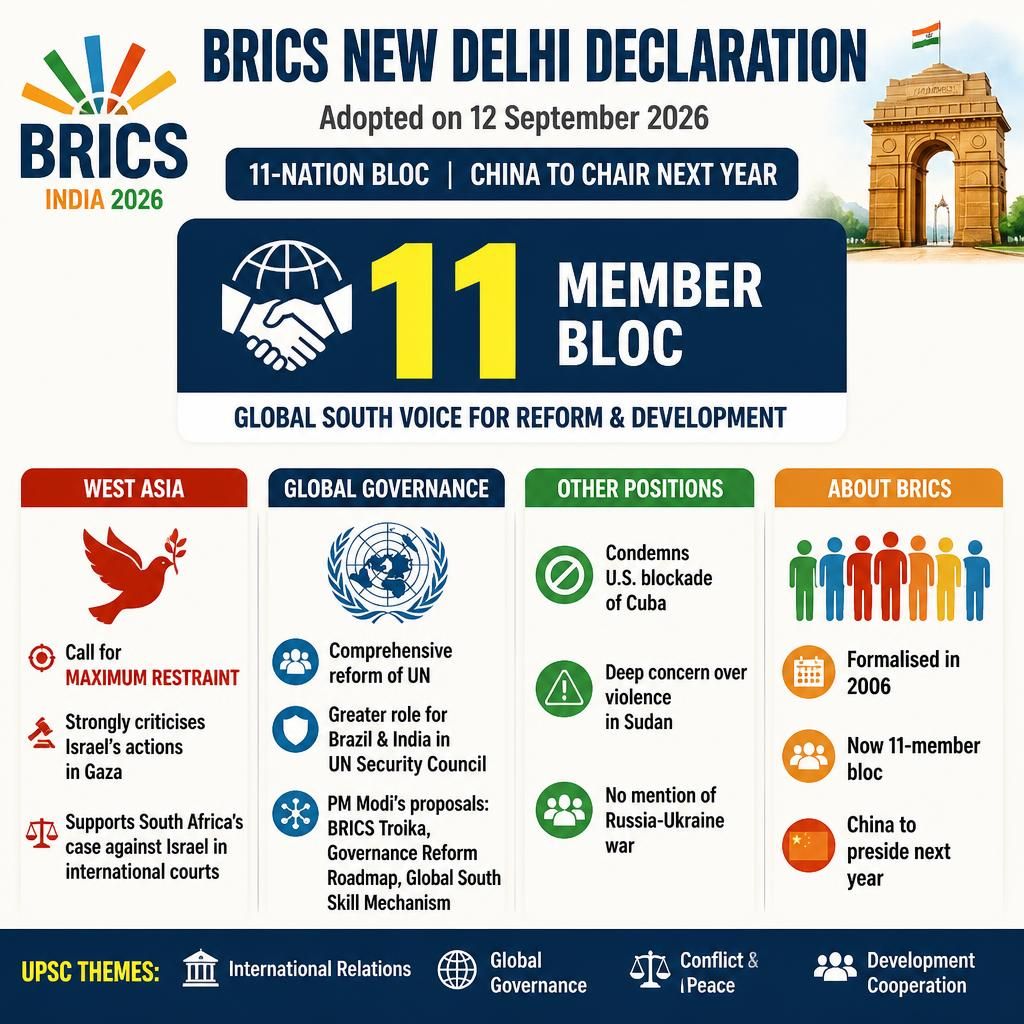
- BRICS countries adopted the New Delhi Declaration on September 12, 2026, at a summit chaired by Prime Minister Narendra Modi.
- The declaration called for "maximum restraint" in West Asia, following a compromise on language regarding conflicts involving Iran and the United Arab Emirates.
- It strongly criticized Israel's bombardment of Gaza and expressed support for South Africa's case against Israel in international courts.
- The declaration advocated for comprehensive reform of the United Nations, including a larger role for Brazil and India in the Security Council.
- Prime Minister Modi proposed a BRICS troika system, a roadmap for global governance reform, and a BRICS Global South mechanism for skill development in new technologies.
- The declaration also condemned the U.S. blockade of Cuba and expressed concern over violence in Sudan.
New Delhi Declaration.jpg
Detailed Insights:
- The consensus on the declaration was achieved after extensive negotiations, particularly concerning the West Asia conflict, where Iran sought strong condemnation of the U.S. and Israel, while the UAE sought equal condemnation of Iran's actions.
- The declaration expressed "deep concern" over attacks on civilian infrastructure and nuclear facilities in West Asia, implicitly referring to U.S. and Israeli strikes in Iran.
- India's close ties with Israel were noted, making the BRICS criticism of Israel significant in the declaration.
- The declaration did not specifically mention the Russian war in Ukraine, reflecting a broader consensus approach among member states.
- The BRICS grouping, formally established in 2006, is now an 11-member bloc, with China set to take over the presidency for the next year.
- The declaration also underlined the bloc's consensus against cross-border terrorism, specifically referencing the Pahalgam terror attack in 2025.
- The proposed BRICS troika system aims to ensure continuity in discussions by involving incoming and outgoing presidents, similar to the G-20 troika model.
Key Concepts Involved:
- BRICS: An intergovernmental organization of major emerging economies, formally established in 2006, aiming to promote cooperation and a more multipolar world order.
- New Delhi Declaration: The joint statement adopted by BRICS leaders at their 2026 summit in New Delhi, outlining their collective stance on global political, economic, and security issues.
- G-20 Troika: An informal steering group within the G-20 comprising the past, current, and future presidency holders, ensuring continuity and institutional memory.
- Global South: A term referring to countries in Asia, Africa, and Latin America, often characterized by developing economies and shared historical experiences.

SuperKalam is your personal mentor for UPSC preparation, guiding you at every step of the exam journey.
Download the App


STUDY RESOURCES
CONTACT US
ⓒ Snapstack Technologies Private Limited