GS 2: International RelationsGS 3: EconomyPrelimsGS 2: Bilateral, Regional and Global Groupings and AgreementsGS 2: Effect of Policies and Politics of Developed and Developing Countries on India's Interests
Behind The Agreement: No Ukraine, Iran-UAE Balance, Swipe At (US) Tariffs, Flagging Gaza, Pg1
BRICS declaration navigates divisive global issues, condemning unilateral sanctions and tariffs while avoiding Ukraine mention, and addressing Gaza conflict and UNSC reforms.
Practice MCQs
876 Students attempted
Key Highlights:
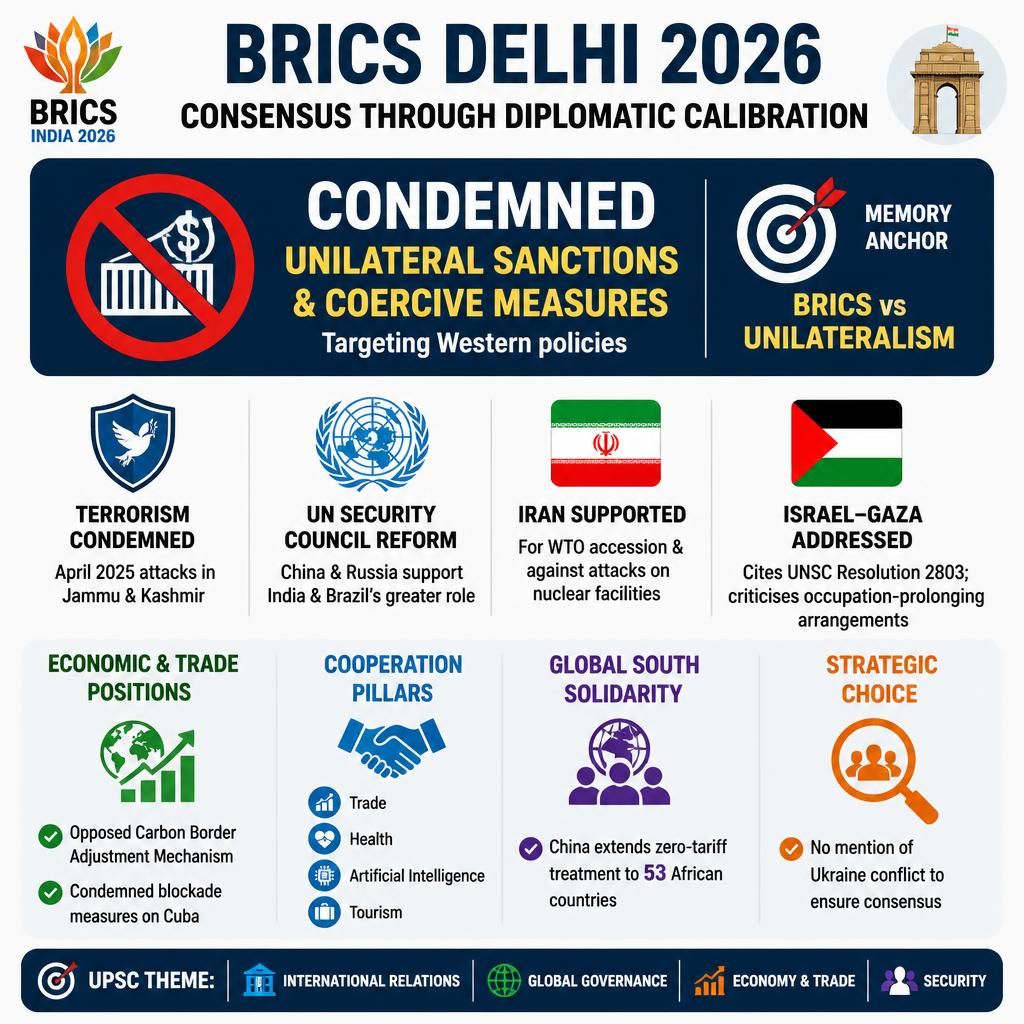
- The BRICS Delhi 2026 declaration achieved consensus on contentious global issues through careful diplomatic calibration.
- The declaration condemned "unilateral coercive measures," "unilateral economic sanctions," and "secondary sanctions," implicitly targeting Western policies.
- It notably omitted any mention of the Ukraine conflict, a significant departure from the Rio 2025 declaration.
- China and Russia reiterated their support for India and Brazil's aspirations for a greater role in the UN Security Council.
- The declaration strongly condemned terrorism, specifically referencing the April 2025 attacks in Jammu and Kashmir.
- It supported Iran's bid for accession to the World Trade Organization (WTO) and condemned attacks on peaceful nuclear facilities.
- The declaration directly addressed the Israel-Gaza conflict, citing UNSC Resolution 2803 and criticizing arrangements that prolong occupation.
BRICS Declaration.jpg
Detailed Insights:
- The 45-page declaration emphasized cooperation across trade, health, artificial intelligence, and tourism, adopting a non-confrontational tone.
- It echoed the Rio 2025 declaration on several points, including the Gaza conflict and UN Security Council reforms.
- The condemnation of "unilateral blockade measures" on Cuba served as an indirect reference to the US embargo.
- The declaration expressed opposition to the "carbon border adjustment mechanism," targeting specific US and EU trade-climate policies.
- Russia's presence at the summit was a key factor in the complete omission of the Ukraine conflict to avoid divisive language.
- The language regarding UN Security Council reform was a direct copy-paste from the Rio 2025 declaration, underscoring China and Russia's geopolitical influence.
- China was acknowledged for extending zero-tariff treatment to 53 African countries, positioning it as a benefactor to the Global South.
- The condemnation of attacks on peaceful nuclear facilities referred to alleged June 2025 strikes on Iranian nuclear sites.
- The declaration criticized arrangements that might legitimize or prolong occupation, referencing South Africa's International Court of Justice (ICJ) case against Israel.
- It called on Israel to respect agreed terms and withdraw occupying forces from Lebanon, mirroring the 2025 declaration's formulation.
Key Concepts Involved:
- Unilateral Coercive Measures: Economic or political measures imposed by one state on another without international authorization.
- Secondary Sanctions: Sanctions imposed on entities that engage in transactions with a primary target of sanctions.
- Carbon Border Adjustment Mechanism (CBAM): A tariff on imports based on the carbon emissions generated during their production.
- UNSC Resolution 2803: A resolution cited in the declaration that opposes the forced displacement of Palestinians.

SuperKalam is your personal mentor for UPSC preparation, guiding you at every step of the exam journey.
Download the App


STUDY RESOURCES
CONTACT US
ⓒ Snapstack Technologies Private Limited