GS 3: Science & TechnologyGS 3: Disaster ManagementGS 3: Environment & EcologyPrelimsGS 3: Major Crops, Cropping Patterns and Irrigation Systems
Kazakhstan, desperate for rain, turns to cloud-seeding, Pg2
Kazakhstan initiates cloud seeding with UAE collaboration to combat severe drought and water shortages, aiming for better harvests and economic benefits.
Practice MCQs
869 Students attempted
Key Highlights:
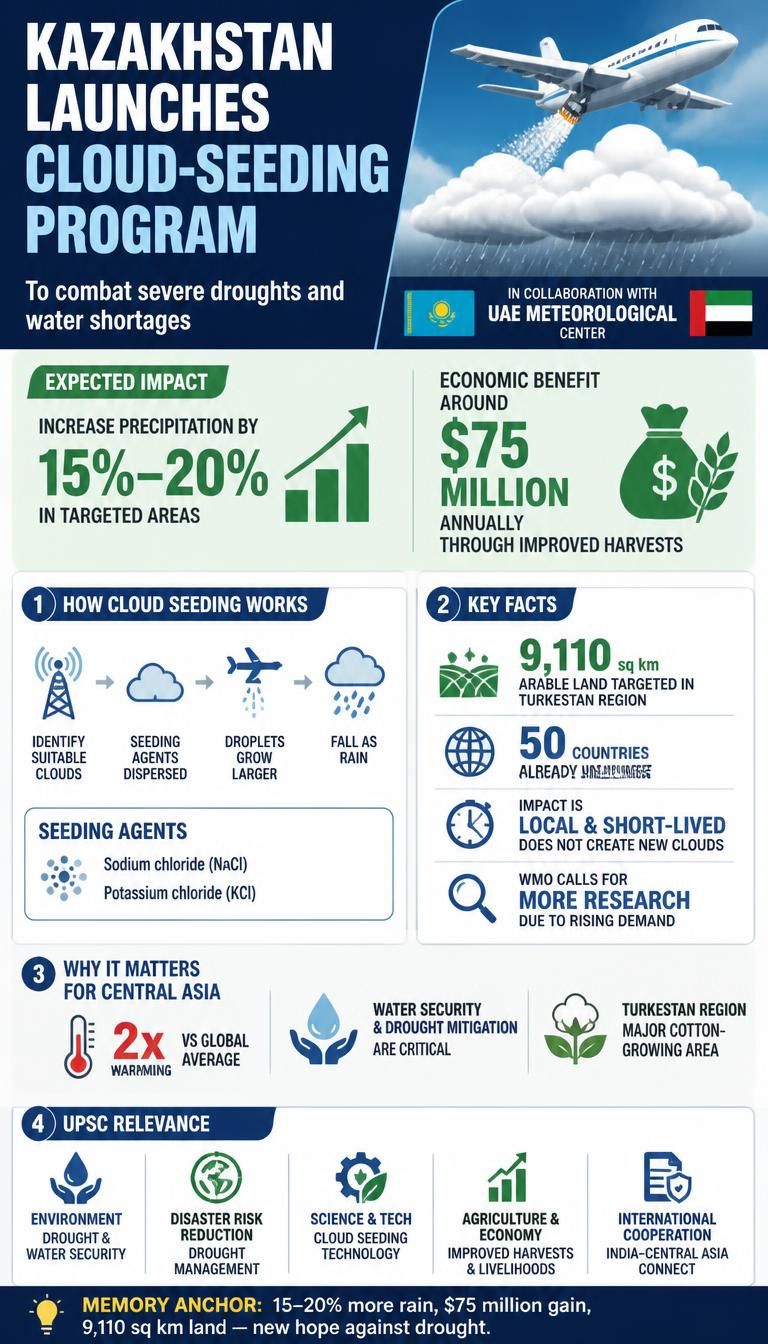
- Kazakhstan has initiated a cloud-seeding program to combat severe droughts and water shortages, particularly in its southern Turkestan region.
- The project involves collaboration with the United Arab Emirates’s meteorological center, utilizing aircraft equipped with cloud-seeding flare systems.
- The primary goal is to increase precipitation by an estimated 15% to 20% in targeted areas, aiming for economic benefits of around $75 million annually through improved harvests.
- Sodium chloride and potassium chloride are commonly used as seeding agents, dispersed to make cloud droplets heavy enough to fall as rain.
Cloud seeding.jpg
Detailed Insights:
- The cloud-seeding operations target approximately 9,110 square kilometers of arable land in the Turkestan region, a major cotton-growing area.
- The technique involves identifying suitable clouds and dispersing seeding agents directly into them to enhance droplet growth.
- While effective, the technique does not create new clouds and its impact is described as local and short-lived, without affecting broader climate processes.
- The World Meteorological Organization has called for more scientific research into cloud seeding due to rising demand amid increasing drought frequency.
- Cloud seeding is already employed in about 50 countries globally to address drought, hail, and air pollution, but it is new to Central Asia.
- Central Asia is experiencing warming at twice the global average, making water management and drought mitigation critical.
Scientific/Technical Concepts Involved:
- Cloud Seeding: A weather modification technique that aims to increase precipitation by introducing substances into clouds to stimulate rainfall.
- Sodium Chloride (NaCl): A common salt used as a hygroscopic cloud-seeding agent, attracting water molecules to form larger droplets.
- Potassium Chloride (KCl): Another salt used in cloud seeding, similar to sodium chloride, to enhance the growth of cloud droplets.
- Hygroscopic Seeding: A method of cloud seeding that uses substances like salts to absorb moisture, promoting the formation of larger raindrops.

SuperKalam is your personal mentor for UPSC preparation, guiding you at every step of the exam journey.
Download the App


STUDY RESOURCES
CONTACT US
ⓒ Snapstack Technologies Private Limited