GS 2: GovernanceGS 3: EconomyPrelimsGS 3: Farm Subsidies and Minimum Support PricesGS 3: Government Budgeting
Rabi Fertiliser Subsidy To Be Rs 62,370 Crore, Up 64% From Last Year, Pg13
Union Cabinet approves massive Rs 62,370 crore Rabi fertiliser subsidy, a 64% hike, ensuring fixed DAP prices for farmers amidst global price volatility.
Practice MCQs
883 Students attempted
Key Highlights:
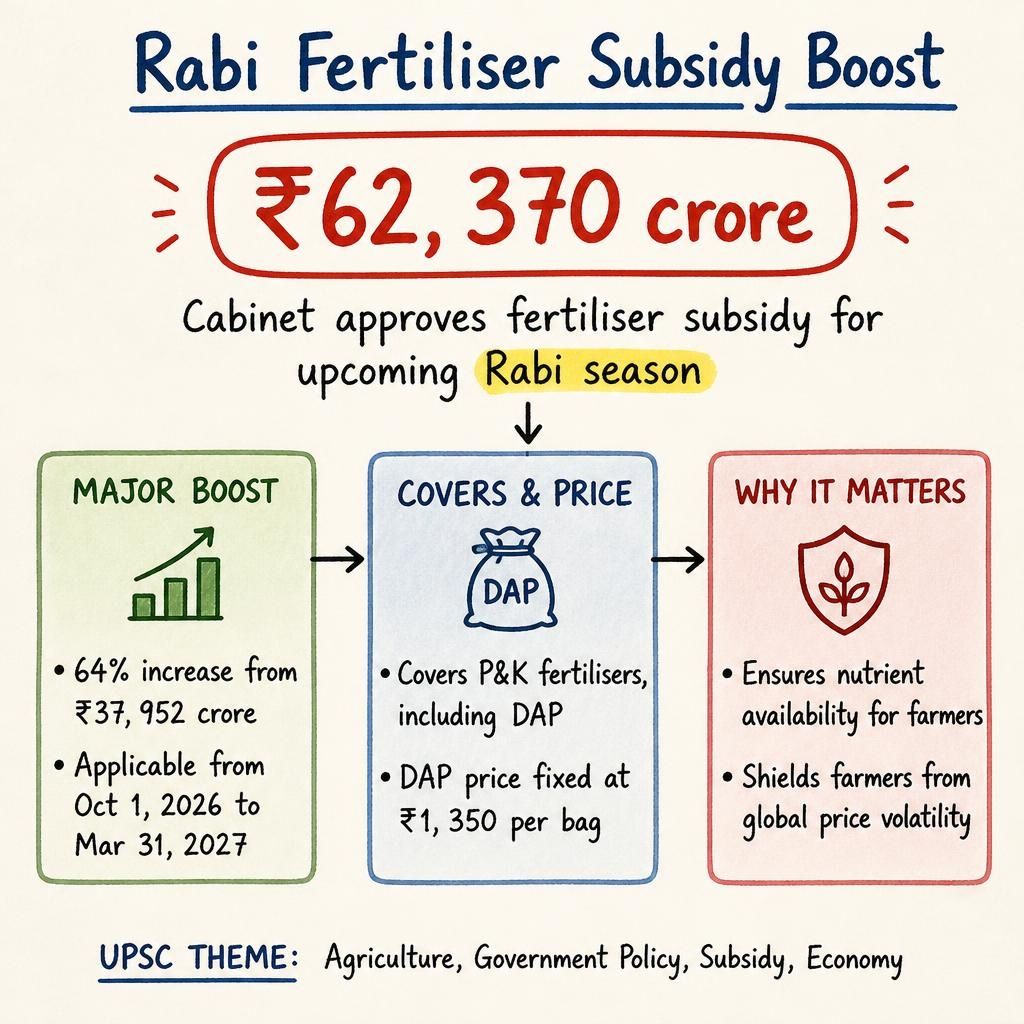
- The Union Cabinet has approved ₹62,370 crore as fertiliser subsidy for the upcoming Rabi season.
- This represents a 64% increase from the previous year's Rabi subsidy of ₹37,952 crore.
- The subsidy covers Phosphatic and Potassic (P&K) fertilisers, including Di-ammonium Phosphate (DAP), nitrogen, phosphorus, potash, and sulphur.
- The fixed price for a bag of DAP for farmers will be maintained at ₹1,350.
- The subsidy is applicable for the period from October 1, 2026, to March 31, 2027.
Fertiliser Subsidy.jpg
Detailed Insights:
- The substantial increase in the Rabi fertiliser subsidy aims to ensure adequate availability of essential nutrients for farmers and support agricultural productivity.
- The government's decision to keep the DAP price fixed at ₹1,350 per bag shields farmers from the volatility of global fertiliser markets.
- Global fertiliser prices have been significantly impacted by geopolitical events, including a "war in West Asia" and energy shocks, which affect the government's fiscal planning.
- The overall fertiliser subsidy bill for the 2026-27 fiscal year was initially projected at ₹1.71 lakh crore, a decrease from ₹1.86 lakh crore in 2025-26.
- Data from the Controller General of Accounts (CGA) indicates that ₹33,664 crore was spent on Nutrient Fertilisers subsidy in Q1 2026-27, against a budget allocation of ₹54,000 crore.
- This subsidy mechanism operates under the Nutrient Based Subsidy (NBS) scheme, which promotes balanced fertilization by subsidizing P&K fertilisers based on their nutrient content.
Key Concepts Involved:
- Rabi Season: The agricultural cropping season in India from October to March, characterized by crops like wheat, barley, and mustard.
- Phosphatic and Potassic (P&K) Fertilisers: Fertilisers providing phosphorus and potassium, essential macronutrients for plant growth and development.
- Di-ammonium Phosphate (DAP): A widely used complex fertiliser providing both nitrogen and phosphorus to crops.
- Nutrient Based Subsidy (NBS) Scheme: A policy introduced in 2010 to subsidize P&K fertilisers based on their nutrient content, encouraging balanced fertilization.

SuperKalam is your personal mentor for UPSC preparation, guiding you at every step of the exam journey.
Download the App


STUDY RESOURCES
CONTACT US
ⓒ Snapstack Technologies Private Limited