GS 3: Science & TechnologyGS 2: International RelationsGS 3: Environment & EcologyGS 3: EconomyPrelims
Needed: A Sustained Decline In Emissions, Pg10
Global Carbon Budget forecasts slight fossil fuel emission decline, but overall carbon emissions rise; India's emissions jump 4%, challenging COP31 delegates.
Practice MCQs
883 Students attempted
Key Highlights:
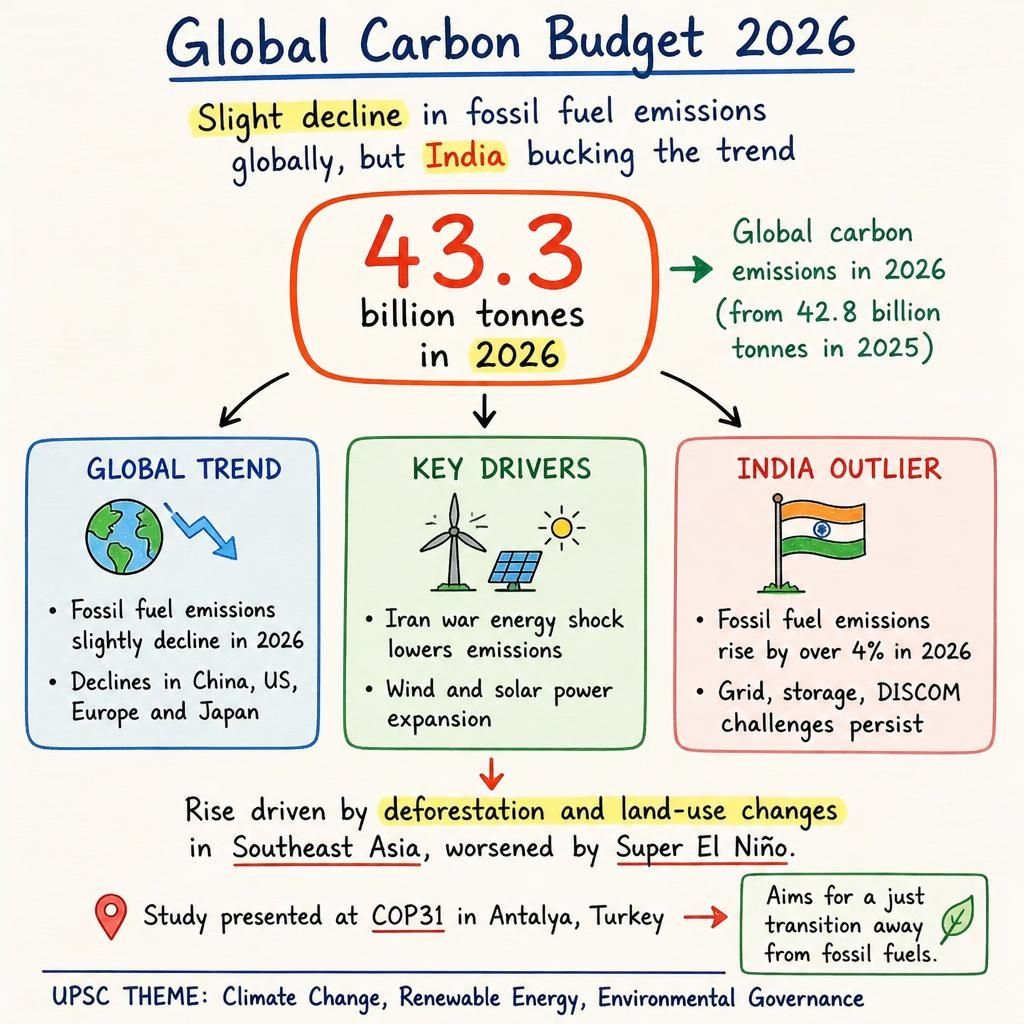
- The Global Carbon Budget study forecasts a slight decline in fossil fuel greenhouse gas emissions for 2026 compared to 2025.
- This projected decline is primarily attributed to the energy shock from the Iran war and the expansion of wind and solar power.
- India is an outlier, with its fossil fuel emissions estimated to rise by over 4% in 2026 compared to 2025.
- Overall global carbon emissions are expected to increase from 42.8 billion tonnes in 2025 to 43.3 billion tonnes in 2026.
- This overall increase is driven by rising emissions from deforestation and land-use changes, particularly in Southeast Asia, exacerbated by the Super El Niño.
- The study was presented at COP31 in Antalya, Turkey, which aims to chart a pathway for a just transition away from fossil fuels.
Global Carbon Budget.jpg
Detailed Insights:
- The anticipated global reduction in fossil fuel emissions is not expected to be sustained, mirroring temporary drops observed during past economic disruptions and the COVID-19 pandemic.
- Major global emitters such as China, the United States, Europe, and Japan are projected to record declines in their fossil fuel emissions this year.
- India's increasing emissions are linked to challenges in optimizing green energy use, including shortfalls in energy storage and inadequate grid infrastructure.
- The financial instability of DISCOMs in India impedes their capacity to upgrade infrastructure necessary for integrating renewable energy effectively.
- COP31, the 31st session of the UN Framework Convention on Climate Change (UNFCCC), is tasked with developing strategies for an equitable shift from fossil fuels and protecting natural carbon sinks.
- Emissions from deforestation and land-use changes, especially in Southeast Asia, are offsetting any reductions achieved in fossil fuel emissions globally.
- The Super El Niño phenomenon contributes to drier conditions, which could intensify peat fires and further elevate carbon emissions.
- India has launched initiatives like the PM Surya Ghar: Muft Bijli Yojana and PM-KUSUM to boost renewable energy adoption and address energy sector challenges.
- The Indian government is also planning to mandate energy storage procurement for DISCOMs and has approved Viability Gap Funding (VGF) for developing energy storage capacity.
Key Concepts Involved:
- Global Carbon Budget: An annual assessment by the Global Carbon Project detailing global carbon dioxide emissions and their distribution among Earth's systems.
- COP (Conference of the Parties): The supreme decision-making body of the UN Framework Convention on Climate Change (UNFCCC), meeting annually to assess climate change progress.
- Just Transition: A framework ensuring that the shift to a low-carbon economy is fair and inclusive, protecting workers and communities affected by the change.
- Carbon Sinks: Natural or artificial reservoirs (like forests, oceans, soils) that absorb and store more carbon dioxide from the atmosphere than they release.
- Super El Niño: An exceptionally strong warming of sea surface temperatures in the central and eastern equatorial Pacific Ocean, leading to significant global climate disruptions.

SuperKalam is your personal mentor for UPSC preparation, guiding you at every step of the exam journey.
Download the App


STUDY RESOURCES
CONTACT US
ⓒ Snapstack Technologies Private Limited