GS 2: International RelationsGS 3: EconomyPrelimsGS 2: Effect of Policies and Politics of Developed and Developing Countries on India's InterestsGS 1: Distribution of Key Natural Resources
Hormuz Will Not Return To Pre-War Status: Ghalibaf, Pg2
Iran's Parliament Speaker declares Strait of Hormuz will not revert to pre-war status, as tanker attacks and regional tensions escalate despite de-escalation hopes.
Practice MCQs
883 Students attempted
Key Highlights:
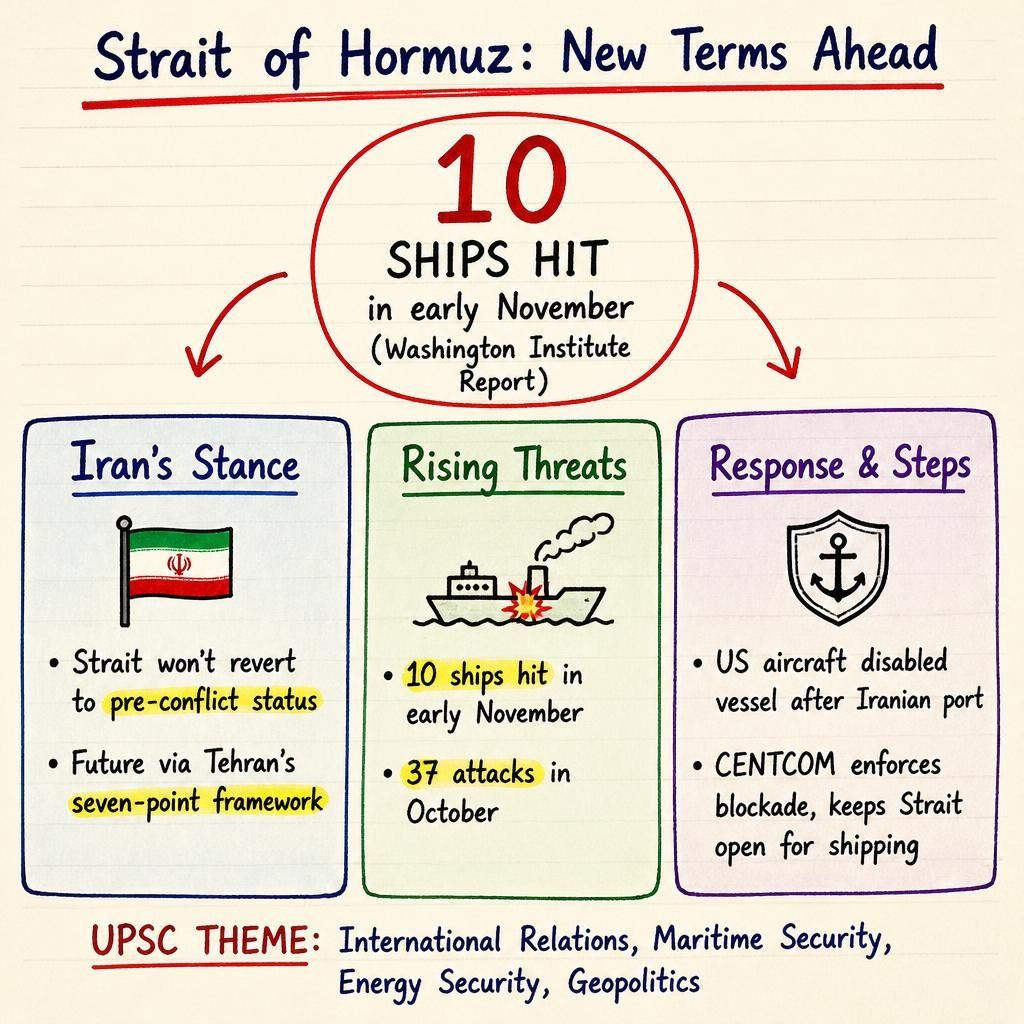
- Iran's Parliament Speaker, Mohammad Bagher Ghalibaf, stated that the Strait of Hormuz will not revert to its pre-conflict status.
- Ghalibaf indicated that the Strait's future would be determined by a seven-point framework proposed by Tehran, emphasizing peace if Iran's terms are accepted.
- Despite expectations of de-escalation, the Strait of Hormuz continues to experience attacks on tankers and infrastructure.
- The Washington Institute for Near East Policy reported 10 ships hit in early November, following 37 attacks in October, the highest monthly tally since the conflict began.
- A US military aircraft disabled a St. Kitts-flagged cargo vessel attempting to depart regional waters after visiting an Iranian port.
Strait of Hormuz.jpg
Detailed Insights:
- The "pre-war status" refers to the period before the "2026 Iran War," when the Strait of Hormuz was generally open for commercial shipping.
- Iran's seven conditions for reopening the Strait include lifting sanctions, releasing frozen assets, withdrawing US forces, and compensation for war damages.
- The Strait of Hormuz is a critical global chokepoint for oil and liquefied natural gas, making its disruption a significant international concern.
- US Central Command (CENTCOM) is actively working to maintain the Strait's openness for commercial shipping while enforcing a naval blockade against Iran.
- Iran has also reached a mutual understanding with Oman regarding a shipping corridor and a traffic separation system in the Strait.
- The ongoing incidents underscore the persistent regional instability and the strategic importance of maritime security in the Persian Gulf.
Key Concepts Involved:
- Strait of Hormuz: A narrow, strategically vital waterway connecting the Persian Gulf to the Arabian Sea, crucial for global oil and LNG transport.
- Chokepoint: A geographical feature, such as a strait or canal, that forces traffic into a narrow channel, making it vulnerable to disruption.
- Naval Blockade: An effort by a belligerent power to prevent vessels from entering or leaving enemy ports or coasts, often to restrict trade and supplies.

SuperKalam is your personal mentor for UPSC preparation, guiding you at every step of the exam journey.
Download the App


STUDY RESOURCES
CONTACT US
ⓒ Snapstack Technologies Private Limited