GS 2: GovernanceGS 3: Environment & EcologyPrelimsGS 3: Conservation, Pollution and DegradationGS 2: Important Aspects of Governance, Transparency and Accountability
Across India, 70% of Stations Reported ‘Severe’ PM2.5 Readings, Pg7
Alarming data reveals 70% of India's air quality stations recorded 'severe' PM2.5 levels during Deepavali, raising concerns over data reporting gaps.
Practice MCQs
883 Students attempted
Key Highlights:
- Nearly 70% of India's Continuous Ambient Air Quality Monitoring Stations (CAAQMS) reported 'severe' PM2.5 levels during Deepavali.
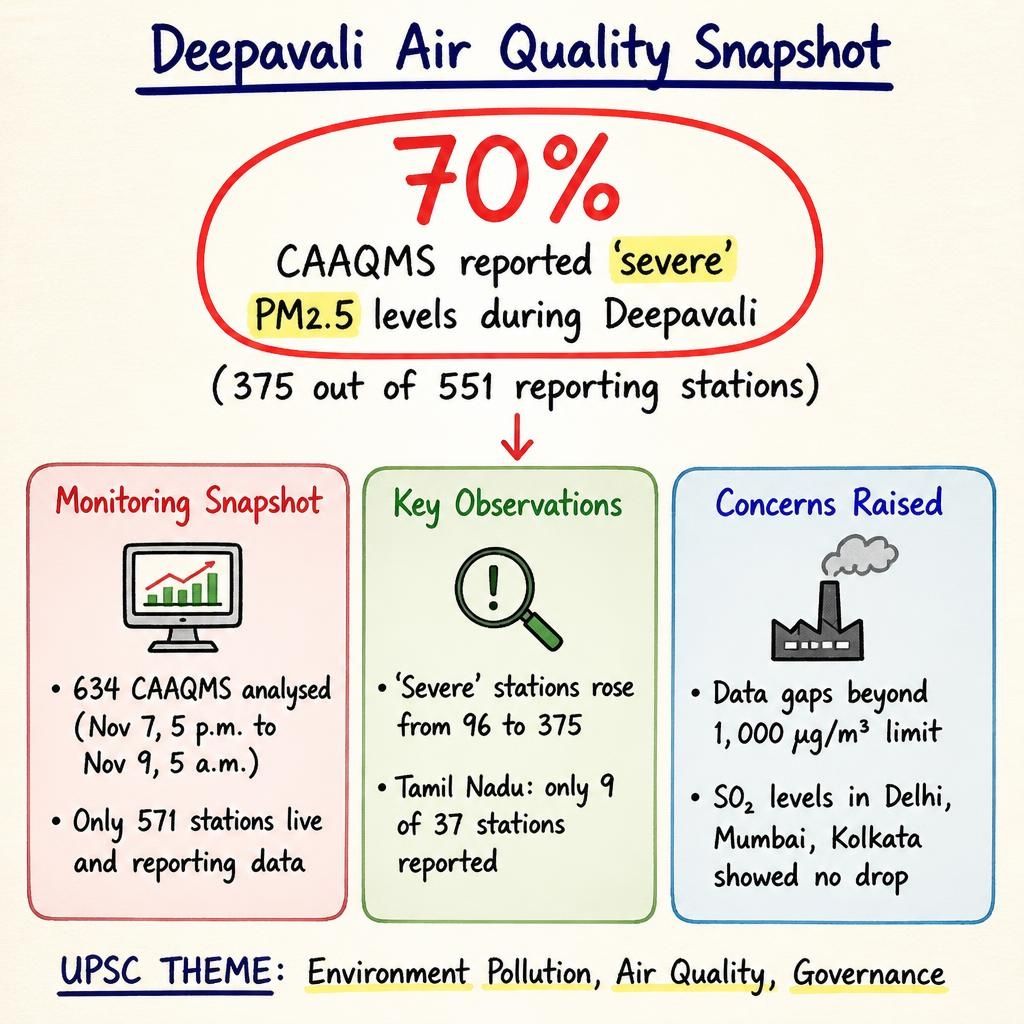
- Out of 551 reporting stations, 375 recorded PM2.5 values of 250 micrograms per cubic metre or more at least once during Deepavali.
- The Central Pollution Control Board (CPCB) stated that data gaps occurred when PM2.5 values exceeded the 1,000 micrograms per cubic metre analyser calibration limit.
- States including Maharashtra, Uttar Pradesh, Rajasthan, Haryana, Madhya Pradesh, Gujarat, and Andhra Pradesh also experienced widespread severe pollution.
- Sulphur Dioxide (SO2) levels in Delhi, Mumbai, and Kolkata showed no significant drop, questioning the effectiveness of green crackers.
Air Quality Snapshot.jpg
Detailed Insights:
- The analysis covered 634 CAAQMS in the CPCB network, focusing on the Deepavali period from November 7 (5 p.m.) to November 9 (5 a.m.).
- Only 571 of the 634 stations were live and reporting data during Deepavali, indicating potential operational issues within the monitoring network.
- The number of stations reporting 'severe' PM2.5 significantly increased from 96 in the pre-Deepavali window to 375 during Deepavali.
- Tamil Nadu showed a notable absence of data, with only 9 out of 37 stations reporting PM2.5 levels at least once during the hourly windows.
- The CPCB clarified that its automated data validation system ignores values outside the 1,000 micrograms per cubic metre range, leading to apparent data gaps during extreme pollution episodes.
- The consistent SO2 levels in major cities suggest that the intended environmental benefits of 'green crackers' in reducing gaseous emissions may not be fully realized.
Key Concepts Involved:
- PM2.5: Fine particulate matter with a diameter of 2.5 micrometers or less, capable of penetrating deep into the lungs and bloodstream.
- Continuous Ambient Air Quality Monitoring Stations (CAAQMS): Automated systems that continuously measure and record various air pollutants in real-time.
- Central Pollution Control Board (CPCB): A statutory organization under the Ministry of Environment, Forest and Climate Change, responsible for pollution control and monitoring in India.
- Severe Air Quality: An air quality category where PM2.5 concentrations are 250 micrograms per cubic metre or above, indicating serious health impacts.

SuperKalam is your personal mentor for UPSC preparation, guiding you at every step of the exam journey.
Download the App


STUDY RESOURCES
CONTACT US
ⓒ Snapstack Technologies Private Limited