GS 3: Environment & EcologyPrelimsGS 3: Conservation, Pollution and DegradationGS 1: Changes in Critical Geographical Features, Water Bodies, Ice Caps, Flora and Fauna
Wild buffalo species return to MP after 100 yrs, Pg9
Eight wild buffaloes from Kaziranga National Park reintroduced to Madhya Pradesh's Kanha Tiger Reserve after a century, marking a significant conservation effort.
Practice MCQs
876 Students attempted
Key Highlights:
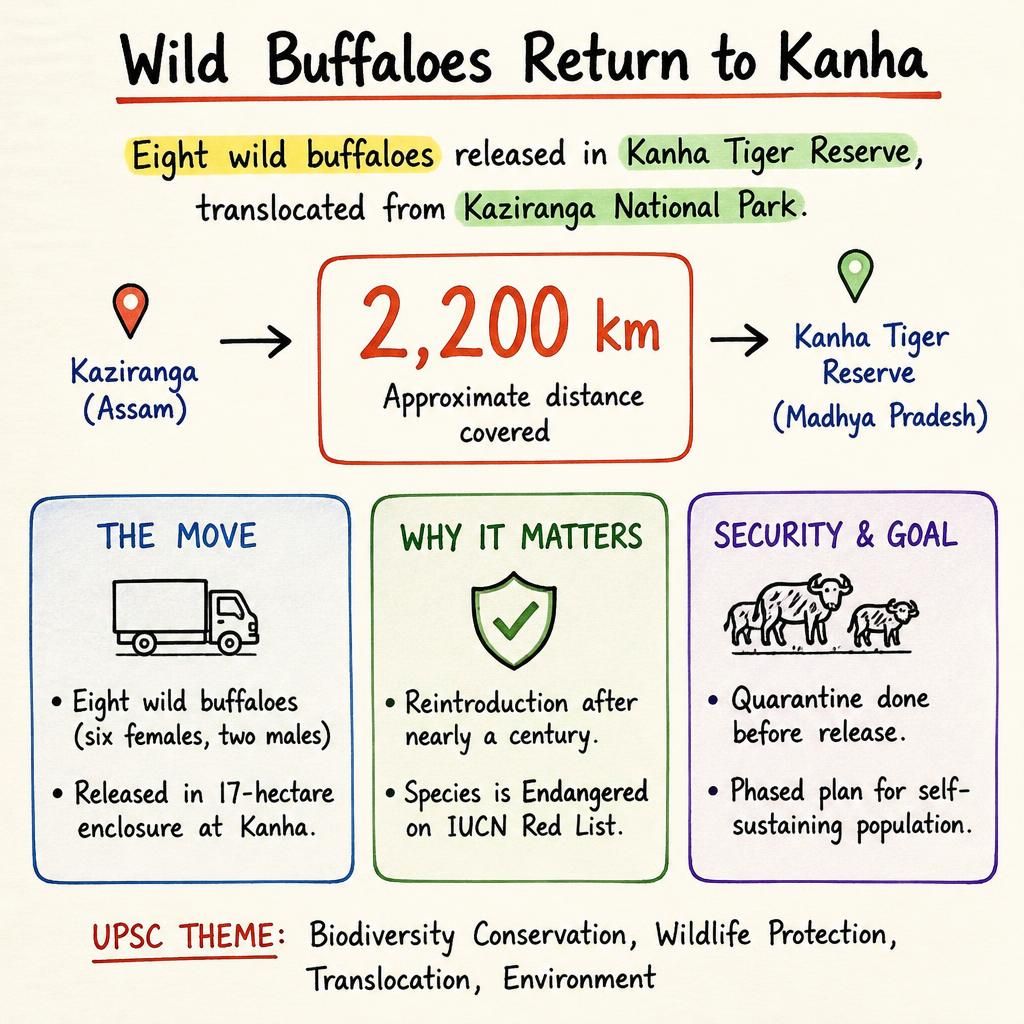
- Eight wild buffaloes, comprising six females and two males, were released into a 17-hectare enclosure at Kanha Tiger Reserve in Madhya Pradesh.
- The buffaloes were translocated from Kaziranga National Park in Assam, covering a distance of approximately 2,200 km.
- This initiative marks an effort to reintroduce the species to Madhya Pradesh after an absence of nearly a century.
- The reintroduction was carried out by Madhya Pradesh Chief Minister Mohan Yadav, with support from Assam Chief Minister Himanta Biswa Sarma.
Wild Buffaloes Return.jpg
Detailed Insights:
- The wild water buffalo (Bubalus arnee) is classified as Endangered on the IUCN Red List since 1986, with a global population estimated at less than 4,000 mature individuals.
- India is home to over 90% of the world's wild buffalo population, predominantly in Assam, making Kaziranga National Park a vital source for such reintroduction programs.
- Kanha Tiger Reserve, established as a national park in 1955 and designated a Project Tiger reserve in 1973, is renowned for its rich biodiversity and successful conservation efforts, including the hard-ground Barasingha.
- The translocated buffaloes underwent a quarantine period before their release and are part of a broader, phased conservation strategy aimed at establishing a self-sustaining breeding population in central India.
- The wild buffalo is listed under Schedule I of the Indian Wild Life (Protection) Act, 1972, indicating its highest level of protection and conservation priority.
Key Concepts Involved:
- Reintroduction: The process of releasing a species into an area where it previously existed but had become locally extinct.
- Ex-situ conservation: The conservation of species outside their natural habitats, often involving breeding programs and translocation to new areas.
- In-situ conservation: The conservation of species within their natural habitats, such as in national parks and wildlife sanctuaries.
- IUCN Red List: A global inventory assessing the conservation status of biological species, categorizing them based on extinction risk.

SuperKalam is your personal mentor for UPSC preparation, guiding you at every step of the exam journey.
Download the App


STUDY RESOURCES
CONTACT US
ⓒ Snapstack Technologies Private Limited