GS 2: GovernanceGS 3: Science & TechnologyGS 3: EconomyPrelimsGS 3: Inclusive Growth
The AI challenge: How to maximise economic impact, spread gains evenly, Pg10
India poised to leverage Artificial Intelligence for widespread economic growth and productivity gains, building on its digital public infrastructure success.
Practice MCQs
876 Students attempted
Key Highlights:
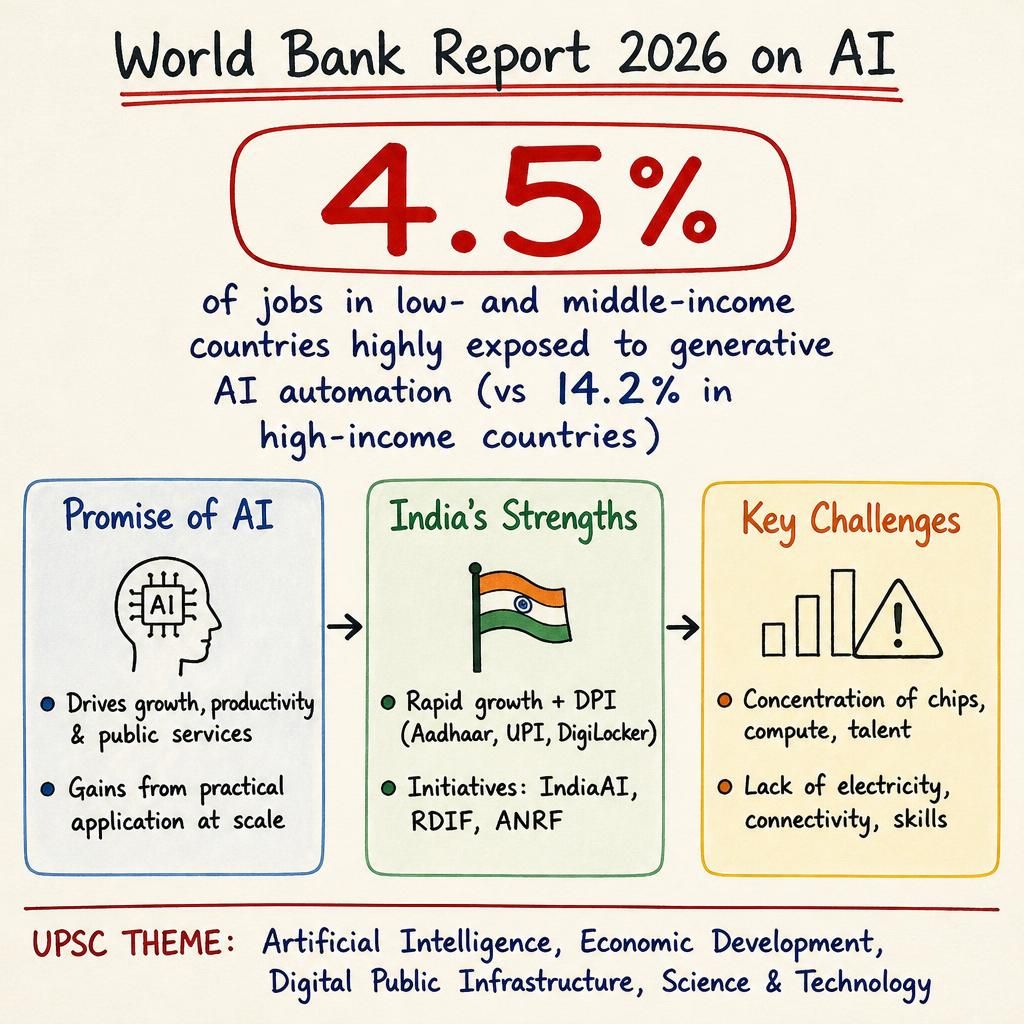
- The World Bank Group’s ‘World Development Report 2026: The Promise of Artificial Intelligence’ emphasizes AI's potential for growth, productivity, public services, and opportunity.
- The report suggests major AI gains will come from practical application at scale, not solely from building frontier models.
- Only 4.5% of jobs in low- and middle-income countries are highly exposed to generative AI automation, compared to 14.2% in high-income countries.
- India is well-positioned to leverage AI due to its rapid economic growth and experience with population-scale technology deployment via digital public infrastructure.
- Key challenges for AI adoption include concentration of resources (chips, compute, talent) and lack of complementary investments (electricity, connectivity, skills).
- Initiatives like IndiaAI, Research, Development and Innovation Fund (RDIF), and Anusandhan National Research Foundation (ANRF) are crucial for India's AI advancement.
AI Report.jpg
Detailed Insights:
- The global AI narrative often overemphasizes intelligence generation, leading to a narrow focus on model-building companies.
- Economic value from general-purpose technologies historically accrues significantly to downstream users who adapt and diffuse them.
- India's Digital Public Infrastructure (e.g., Aadhaar, UPI, DigiLocker) demonstrates successful technology deployment at scale, reducing costs and fostering innovation.
- For developing countries, AI is more likely to complement workers, enhancing capabilities in agriculture, healthcare, education, and public administration.
- Examples like Bharat VISTAAR (digital platform for farmers) and Wadhwani AI’s tuberculosis-screening tools show AI's tangible benefits in India.
- India's approach should prioritize open architectures, similar to UPI, to promote competition and avoid technological lock-in.
- Strategic capabilities for India include domestic research, Indian-language models, shared compute resources, and a stronger deep-tech investment ecosystem.
- The IndiaAI Mission is a central-sector scheme approved in March 2024 with an outlay of ₹10,371.92 crore over five years to build India's AI ecosystem.
- The Research, Development and Innovation Fund (RDIF) is a ₹1 lakh crore initiative launched in November 2025 to strengthen deep-tech R&D, operating under the Department of Science and Technology (DST) and ANRF.
- The Anusandhan National Research Foundation (ANRF), established by the ANRF Act, 2023, is India's apex body for funding and directing scientific research and innovation.
- Three principles for India's AI strategy are designing for scale, evidence-based testing, and scaling successful initiatives while discontinuing ineffective ones.
Key Concepts Involved:
- Digital Public Infrastructure (DPI): Shared digital platforms and systems (like Aadhaar, UPI) that enable public and private services at scale.
- Generative AI: Artificial intelligence capable of producing new content, such as text, images, or other data, often based on learned patterns.
- Technology Readiness Level (TRL): A measurement system used to assess the maturity of a particular technology, typically from TRL 1 (basic principles observed) to TRL 9 (actual system proven in operational environment).
- Deep-tech: Technologies based on substantial scientific or engineering breakthroughs, often requiring significant R&D investment and longer development cycles.

SuperKalam is your personal mentor for UPSC preparation, guiding you at every step of the exam journey.
Download the App


STUDY RESOURCES
CONTACT US
ⓒ Snapstack Technologies Private Limited