GS 2: International RelationsGS 3: EconomyPrelimsGS 2: Effect of Policies and Politics of Developed and Developing Countries on India's InterestsGS 2: Indian Diaspora
What are the changes proposed to U.S. H-1B programme?, Pg11
U.S. government proposes stringent H-1B, OPT, Green Card reforms, tightening rules for Indian tech workers, students, and spouses, impacting millions.
Practice MCQs
855 Students attempted
Key Highlights:
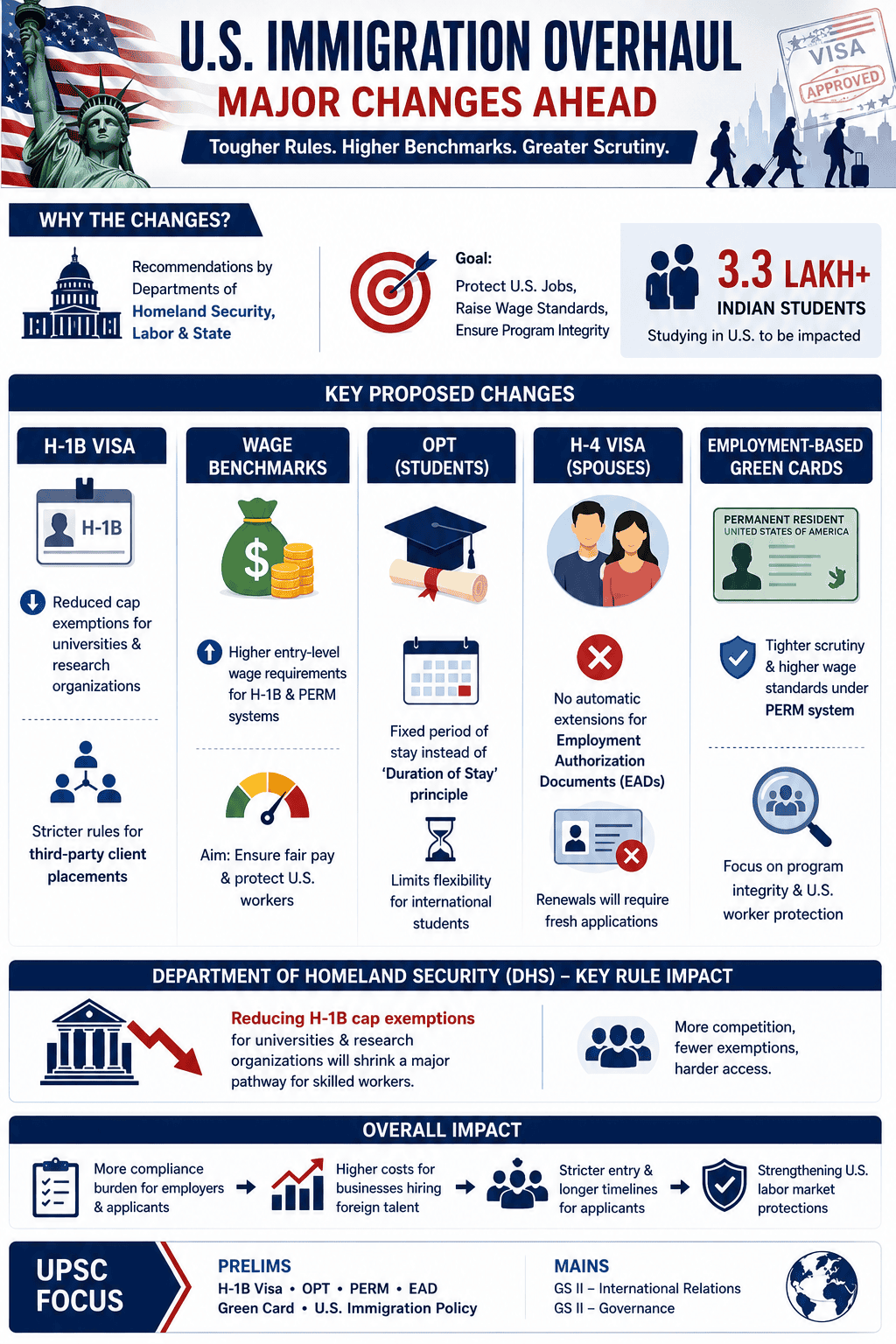
- The U.S. government is introducing significant changes to its immigration programs, including the H-1B work visa, Optional Practical Training (OPT), and employment-based Green Cards.
- These changes stem from recommendations by the Departments of Homeland Security, Labor, and State under their Unified Regulatory Agendas.
- Proposed alterations include reducing H-1B cap exemptions for universities, stricter rules for third-party client placements, and increased entry-level wage benchmarks for H-1B and PERM systems.
- International students will face fixed periods of stay instead of the 'duration of stay' principle, impacting the 3.3 lakh Indian students in the U.S.
- Spouses of H-1B workers on H-4 visas will no longer receive automatic extensions for their Employment Authorization Documents (EADs).
US Immigration.png
Detailed Insights:
- The Department of Homeland Security (DHS) rule will reduce H-1B cap exemptions for universities and research organizations, impacting a common pathway for skilled workers.
- Stricter requirements for H-1B workers at third-party client sites will particularly affect Indian IT and consulting firms, which frequently use this model.
- Companies placing H-1B workers at client sites must now prove a genuine employer-employee relationship and specialized work, alongside more detailed documentation.
- The Department of Labor proposes increasing the entry-level wage benchmark for H-1B and PERM from the 17th to the 34th percentile, making Green Cards more expensive.
- The shift from 'duration of stay' to fixed periods for international students will necessitate extensions for continued study or stay, affecting a large Indian student population.
- Tighter rules for the OPT system, including the two-year STEM OPT extension and Curricular Practical Training (CPT), are set to come into effect by February 2027.
- The cessation of automatic EAD extensions for H-4 visa holders could lead to work permit loss if renewals are delayed.
Key Concepts Involved:
- H-1B visa: A non-immigrant visa that allows U.S. employers to temporarily employ foreign workers in specialty occupations.
- Optional Practical Training (OPT): A period during which international students in the U.S. can work in their field of study.
- Program Electronic Review Management (PERM): The first step in the process for U.S. employers to obtain a labor certification for foreign workers seeking permanent residency.
- Green Card: An identification card issued to permanent residents of the U.S., granting them the right to live and work permanently in the country.
- H-4 visa: A non-immigrant visa issued by the U.S. Citizenship and Immigration Services to immediate family members of H-1B visa holders.
- Employment Authorization Document (EAD): A document issued by the U.S. government that provides temporary employment authorization to non-citizens in the U.S.

SuperKalam is your personal mentor for UPSC preparation, guiding you at every step of the exam journey.
Download the App


STUDY RESOURCES
CONTACT US
ⓒ Snapstack Technologies Private Limited