EthicsGS 2: PolityGS 3: Science & TechnologyPrelimsGS 2: Structure and Functioning of Executive and Judiciary
Role of AI is only to assist, not to judge, says CJI Surya Kant, Pg11
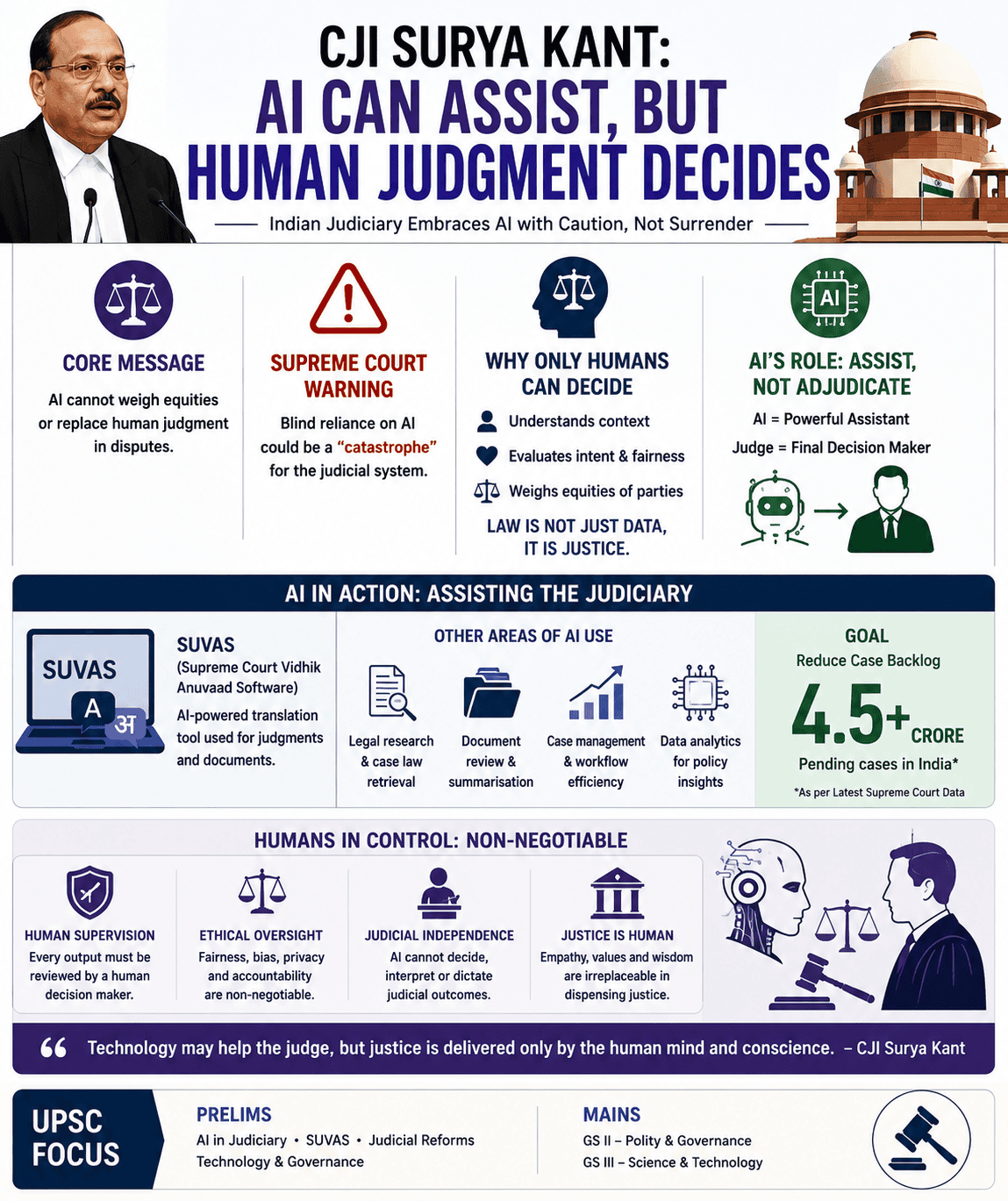
CJI Surya Kant cautions against AI's judicial role, emphasizing assistance over judgment, following tribunal's reliance on "AI-hallucinated verdicts."
Practice MCQs
855 Students attempted
Key Highlights:
- CJI Surya Kant stated that Artificial Intelligence (AI) should serve only as an assistant in judicial processes, not as a decision-maker.
- He emphasized that AI's role is limited to procedural tasks like triaging disputes, organizing evidence, or drafting initial translations.
- The caution follows a recent incident where a Tribunal relied on "AI-hallucinated verdicts" to decide a case.
- The Supreme Court has advocated for "zero-tolerance" towards uncritical dependence on machine intelligence in judicial decisions.
AI in Courts.png
Detailed Insights:
- CJI Surya Kant delivered these remarks at a summit organized by the Indian Institute of Arbitration and Mediation.
- He clarified that AI lacks the authority to weigh the equities of opposing parties, which is a core function of human judgment.
- The Supreme Court has previously warned that blind reliance on AI could lead to a "catastrophe" for the judicial system.
- AI tools like SUVAS (Supreme Court Vidhik Anuvaad Software) are already used for translation, demonstrating AI's assistive potential in the judiciary.
- The Indian judiciary is exploring AI to enhance efficiency and reduce case backlogs, but with a clear emphasis on human supervision and ethical oversight.
Key Concepts Involved:
- Artificial Intelligence (AI): The simulation of human intelligence processes by machines, especially computer systems, for tasks like learning, problem-solving, and decision-making.
- Judicial Process: The formal procedures and stages involved in legal proceedings and the administration of justice within a court system.
- AI Hallucination: A phenomenon where an AI model generates outputs that are plausible but factually incorrect, nonsensical, or not based on its training data.
- Arbitration and Mediation: Alternative Dispute Resolution (ADR) methods where parties resolve conflicts outside of traditional court litigation, often facilitated by a neutral third party.

SuperKalam is your personal mentor for UPSC preparation, guiding you at every step of the exam journey.
Download the App


STUDY RESOURCES
CONTACT US
ⓒ Snapstack Technologies Private Limited