GS 2: GovernanceGS 3: Environment & EcologyGS 3: EconomyPrelimsGS 3: Conservation, Pollution and Degradation
SC Panel: Phase Out 'Unsustainable' River Sand Mining In 3 Yrs, Pg12
SC panel mandates phasing out unsustainable river sand mining in three years, urging dam desilting to restore reservoir capacity and meet construction material demand.
Practice MCQs
876 Students attempted
Key Highlights:
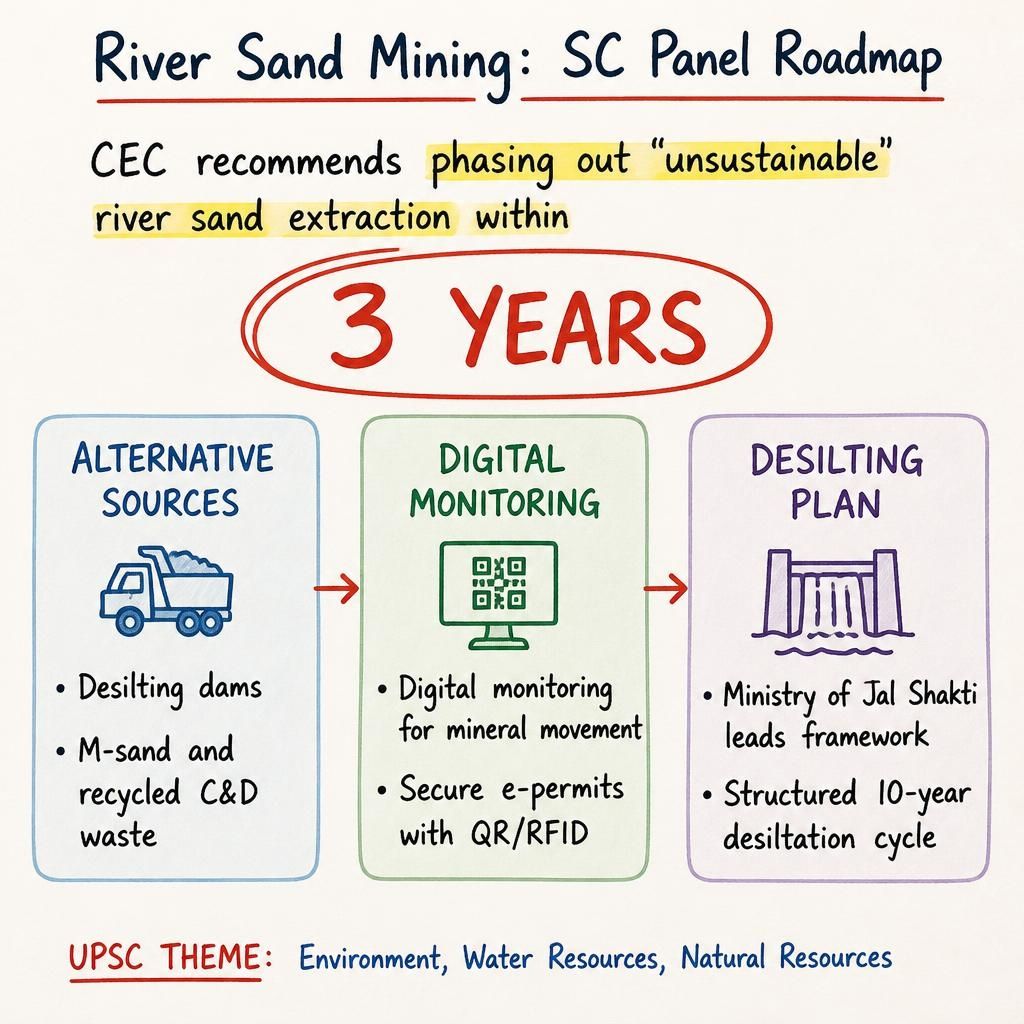
- The Supreme Court-appointed Central Empowered Committee (CEC) recommended phasing out "unsustainable" river sand extraction within three years.
- The CEC proposed alternative sources for construction, including desilting dams, M-sand, and recycled construction and demolition waste.
- This recommendation is part of CEC's Report No. 36 of 2026, submitted in a suo motu case concerning illegal sand mining in the National Chambal Sanctuary.
- The committee also suggested implementing a digital monitoring system for mineral movement, utilizing secure electronic transit permits with QR/barcodes or RFID-based identification.
- The Ministry of Jal Shakti is tasked with leading a national framework for reservoir desilting, aiming for a structured 10-year desiltation cycle for suitable reservoirs.
River Sand Mining.jpg
Detailed Insights:
- The Supreme Court expanded the National Chambal Sanctuary proceedings to cover river sand mining across the country, citing its "disastrous effect" on river ecosystems.
- Desilting dams serves the dual purpose of restoring reservoir storage capacity and meeting the growing demand for construction materials.
- Data from the Ministry of Jal Shakti (March 2025) indicated an average 19.24% live storage loss due to sedimentation in 43 assessed reservoirs, with 23 having lost over half their capacity.
- Gobind Sagar, the reservoir behind the Bhakra Dam, has reportedly shrunk by 4,100 million cubic metres, losing 41% of its original capacity.
- Sand, classified as a minor mineral, and water are subjects under the legislative and administrative jurisdiction of state governments.
- The CEC recommended that all storage dams over 25 years old, which have not been systematically desilted, should undergo the process, with recovered sediment sold through transparent mechanisms.
Key Concepts Involved:
- Central Empowered Committee (CEC): An advisory body to the Supreme Court on matters related to forests and environmental protection.
- Suo motu: A legal action initiated by a court on its own accord, without a formal petition from any party.
- M-sand (Manufactured Sand): A fine aggregate produced by crushing and processing suitable rock, serving as a substitute for natural river sand in construction.
- Minor Mineral: Minerals specified in the Schedule to the Mines and Minerals (Development and Regulation) Act, 1957, whose regulation falls under state governments.
- RFID (Radio-Frequency Identification): A technology that uses electromagnetic fields to automatically identify and track tags attached to objects.

SuperKalam is your personal mentor for UPSC preparation, guiding you at every step of the exam journey.
Download the App


STUDY RESOURCES
CONTACT US
ⓒ Snapstack Technologies Private Limited