GS 2: GovernanceGS 2: PolityGS 2: Social JusticePrelimsGS 2: Government policies and interventions for development in various sectors
OBC Reservation: What Determines Creamy Layer Status, Pg16
Supreme Court reaffirms its landmark ruling: parental salary alone cannot determine OBC creamy layer status, mandating Centre to implement for future selections.
Practice MCQs
876 Students attempted
Key Highlights:
- The Supreme Court reaffirmed its March judgment that parental salary alone cannot determine the creamy layer status for Other Backward Classes (OBCs).
- Individuals falling under the creamy layer are not entitled to OBC reservation benefits.
- The Court clarified that a 2004 clarification by the Department of Personnel and Training (DoPT), which included salary income from PSUs and the private sector for creamy layer determination, cannot override the original 1993 Office Memorandum (OM).
- The March verdict's interpretation will govern service allocation for Civil Services Examination (CSE) 2025 candidates, but it does not retrospectively reopen concluded selections.
- The Court emphasized that the status and category of the parent's post, along with the income/wealth test (excluding salary income), are essential for determining creamy layer status.
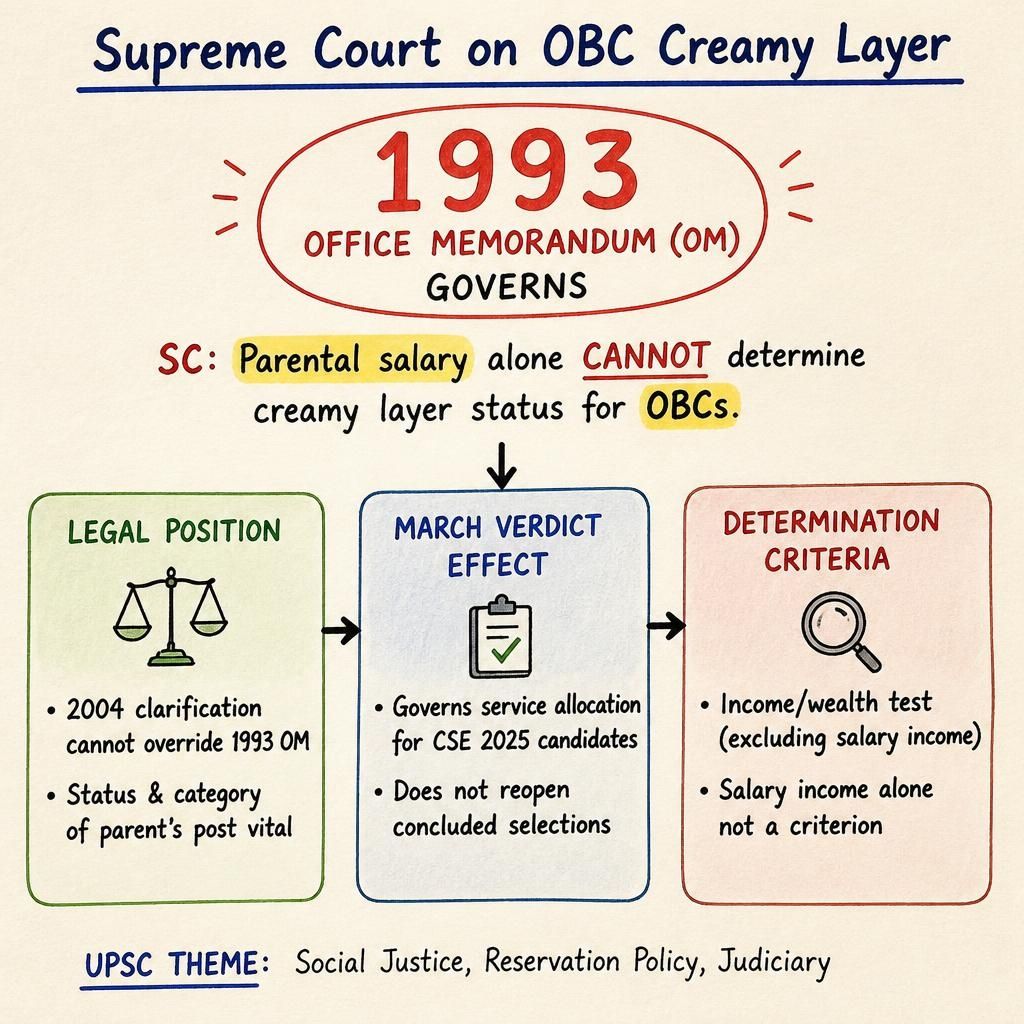
OBC Creamy Layer.jpg
Detailed Insights:
- The concept of the creamy layer was introduced following the landmark 1992 Supreme Court ruling in Indra Sawhney vs Union of India, which upheld OBC reservation but mandated the exclusion of advanced sections.
- The 1993 DoPT OM specified criteria for identifying the creamy layer, including constitutional posts, Group-A/Class-I officers, professionals, property owners, and an income/wealth test, explicitly excluding income from salary and agricultural land.
- A 2004 DoPT clarification began rigorously applying salary income of PSU and private sector employees as a criterion if "equivalence" of posts was not determined, leading to their children being classified as creamy layer if salaries crossed the prescribed limit for three consecutive years.
- The Supreme Court's March judgment held that treating children of PSU and private employees differently from government servants in similar posts amounted to "hostile discrimination."
- The Court ruled that a clarificatory letter, like the 2004 one, cannot introduce substantive conditions not present in the parent policy, i.e., the 1993 OM.
- The recent clarification by the Supreme Court ensures that selections, appointments, and roster allotments will follow the 1993 OM as interpreted, meaning salary income alone cannot be the sole criterion.
- For cases where post equivalence has not been established, children of PSU and private-sector employees must be assessed under the income/wealth test, which specifically excludes salary income.
Key Concepts Involved:
- Creamy Layer: The relatively affluent and advanced sections within Other Backward Classes (OBCs) who are excluded from reservation benefits.
- OBC Reservation: A system providing affirmative action, typically 27% reservation, for Other Backward Classes in government jobs and educational institutions.
- Indra Sawhney vs Union of India: A landmark 1992 Supreme Court judgment that upheld OBC reservation but introduced the concept of the creamy layer for exclusion.
Previous9/9

SuperKalam is your personal mentor for UPSC preparation, guiding you at every step of the exam journey.
Download the App


STUDY RESOURCES
CONTACT US
ⓒ Snapstack Technologies Private Limited