GS 2: GovernanceGS 3: Environment & EcologyGS 3: EconomyGS 3: Indian Economy, Planning, Mobilization of Resources, Growth, Development and EmploymentGS 3: Infrastructure: Energy, Ports, Roads, Airports, Railways etc.
Discoms' finance concern amid energy storage mandate, Pg15
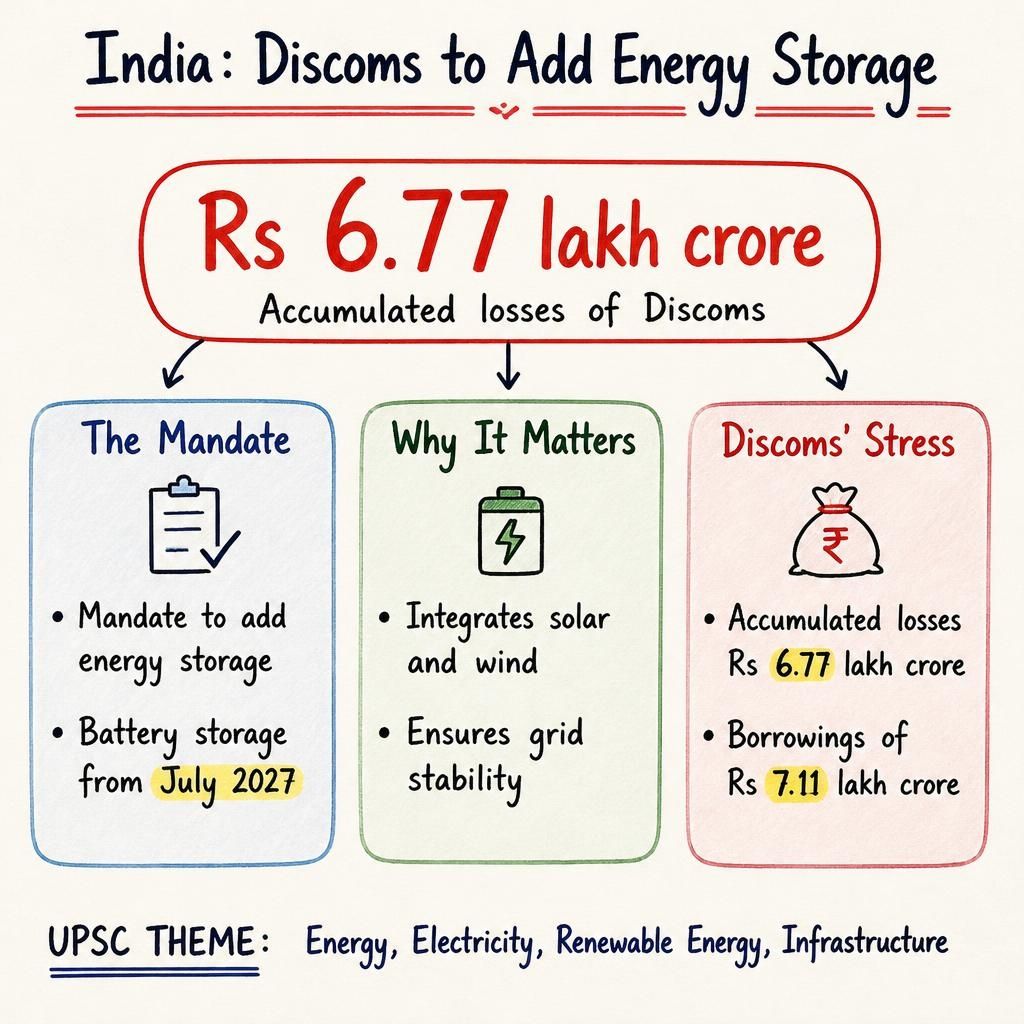
Financially stressed Discoms face massive investment burden from government's new energy storage mandate, risking further debt amid Rs 7.11 lakh crore borrowings.
Practice MCQs
876 Students attempted
Key Highlights:
- The Indian government is formulating a mandate requiring electricity distribution utilities (Discoms) to add energy storage capacity.
- Concerns are emerging regarding the financial capacity of already stressed Discoms to bear this additional investment burden.
- Discoms currently face accumulated losses of Rs 6.77 lakh crore and borrowings of Rs 7.11 lakh crore.
- Energy storage systems are crucial for integrating intermittent renewable energy sources like solar and wind into the power grid.
- The government has already proposed making battery storage mandatory for all new government solar and wind projects from July 2027.
Discoms.jpg
Detailed Insights:
- The proposed mandate aims to address the demand-supply mismatch caused by the increasing share of intermittent renewable energy in India's power mix.
- Energy storage allows for storing surplus electricity generated during peak renewable production and releasing it when demand rises or generation falls, ensuring grid stability.
- The weak financial health of Discoms often leads to higher borrowing costs, which could further exacerbate their debt-servicing burden with new infrastructure investments.
- India's ambitious renewable energy targets necessitate robust energy storage solutions for effective grid integration and enhanced reliability of power supply.
- The Revamped Distribution Sector Scheme (RDSS) is a government initiative aimed at improving the operational efficiencies and financial sustainability of Discoms.
- The National Energy Storage Mission (NESM) promotes the development, manufacturing, and deployment of energy storage technologies in India.
Key Concepts Involved:
- Electricity Distribution Utilities (Discoms): Entities responsible for the last-mile delivery of electricity from transmission networks to end-consumers.
- Intermittent Renewable Energy: Power sources like solar and wind that generate electricity variably depending on natural conditions.
- Energy Storage Systems: Technologies designed to capture energy produced at one time for use at a later time, balancing supply and demand on the grid.
- Grid Stability: The ability of an electrical power system to maintain continuous operation and recover from disturbances.

SuperKalam is your personal mentor for UPSC preparation, guiding you at every step of the exam journey.
Download the App


STUDY RESOURCES
CONTACT US
ⓒ Snapstack Technologies Private Limited