GS 2: GovernanceGS 2: Social JusticeGS 3: EconomyPrelimsGS 3: Economics of Animal Rearing
As demand overtakes supply, a big fat problem, Pg10
India faces a severe milk fat shortage as demand outstrips supply, driven by changing production patterns and increased consumer awareness, despite overall milk surplus.
Practice MCQs
876 Students attempted
Key Highlights:
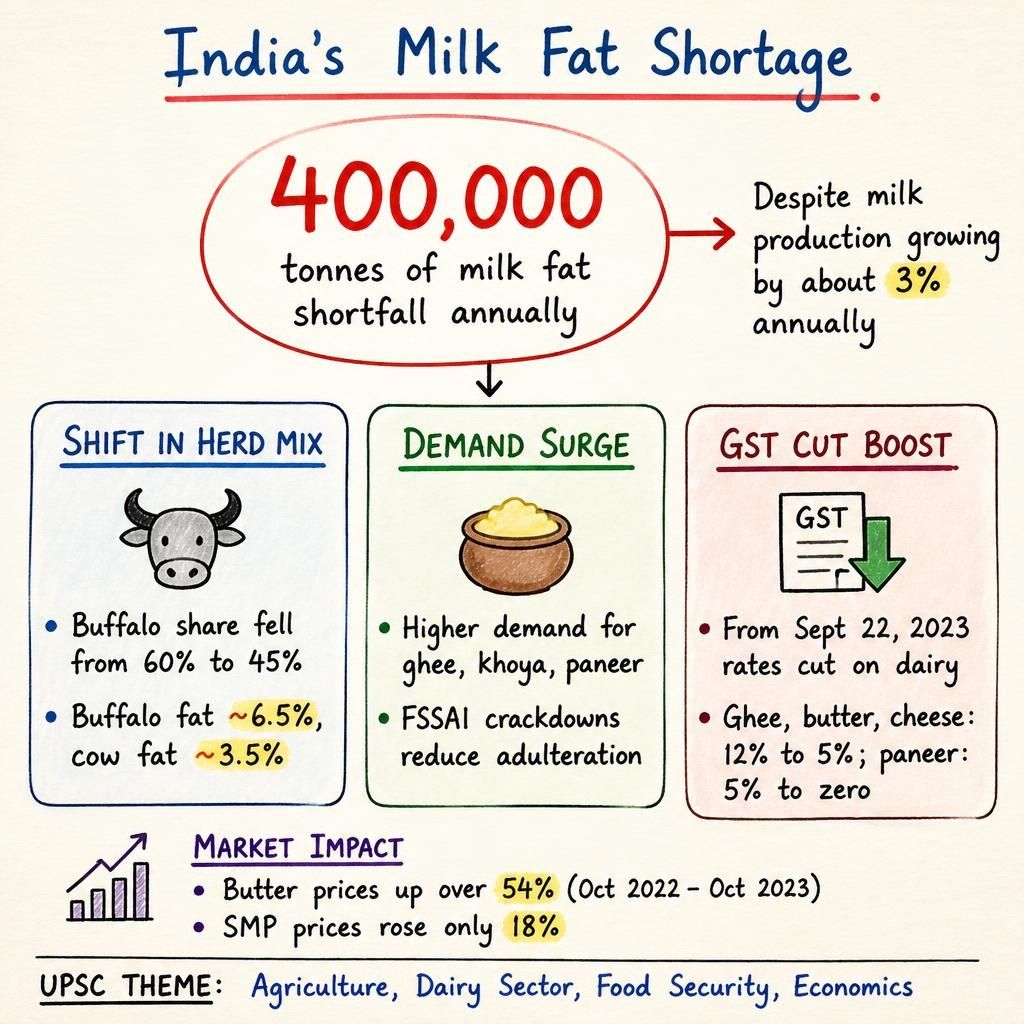
- India is facing a significant shortage of milk fat, despite overall milk production growing by about 3% annually over the past decade.
- This shortage is driven by a shift in milk production from buffaloes to cows; buffaloes, which contributed 60% of national milk output three decades ago, now contribute only about 45%.
- Buffalo milk has a higher fat content (around 6.5%) compared to cow milk (around 3.5%), leading to less total fat being produced.
- Increased demand for genuine dairy products like ghee, khoya, and paneer has resulted from rising incomes, consumer awareness, and crackdowns on adulteration by bodies like the Food Safety and Standards Authority of India (FSSAI).
- Recent Goods and Services Tax (GST) rate cuts in September 2023 on dairy products further stimulated demand; for instance, ghee, butter, and cheese saw rates reduced from 12% to 5%, and paneer from 5% to zero.
- The deficit is evident in market prices, with average ex-dairy prices of butter soaring over 54% between October 2022 and October 2023, while Skimmed Milk Powder (SMP) prices rose only 18%.
Milk Fat Shortage.jpg
Detailed Insights:
- The FSSAI crackdowns, particularly after the Tirupati laddu scandal in September 2023, have reduced the supply of adulterated products, increasing demand for authentic milk fat products.
- The shift from buffalo to cow milk is partly due to higher milk yields from crossbred cows compared to buffaloes, making them more attractive to dairy farmers.
- This change in livestock composition has led to an estimated annual shortfall of about 400,000 tonnes of milk fat compared to what would have been produced with the older herd mix.
- The growing reliance on cow milk to meet fat demand also results in a surplus production of Solids-Not-Fat (SNF), primarily Skimmed Milk Powder (SMP), for which domestic market expansion is slower.
- India, while being the world's top milk producer, faces an imbalance where it could be surplus in SMP but deficient in milk fat.
- The GST rationalization, effective September 22, 2023, aimed to support the dairy sector and benefit both farmers and consumers by making dairy products more affordable.
Key Concepts Involved:
- Food Safety and Standards Authority of India (FSSAI): A statutory body under the Ministry of Health & Family Welfare responsible for protecting and promoting public health through the regulation and supervision of food safety.
- Goods and Services Tax (GST): An indirect tax levied on the supply of goods and services, which replaced multiple cascading taxes levied by the central and state governments.
- Solids-Not-Fat (SNF): All components of milk except water and butterfat, including proteins, lactose, vitamins, and minerals, contributing to milk's nutritional value.
- Skimmed Milk Powder (SMP): A dairy product made by evaporating pasteurized skimmed milk, retaining proteins, lactose, and minerals but with significantly reduced fat content.

SuperKalam is your personal mentor for UPSC preparation, guiding you at every step of the exam journey.
Download the App


STUDY RESOURCES
CONTACT US
ⓒ Snapstack Technologies Private Limited