GS 3: Science & TechnologyPrelimsGS 3: BiotechnologyGS 3: Science and Technology in Everyday LifeGS 2: Health Sector
What was the Chemistry Nobel Prize given for?, Pg12
Nobel Prize in Chemistry awarded for groundbreaking work on amplifying molecular handedness, revolutionizing pharmaceutical purity and offering clues to life's origins.
Practice MCQs
869 Students attempted
Key Highlights:
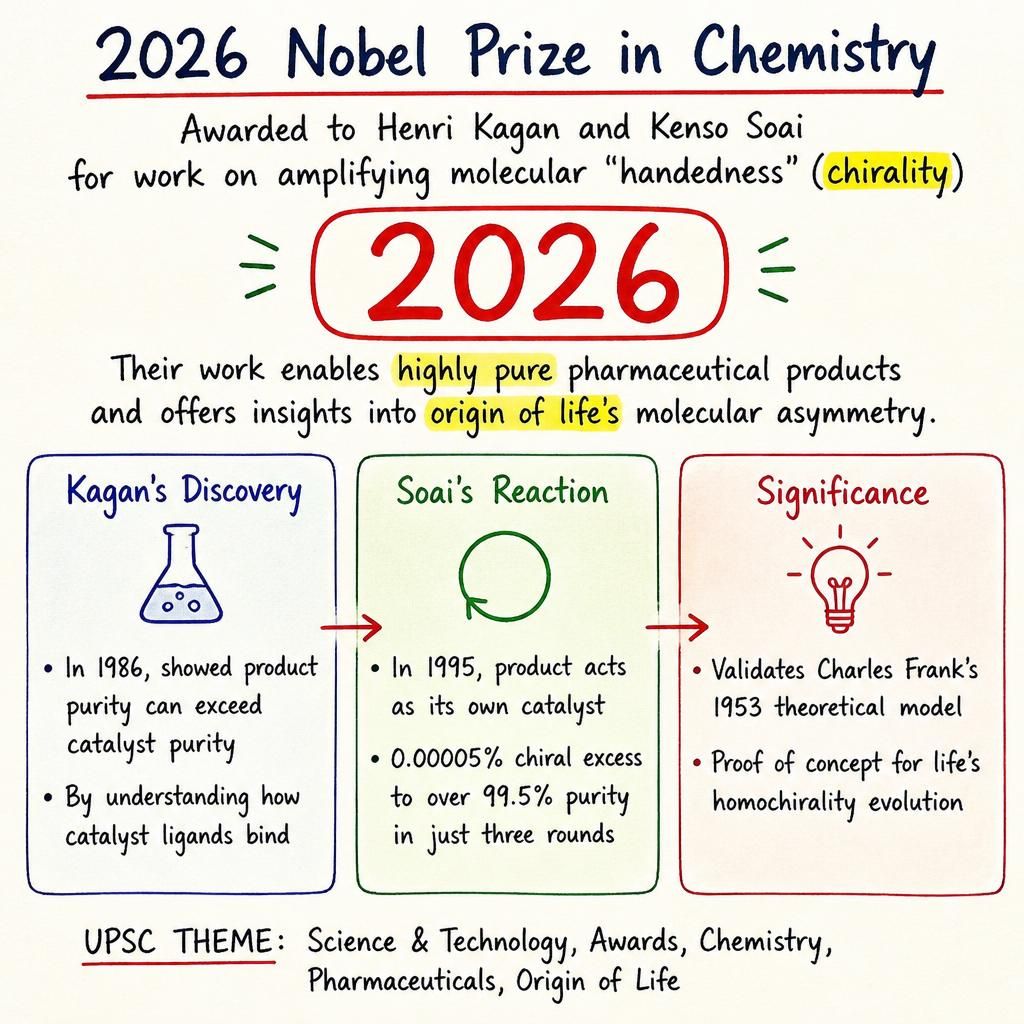
- The 2026 Nobel Prize in Chemistry was awarded to Henri Kagan and Kenso Soai for their work on amplifying molecular "handedness" (chirality).
- Their discoveries enable the production of highly pure pharmaceutical products and offer insights into the origin of life's molecular asymmetry.
- Kagan demonstrated in 1986 that product purity can exceed catalyst purity by understanding how catalyst ligands bind, overturning previous assumptions.
- Soai, in 1995, developed a reaction where the product acts as its own catalyst, exponentially amplifying chirality from a minute initial imbalance or even from non-chiral starting materials.
- This work experimentally validated Charles Frank's 1953 theoretical model for the emergence of homochirality in biological molecules.
Nobel Prize in Chemistry.jpg
Detailed Insights:
- Chirality, or "handedness," is a fundamental property of molecules that are non-superimposable on their mirror images, similar to human hands.
- In living organisms, essential molecules like amino acids and sugars exhibit homochirality, meaning they predominantly exist in one specific "handed" form.
- Ordinary laboratory reactions typically produce equal mixtures of both mirror-image forms, known as racemates.
- The pharmaceutical industry critically relies on producing single-handed molecules because different enantiomers of a drug can have vastly different, sometimes harmful, biological effects (e.g., thalidomide).
- Frank's model proposed that homochirality could arise from a combination of autocatalysis, enantioselective catalysis, and mutual antagonism between enantiomers.
- Kagan's discovery of "non-linear effects" showed that a catalyst's minority enantiomer can be effectively sidelined, allowing the majority enantiomer to drive the reaction to higher purity.
- Soai's reaction demonstrated extreme amplification, converting a 0.00005% chiral excess to over 99.5% purity in just three rounds, a 630,000-fold amplification.
- While Soai's reaction provides a proof of concept for how life's homochirality might have evolved, it uses conditions different from the early Earth's "prebiotic soup."
Scientific/Technical Concepts Involved:
- Chirality: A geometric property of a molecule that makes it non-superimposable on its mirror image.
- Enantiomers: Two molecules that are non-superimposable mirror images of each other, often referred to as "left-handed" and "right-handed" forms.
- Homochirality: The property where a collection of chiral molecules predominantly consists of only one enantiomeric form.
- Autocatalysis: A chemical reaction where one of the products acts as a catalyst for the same reaction, accelerating its own formation.
- Enantioselective Catalysis: A type of catalysis where a chiral catalyst preferentially forms one enantiomer over the other in a reaction.

SuperKalam is your personal mentor for UPSC preparation, guiding you at every step of the exam journey.
Download the App


STUDY RESOURCES
CONTACT US
ⓒ Snapstack Technologies Private Limited