GS 3: Science & TechnologyPrelimsGS 3: BiotechnologyGS 3: Science and Technology in Everyday LifeGS 2: Health Sector
What made optogenetics research Nobel-worthy?, Pg12
Nobel Prize awarded for optogenetics, a revolutionary technique using light-gated ion channels to map brain functions, offering new insights into neurological disorders.
Practice MCQs
869 Students attempted
Key Highlights:
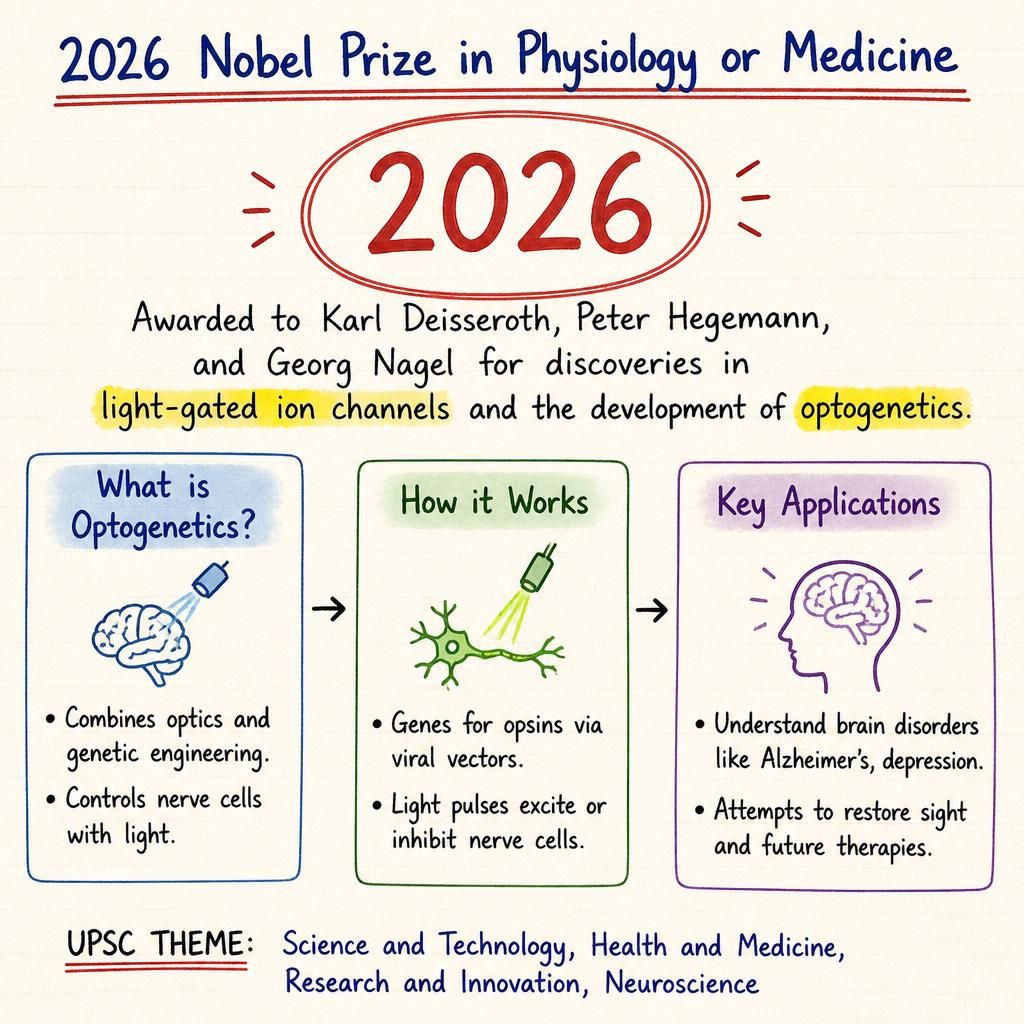
- The 2026 Nobel Prize in Physiology or Medicine was jointly awarded to Karl Deisseroth, Peter Hegemann, and Georg Nagel.
- They were recognized for their discoveries concerning light-gated ion channels and the development of optogenetics.
- Optogenetics is a revolutionary technique that combines optics and genetic engineering to control nerve cells with light.
- This method allows researchers to precisely map how neural circuits in the brain shape memories, feelings, and behavior.
- Applications include understanding neurological and psychiatric disorders like Alzheimer's, dementia, addiction, and depression, as well as attempts to restore sight.
Nobel Prize in Medicine.jpg
Detailed Insights:
- The Nobel Prize amount of 12 million Swedish kronor was shared equally among the three laureates.
- The term "optogenetics" is a portmanteau of "optics" and "genetics," first appearing in print in the Journal of Neuroscience in late 2006.
- Hegemann's initial curiosity about how the alga Chlamydomonas swims towards light led to the discovery of channelrhodopsin.
- Nagel identified channelrhodopsin, an algal protein that acts as a light-sensitive ion channel, opening when illuminated by blue light.
- Deisseroth adapted channelrhodopsin to function as a light-controlled switch for nerve cells, demonstrating its use in rat nerve cells (2005) and later in the brains of living mice (2007).
- The technique involves delivering genes for light-sensitive proteins (opsins) into specific target cells using harmless viral vectors.
- Precise pulses of light, delivered via fiber-optic cables or LEDs, then activate these opsins to either excite or inhibit the nerve cells.
- This breakthrough has significantly advanced the understanding of brain functions and holds potential for future healthcare interventions, including those for age-related conditions.
- In India, institutions like the Indian Institute of Science (IISc) are engaged in advanced neurotechnology research, such as the Moonshot Project for brain co-processors, aiming to enhance brain capabilities and treat neurological disorders.
- The National Institute of Mental Health and Neuro Sciences (NIMHANS) in Bengaluru is a premier institution for mental health and neurosciences, contributing to brain research and national mental health programs.
- India also launched CALM-Brain, the country's first digital repository for major psychiatric disorders, developed by NIMHANS and the National Centre for Biological Sciences (NCBS).
Scientific/Technical Concepts Involved:
- Optogenetics: A biological technique combining genetic engineering and light to control the activity of specific cells, particularly neurons.
- Light-gated ion channels: Proteins that form pores in cell membranes, opening or closing in response to specific wavelengths of light to regulate ion flow.
- Channelrhodopsin: A specific light-sensitive ion channel protein, originally found in algae, that opens in response to blue light, allowing ions to flow into cells.
- Opsins: A class of light-sensitive proteins, including channelrhodopsin, that are genetically introduced into cells to enable their control by light.

SuperKalam is your personal mentor for UPSC preparation, guiding you at every step of the exam journey.
Download the App


STUDY RESOURCES
CONTACT US
ⓒ Snapstack Technologies Private Limited