GS 2: PolityGS 3: EconomyPrelimsGS 3: Indian Economy, Planning, Mobilization of Resources, Growth, Development and EmploymentGS 2: Government policies and interventions for development in various sectors
Rajya Sabha clears two Bills; Minister says consumers will not pay UPI charges, Pg11
Rajya Sabha clears two Bills amidst opposition walkout; Finance Minister assures consumers will not pay UPI transaction charges.
Practice MCQs
855 Students attempted
Key Highlights:
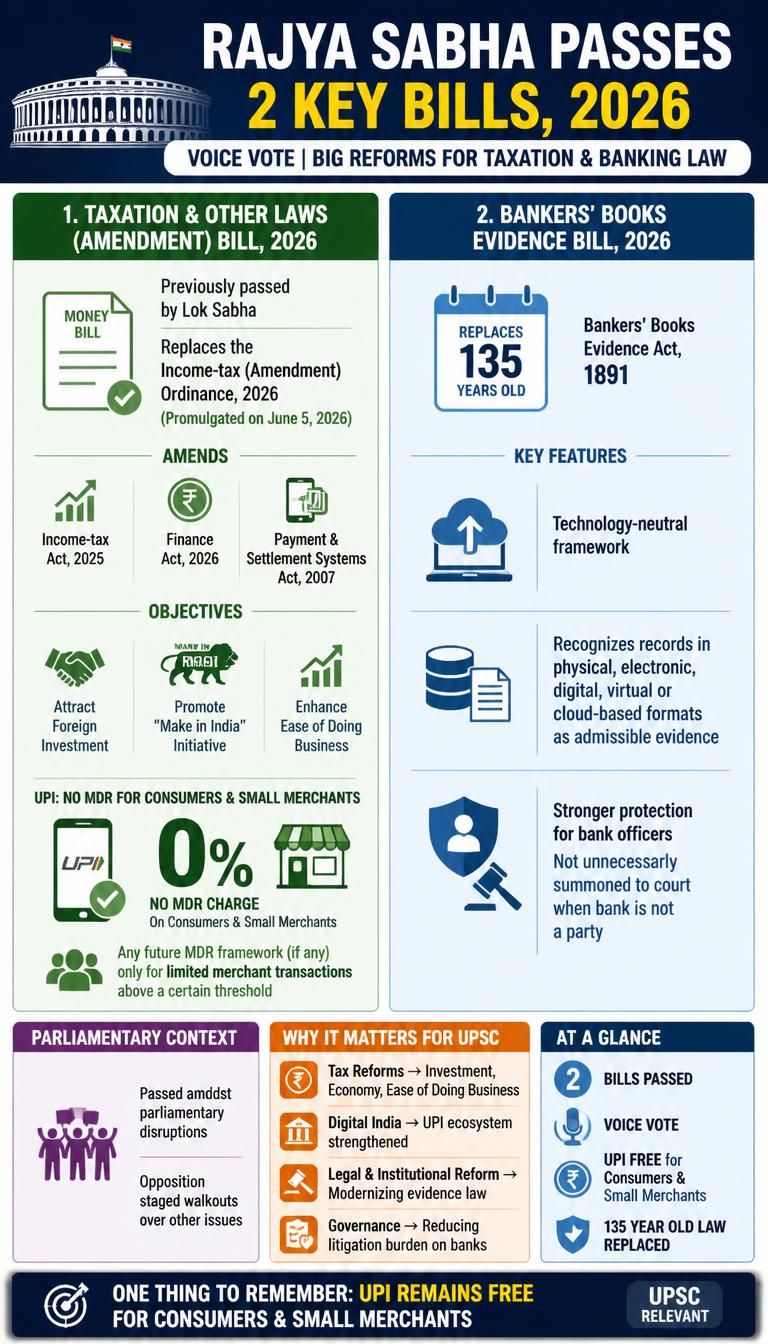
- The Rajya Sabha passed the Bankers’ Books Evidence Bill, 2026 and returned the Taxation and Other Laws (Amendment) Bill, 2026 on Monday.
- Union Finance Minister Nirmala Sitharaman clarified that Unified Payments Interface (UPI) transactions would remain free for consumers.
- The Taxation and Other Laws (Amendment) Bill, 2026 allows the National Payments Corporation of India (NPCI) to finalize the Merchant Discount Rate (MDR) for certain merchant transactions.
- The Bankers’ Books Evidence Bill, 2026 aims to modernize the legal framework for banking records, including electronic and digital forms, replacing a 135-year-old law.
RS Bill.jpg
Detailed Insights:
- The Bankers’ Books Evidence Bill, 2026 updates the legal framework to recognize electronic and digital banking records as admissible evidence in courts.
- The Taxation and Other Laws (Amendment) Bill, 2026 seeks to amend the Payment and Settlement Systems Act, 2007, the Income-tax Act, 2025, and the Finance Act, 2026.
- This bill replaces an Income-tax (Amendment) Ordinance, 2026 that was promulgated in June to address economic shocks and support key sectors.
- Opposition members raised concerns that the Taxation and Other Laws (Amendment) Bill, 2026 could lead to charges on UPI transactions, burdening small traders and consumers.
- The Finance Minister assured that the vast majority of merchant transactions, including low-value transactions, would continue to remain free for consumers.
- The potential reintroduction of MDR on some UPI transactions is intended to create a sustainable revenue model for banks and payment service providers.
- A Statutory Motion was moved by a CPI(M) member to disapprove the ordinance that preceded the Taxation and Other Laws (Amendment) Bill, 2026.
Key Concepts Involved:
- Unified Payments Interface (UPI): A real-time payment system developed by NPCI that facilitates instant money transfers between bank accounts via mobile devices.
- National Payments Corporation of India (NPCI): An umbrella organization for operating retail payments and settlement systems in India, established by the RBI and IBA.
- Merchant Discount Rate (MDR): A fee paid by a merchant to their bank or payment provider for processing digital transactions.
- Ordinance: A law promulgated by the President of India when Parliament is not in session, having the same force as an Act of Parliament but temporary.
- Statutory Motion: A formal proposal made by a Member of Parliament to initiate discussion or take a decision on a matter, often to disapprove an ordinance.

SuperKalam is your personal mentor for UPSC preparation, guiding you at every step of the exam journey.
Download the App


STUDY RESOURCES
CONTACT US
ⓒ Snapstack Technologies Private Limited