GS 2: GovernanceGS 2: Social JusticePrelimsGS 2: Government policies and interventions for development in various sectorsGS 2: Education Sector
Indian institutions in QS World University Rankings, Pg8
Indian institutions in QS World University Rankings surged from 11 to 52 since 2015, government informs Lok Sabha, crediting National Institutional Ranking Framework.
Practice MCQs
855 Students attempted
Key Highlights:
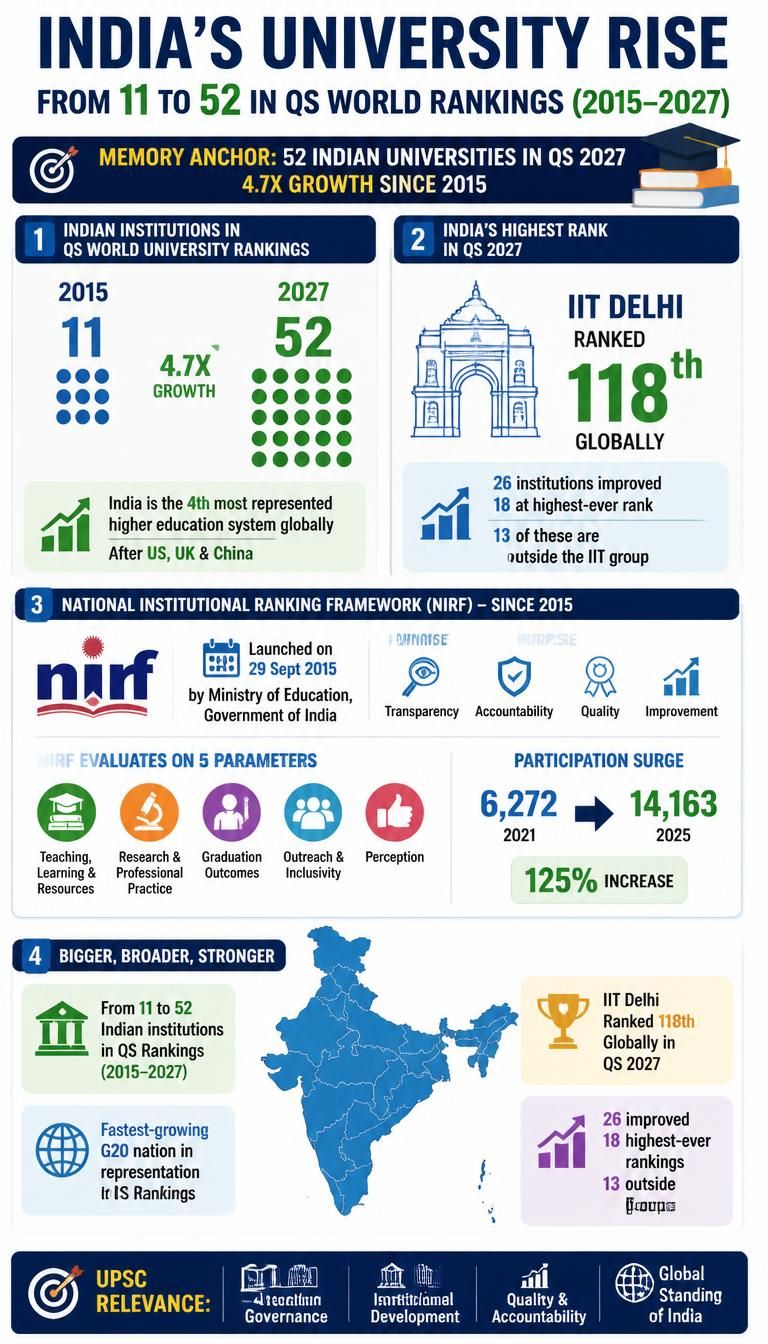
- The number of Indian institutions featured in the QS World University Rankings increased from 11 in 2015 to 52 in the 2027 edition.
- This significant rise coincides with the launch of the National Institutional Ranking Framework (NIRF) in 2015.
- The government informed the Lok Sabha about this expansion, highlighting growth in India's higher education ecosystem.
- IIT Delhi achieved India's highest rank in the 2027 edition, securing the 118th position globally.
- The improvement in rankings is becoming more broad-based, with non-IIT institutions also showing substantial gains.
QS Ranking.jpg
Detailed Insights:
- The QS World University Rankings, published annually by Quacquarelli Symonds (QS), assess universities based on indicators such as academic reputation, employer reputation, faculty/student ratio, and research impact.
- The National Institutional Ranking Framework (NIRF) was launched by the Ministry of Education, Government of India, on September 29, 2015, to evaluate higher education institutions across India.
- NIRF aims to foster transparency, accountability, and quality in higher education by ranking institutions on parameters like Teaching, Learning & Resources; Research & Professional Practice; Graduation Outcomes; Outreach & Inclusivity; and Perception.
- Participation in NIRF has grown substantially, with applications increasing from 6,272 in 2021 to 14,163 in 2025.
- India is now the fourth most represented higher education system globally, after the US, UK, and China, and the fastest-growing G20 nation in terms of representation in these rankings.
- In the QS 2027 rankings, 26 Indian institutions improved their positions, and 18 achieved their highest-ever rankings, including 13 institutions outside the traditional IIT group.
- Notable improvements were observed from institutions like VIT, BITS Pilani, IIT Hyderabad, Jamia Millia Islamia, and Shoolini University.
- Government initiatives such as the National Education Policy (NEP) 2020, Rashtriya Uchchatar Shiksha Abhiyan (RUSA), Higher Education Financing Agency (HEFA), and the Study in India program are contributing to the enhancement of India's higher education landscape.
Key Concepts Involved:
- QS World University Rankings: A global university ranking system published annually by Quacquarelli Symonds, evaluating institutions based on various performance indicators.
- National Institutional Ranking Framework (NIRF): An annual ranking methodology developed by the Ministry of Education, Government of India, to assess and rank higher education institutions within India.
- National Education Policy (NEP) 2020: A comprehensive framework by the Indian government aimed at transforming India's education system from elementary to higher education and vocational training.

SuperKalam is your personal mentor for UPSC preparation, guiding you at every step of the exam journey.
Download the App


STUDY RESOURCES
CONTACT US
ⓒ Snapstack Technologies Private Limited