GS 2: GovernanceGS 3: Environment & EcologyPrelimsGS 3: Conservation, Pollution and DegradationGS 2: E Governance
Delhi Logs Worst Diwali Air In 5 Years (PM 2.5 Reading At One Station Over 83 Times The National 24-Hour Safe Limit), Pg1
Delhi chokes on worst Diwali air in five years, PM 2.5 levels at one station skyrocket 83 times national safe limit, prompting urgent government intervention.
Practice MCQs
869 Students attempted
Key Highlights:
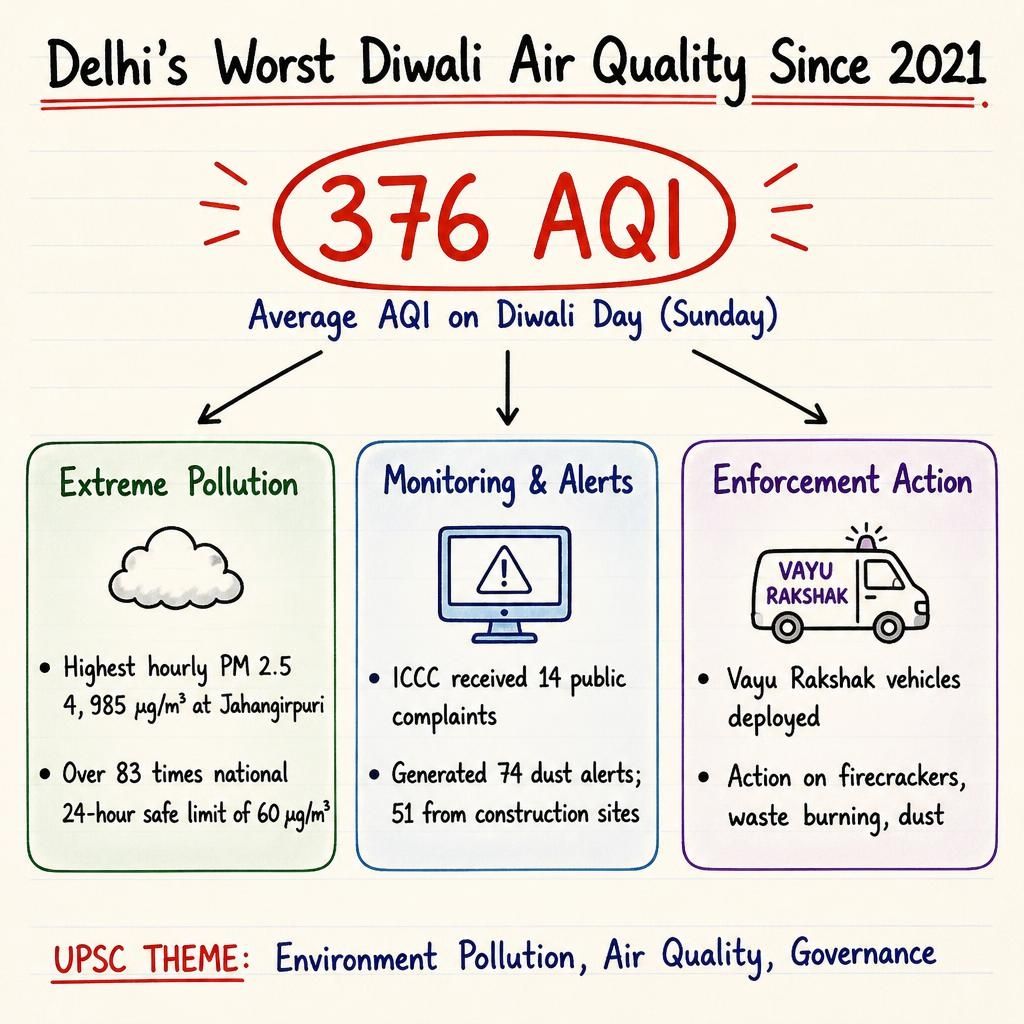
- Delhi recorded its worst Diwali-day air quality since 2021, with the average Air Quality Index (AQI) touching 376 on Sunday.
- The highest hourly PM 2.5 reading was 4,985 µg/m³ at Jahangirpuri, which is over 83 times the national 24-hour safe limit of 60 µg/m³.
- The Integrated Command and Control Centre (ICCC) received 14 public complaints and generated 74 dust alerts, including 51 from construction sites, between Diwali night and Monday afternoon.
- Enforcement teams in Vayu Rakshak vehicles are deployed to address complaints regarding illegal firecracker bursting, waste burning, and construction dust.
- Pollution levels continued into Monday, with the city's average AQI remaining around 370, placing it in the 'Severe' category.
Delhi AQI.jpg
Detailed Insights:
- Delhi's Diwali-day AQI has shown a concerning trend, increasing from 218 in 2023 to 376 in the current year, indicating worsening air quality.
- The ICCC, established by the Delhi Pollution Control Committee (DPCC), utilizes AI-enabled cameras and real-time data for comprehensive monitoring of pollution sources and coordinating field-level enforcement actions.
- Complaints handled by the ICCC range from the burning of electronic waste and general dust pollution to specific violations at construction and demolition sites.
- Vayu Rakshak vehicles are operated by joint teams comprising junior engineers from the DPCC, personnel from the Municipal Corporation of Delhi (MCD), and Civil Defence staff for effective on-ground pollution control.
- The national 24-hour safe limit for PM 2.5 is 60 µg/m³, significantly higher than the World Health Organization (WHO) 24-hour guideline of 15 µg/m³.
- Post-Diwali pollution is exacerbated by multiple factors including firecracker emissions, unfavorable meteorological conditions, stubble burning in neighboring states, and a drop in ambient temperatures.
- The Graded Response Action Plan (GRAP), overseen by the Commission for Air Quality Management (CAQM), provides a structured framework of emergency measures activated based on the severity of air pollution levels.
Key Concepts Involved:
- Air Quality Index (AQI): A numerical scale used to communicate daily air quality levels, indicating how clean or polluted the air is and its associated health risks.
- Particulate Matter (PM 2.5 & PM 10): Microscopic solid or liquid particles suspended in the air; PM 2.5 are fine particles that pose greater health risks due to their ability to penetrate deep into the lungs.
- Central Pollution Control Board (CPCB): A statutory organization under the Ministry of Environment, Forest and Climate Change, responsible for pollution control, monitoring, and setting environmental standards.
- Delhi Pollution Control Committee (DPCC): A regulatory body responsible for implementing environmental laws and rules, and monitoring pollution levels within the National Capital Territory of Delhi.
- Integrated Command and Control Centre (ICCC): A centralized technological hub that integrates data from various sources for real-time monitoring, analysis, and coordinated response to urban issues, including environmental pollution.

SuperKalam is your personal mentor for UPSC preparation, guiding you at every step of the exam journey.
Download the App


STUDY RESOURCES
CONTACT US
ⓒ Snapstack Technologies Private Limited