GS 2: International RelationsGS 3: Environment & EcologyPrelimsGS 3: Conservation, Pollution and DegradationGS 2: Bilateral, Regional and Global Groupings and Agreements
Climate Meet Opens, 2026 Among Warmest, Pg8
WMO warns 2026 could be second warmest year, with global temperatures 1.47°C above pre-industrial levels, as COP31 climate talks open.
Practice MCQs
869 Students attempted
Key Highlights:
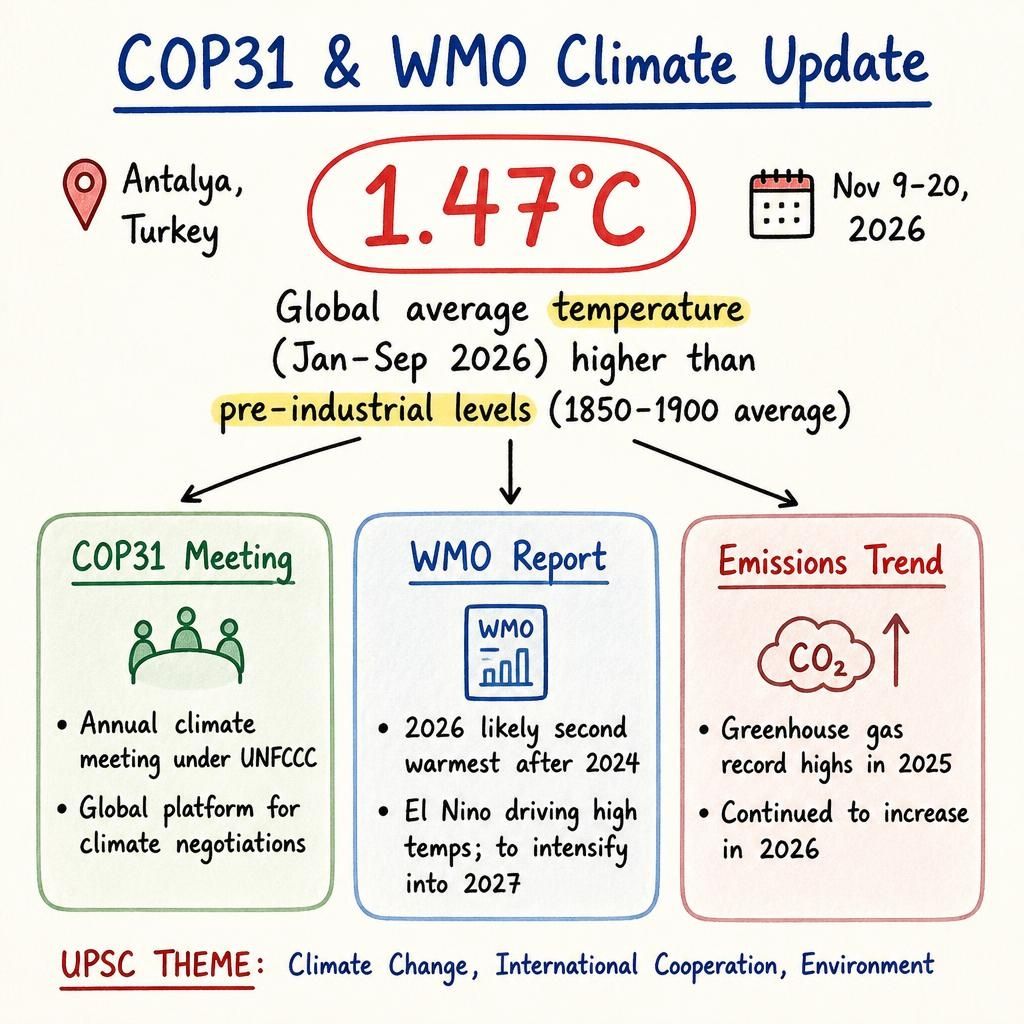
- The annual climate meeting, COP31, commenced in Antalya, Turkey, from November 9-20, 2026.
- The World Meteorological Organization (WMO) released its State of the Climate Report, highlighting the worsening climate situation.
- The report indicates that 2026 is projected to be one of the warmest years on record, likely the second warmest after 2024.
- Global average temperature from January to September 2026 was 1.47°C higher than pre-industrial levels (1850-1900 average).
- Greenhouse gas concentrations reached new record highs in 2025 and continued to increase in 2026.
COP 31 and WMO Update.jpg
Detailed Insights:
- The COP31 meeting serves as a crucial platform for global climate negotiations under the United Nations Framework Convention on Climate Change (UNFCCC).
- The WMO report underscores the persistent failure to reduce global emissions despite decades of international discussions and legal frameworks.
- The 1.47°C rise above pre-industrial levels highlights the world's proximity to the 1.5°C warming limit set by the Paris Agreement.
- Prevailing El Nino conditions are significantly contributing to the elevated global temperatures observed in 2026, expected to intensify into 2027.
- The report notes increasing divisions among climate negotiators, posing challenges to significant climate action.
Scientific/Technical Concepts Involved:
- World Meteorological Organization (WMO): A specialized agency of the United Nations for international cooperation on atmospheric science, climate, and water resources.
- COP (Conference of the Parties): The supreme decision-making body of the United Nations Framework Convention on Climate Change (UNFCCC).
- Pre-industrial times: The period between 1850 and 1900, used as a baseline to measure global warming before significant human-induced emissions.
- El Nino: A climate pattern characterized by the unusual warming of surface waters in the eastern tropical Pacific Ocean, affecting global weather.
- Greenhouse Gases: Atmospheric gases, such as carbon dioxide and methane, that trap heat and contribute to the greenhouse effect and global warming.

SuperKalam is your personal mentor for UPSC preparation, guiding you at every step of the exam journey.
Download the App


STUDY RESOURCES
CONTACT US
ⓒ Snapstack Technologies Private Limited