GS 3: EconomyPrelimsGS 3: Indian Economy, Planning, Mobilization of Resources, Growth, Development and EmploymentGS 2: Statutory, Regulatory and Quasi Judicial BodiesGS 2: Effect of Policies and Politics of Developed and Developing Countries on India's Interests
How India's Growth Rate Keeps Beating Forecasts, Pg13
RBI raises GDP forecast to 7.1%, highlighting India's economic resilience as actual growth repeatedly beats professional predictions since FY23, puzzling economists.
Practice MCQs
862 Students attempted
Key Highlights:
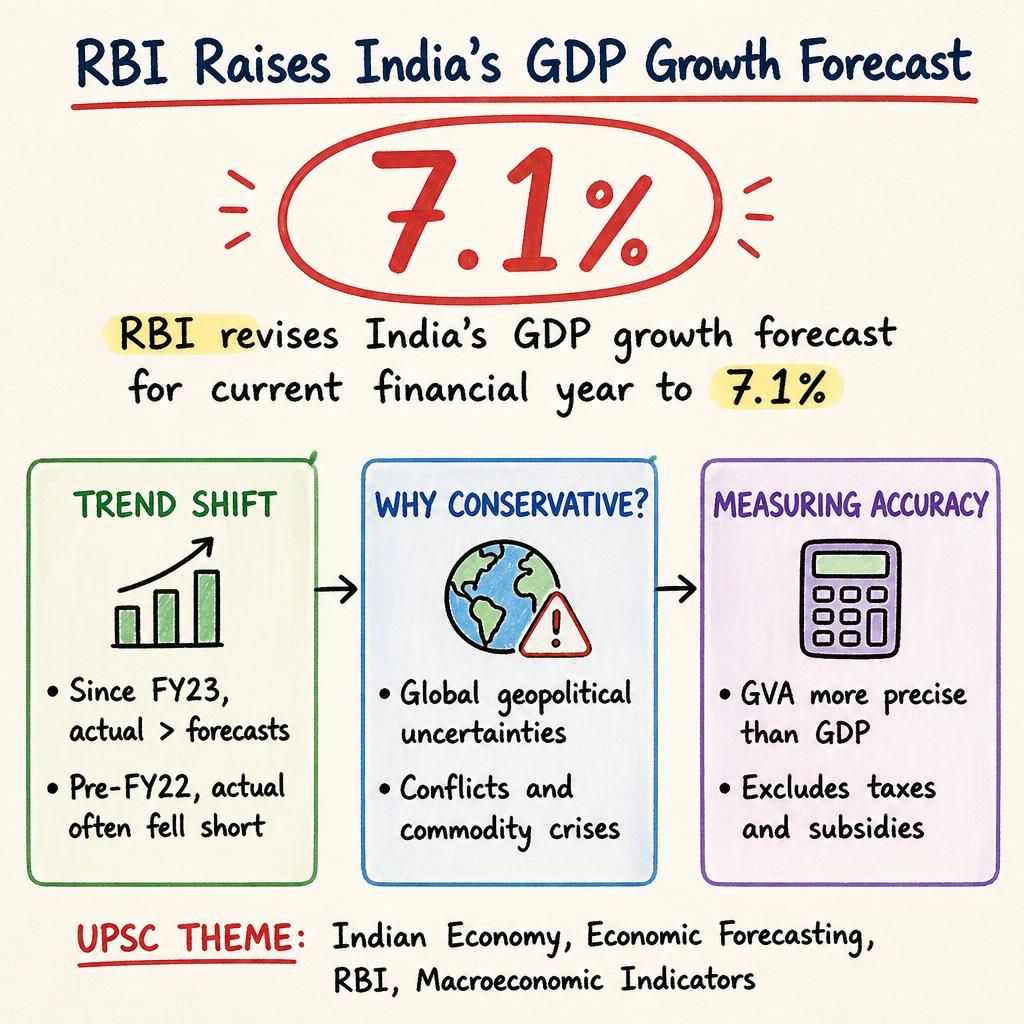
- The Reserve Bank of India (RBI) recently revised India's GDP growth forecast for the current financial year upwards to 7.1%.
- This marks a significant increase from initial projections of 6.9%, 6.6%, and 6.7% earlier in the fiscal year.
- Since FY23, India's actual economic growth has consistently exceeded professional forecasts.
- This trend contrasts with the period before FY22, when actual growth often fell short of initial predictions.
- Forecasters attribute their recent conservative estimates to ongoing global geopolitical uncertainties, including conflicts and commodity crises.
GDP Forecast.jpg
Detailed Insights:
- The RBI conducts a bimonthly survey of professional forecasters to gather economic outlooks and refine its projections.
- Gross Value Added (GVA) is considered a more precise metric than GDP for analyzing forecasting accuracy as it excludes the impact of taxes and subsidies.
- Prior to FY23, economic forecasters tended to be overly optimistic, resulting in actual growth rates frequently underperforming initial forecasts.
- Post-2022, a series of global disruptions, such as the Russia-Ukraine war and crude oil price volatility, have led forecasters to adopt a more cautious approach.
- The demonetisation event in November 2016 presented an anomaly, with actual GVA growth of 8% for FY17 significantly surpassing the revised forecast of 6.7%.
- The article suggests that the full economic impact of demonetisation might have been reflected in the subdued performance of subsequent years (FY18, FY19, FY20).
Key Concepts Involved:
- Gross Domestic Product (GDP): The total monetary value of all final goods and services produced within a country's borders in a specific time period.
- Gross Value Added (GVA): A measure of the value of goods and services produced in an economy, minus the cost of inputs and raw materials used.
- Monetary Policy Review: The periodic assessment by a central bank, like the RBI, of economic conditions to adjust interest rates and other monetary tools.

SuperKalam is your personal mentor for UPSC preparation, guiding you at every step of the exam journey.
Download the App


STUDY RESOURCES
CONTACT US
ⓒ Snapstack Technologies Private Limited