GS 2: GovernanceGS 3: Science & TechnologyGS 3: Environment & EcologyGS 3: EconomyPrelims
Why Stubble Fires Keep Coming Back, Pg10
North India's stubble burning crisis persists due to complex interplay of economic incentives, water laws, and technological challenges, demanding integrated solutions.
Practice MCQs
855 Students attempted
Key Highlights:
- Stubble burning in North India, particularly Punjab and Haryana, is a significant contributor to air pollution.
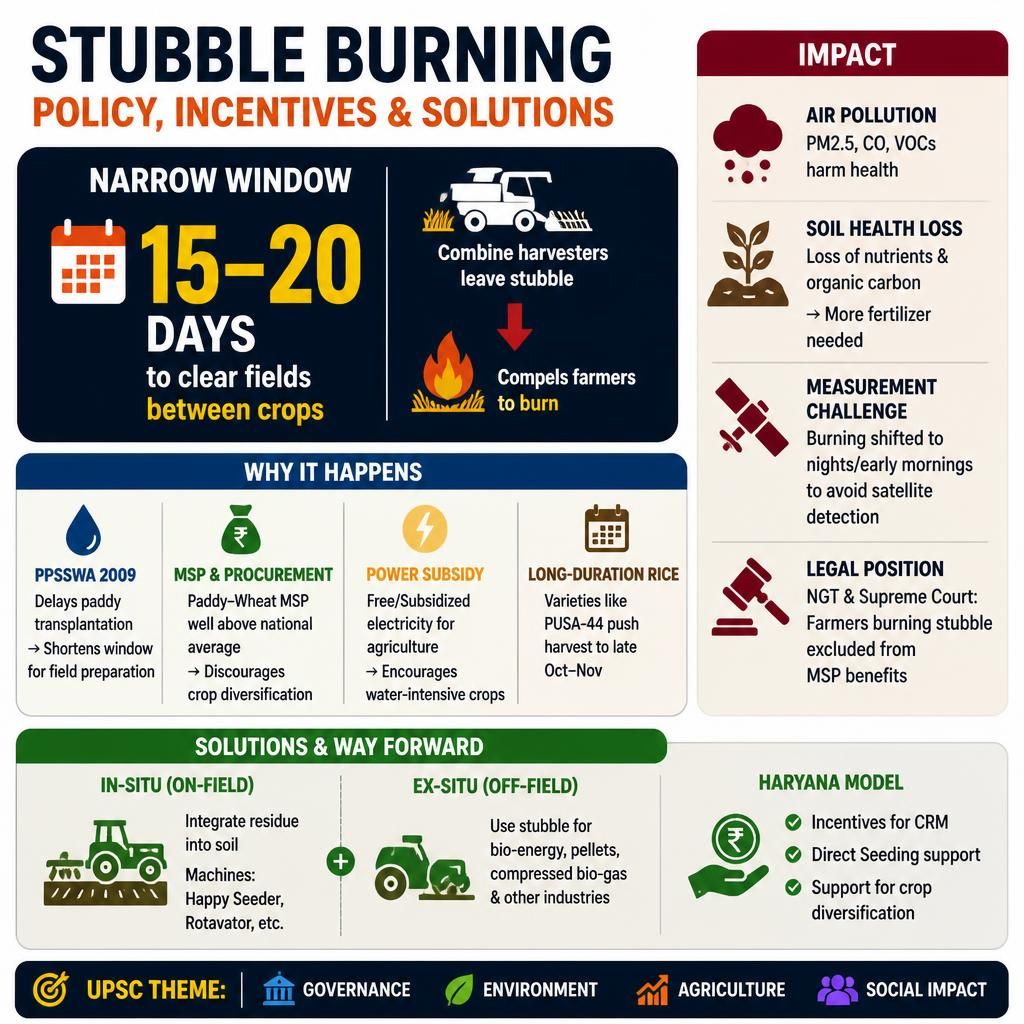
- The Punjab Preservation of Sub-Soil Water Act, 2009 (PPSSWA 2009), by delaying paddy transplantation, inadvertently shortened the window for field preparation.
- This narrow window, coupled with the use of combine harvesters, compels farmers to burn crop residue quickly.
- The Minimum Support Price (MSP) and procurement system for rice and wheat heavily incentivize their cultivation, discouraging crop diversification.
- Technical solutions like Crop Residue Management (CRM) machines and ex-situ options face economic and logistical barriers for farmers.
- Measurement of stubble burning incidents is challenged by farmers shifting burning times to avoid detection by polar satellites.
Stubble Burning.jpg
Detailed Insights:
- Stubble burning releases harmful pollutants such as particulate matter, carbon monoxide, and volatile organic compounds, adversely affecting human health.
- It also severely degrades soil health by depleting essential nutrients and organic content, necessitating increased fertilizer use.
- The PPSSWA 2009 was enacted to address severe groundwater depletion in Punjab, where water levels were declining rapidly.
- The Act's restrictions on paddy sowing and transplantation pushed harvesting into late October and early November.
- The cultivation of long-duration paddy varieties like PUSA-44 further reduces the critical time available between crop cycles.
- High government procurement rates for paddy and wheat in Punjab and Haryana, significantly above the national average, disincentivize crop diversification.
- Subsidized or free electricity for agriculture in these states further encourages the cultivation of water-intensive crops.
- In-situ crop residue management involves integrating residue into the soil using machines like Happy Seeders, while ex-situ management utilizes stubble for bio-energy.
- The National Green Tribunal and Supreme Court have upheld the exclusion of stubble-burning farmers from MSP benefits.
- Haryana has adopted an incentive-based approach, providing financial support for CRM use, direct seeding, and crop diversification.
- The CREAMS protocol, relying on polar satellites, may undercount actual burning incidents as farmers adjust their schedules.
- Scientists from ISRO recommend integrating both polar and geostationary satellite data for a more accurate assessment of stubble burning.
Key Concepts Involved:
- Stubble Burning: The practice of igniting crop residue left in agricultural fields after harvest, primarily paddy straw.
- Punjab Preservation of Sub-Soil Water Act, 2009 (PPSSWA 2009): A state legislation aimed at groundwater conservation by regulating paddy cultivation timings.
- Minimum Support Price (MSP): A government-guaranteed price for certain agricultural crops, ensuring a protective floor for farmers' income.
- In-situ Crop Residue Management: The process of managing crop residue directly within the field, often through mechanical incorporation.
- Ex-situ Crop Residue Management: The practice of removing crop residue from fields for off-farm uses, such as biomass energy production.
- PUSA-44: A specific high-yielding, long-duration paddy variety that impacts the agricultural calendar in North India.

SuperKalam is your personal mentor for UPSC preparation, guiding you at every step of the exam journey.
Download the App


STUDY RESOURCES
CONTACT US
ⓒ Snapstack Technologies Private Limited