GS 2: GovernanceGS 3: EconomyPrelimsGS 3: Inclusive GrowthGS 3: Indian Economy, Planning, Mobilization of Resources, Growth, Development and Employment
Why are users worried about UPI charges?, Pg14
Government considers levying charges on UPI transactions via new bill, sparking user concerns about the future of free digital payments.
Practice MCQs
840 Students attempted
Key Highlights:
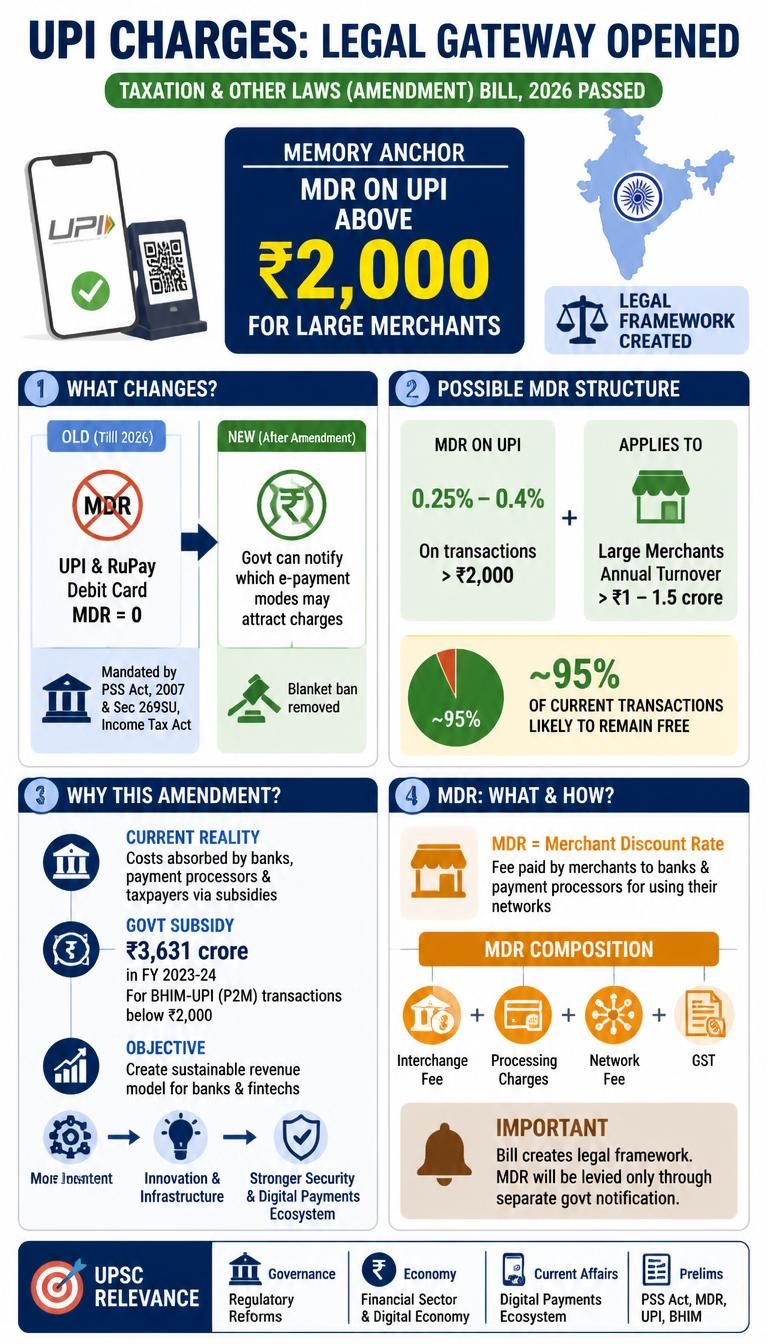
- The Taxation and Other Laws (Amendment) Bill, 2026, passed by the Lok Sabha on August 6, 2026, empowers the government to allow charges on Unified Payments Interface (UPI) transactions.
- Previously, UPI and RuPay debit card transactions were mandated to be free of Merchant Discount Rate (MDR) charges since 2020, as per provisions linked to the Payment and Settlement Systems Act, 2007, and Section 269SU of the Income Tax Act, 1961.
- The amendment modifies the Payment and Settlement Systems Act, 2007, removing the blanket prohibition on charges and allowing the Central Government to notify which electronic payment modes may attract fees.
- The government is reportedly considering an MDR of 0.25-0.4% on UPI transactions exceeding ₹2,000 and for large merchants with an annual turnover above ₹1-1.5 crore, potentially excluding about 95% of current transactions.
- The government provided a subsidy of ₹3,631 crore in 2023-24 under the 'Incentive Scheme for Promotion of Low-Value BHIM-UPI Transactions (Person-to-Merchant)' for transactions below ₹2,000.
UPI Charges.jpg
Detailed Insights:
- The current free nature of UPI transactions means costs are absorbed by banks, payment processors, and taxpayers through government subsidies.
- The MDR is a fee paid by merchants to banks and payment processors for using their networks, comprising an interchange fee, processing charges, a network fee, and Goods and Services Tax.
- The amendment aims to create a sustainable revenue model for banks and fintech companies, encouraging investment in infrastructure, innovation, and security for the digital payments ecosystem.
- While the bill creates the legal framework for charges, it does not automatically impose them; any decision to levy MDR would require a separate government notification.
- The move is also seen by some as a response to international pressure, particularly from the United States, regarding India's zero-MDR policy favoring domestic payment systems.
- The government's approach seeks to balance the promotion of digital payments with ensuring the financial viability of the underlying payment infrastructure.
Key Concepts Involved:
- Unified Payments Interface (UPI): An instant real-time payment system developed by the National Payments Corporation of India (NPCI), allowing inter-bank peer-to-peer and person-to-merchant transactions.
- Merchant Discount Rate (MDR): A fee charged to merchants by banks and payment service providers for processing digital transactions, covering infrastructure and operational costs.
- Payment and Settlement Systems Act, 2007: An Act that provides for the regulation and supervision of payment systems in India, designating the Reserve Bank of India (RBI) as the authority.
- Section 269SU of the Income Tax Act, 1961: A provision mandating businesses with a turnover exceeding ₹50 crore to provide facilities for accepting payments through prescribed electronic modes, including RuPay debit cards and UPI.

SuperKalam is your personal mentor for UPSC preparation, guiding you at every step of the exam journey.
Download the App


STUDY RESOURCES
CONTACT US
ⓒ Snapstack Technologies Private Limited