GS 2: GovernanceGS 3: Environment & EcologyPrelimsGS 3: Major Crops, Cropping Patterns and Irrigation SystemsGS 3: Conservation, Pollution and Degradation
Punjab Records 3,000 Stubble Burning Cases As Tarn Taran Tops List; 795 FIRs Registered, Pg1
Punjab records over 3,000 stubble burning incidents, Tarn Taran leads with 611 cases; 795 FIRs filed, ₹54.55 lakh fines imposed.
Practice MCQs
855 Students attempted
Key Highlights:
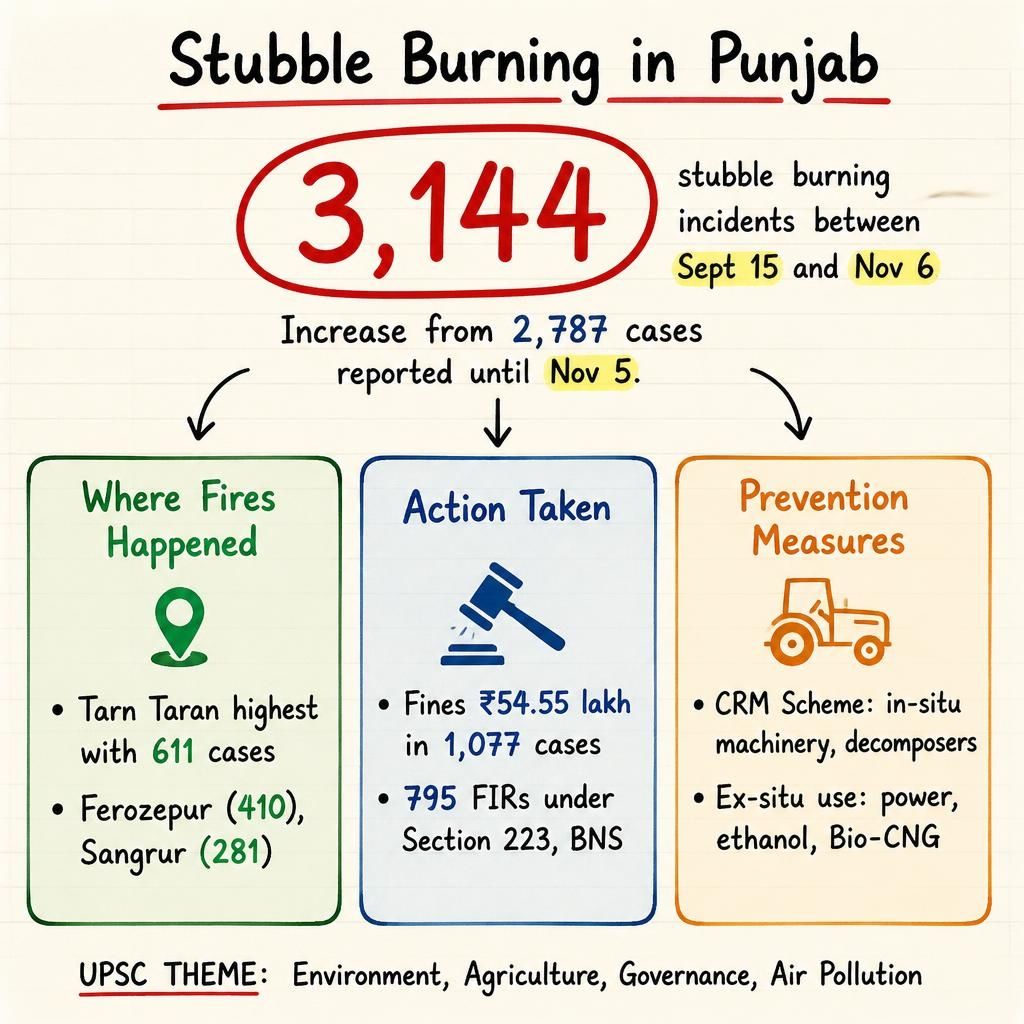
- Punjab recorded 3,144 stubble burning incidents between September 15 and November 6, an increase from 2,787 cases reported until November 5.
- Tarn Taran district reported the highest number of farm fires with 611 cases, followed by Ferozepur (410) and Sangrur (281).
- Fines totaling ₹54.55 lakh were imposed in 1,077 cases, with ₹30.05 lakh already recovered.
- Authorities registered 795 First Information Reports (FIRs) under Section 223 of the Bharatiya Nyaya Sanhita (BNS) for farm fire incidents.
- Additionally, 931 red entries were made in the land records of farmers found burning crop residues, including 301 in Tarn Taran.
Stubble Burning.jpg
Detailed Insights:
- The practice of stubble burning in Punjab and Haryana is a significant contributor to air pollution in the Delhi-National Capital Region (NCR) during the post-harvest season.
- Farmers resort to burning crop residue, primarily paddy stubble, due to a narrow window of time available to clear fields for sowing the subsequent rabi crop, such as wheat.
- This short window is partly influenced by the Punjab Preservation of Sub-Soil Water Act, 2009, which delays paddy transplantation to conserve groundwater, consequently pushing harvesting closer to the wheat sowing period.
- The Bharatiya Nyaya Sanhita (BNS), which replaced the Indian Penal Code (IPC) from July 1, 2024, includes provisions under Section 223 to penalize disobedience to orders promulgated by public servants, which can be applied to stubble burning.
- Government initiatives to combat stubble burning include the Crop Residue Management (CRM) Scheme, providing subsidies for in-situ management machinery like Happy Seeders and bio-decomposers such as Pusa Decomposer.
- Ex-situ management solutions involve utilizing paddy straw for biomass power generation, ethanol production, and bio-Compressed Natural Gas (Bio-CNG).
- The Commission for Air Quality Management (CAQM) coordinates efforts across states, employing satellite monitoring and enforcement measures to curb farm fires.
Key Concepts Involved:
- Stubble Burning: The practice of intentionally setting fire to crop residue after harvest to clear fields quickly.
- Bharatiya Nyaya Sanhita (BNS): India's new criminal code, effective July 1, 2024, replacing the Indian Penal Code (IPC).
- Kharif Crops: Monsoon crops sown between June and October, harvested around October-November, e.g., paddy.
- Rabi Crops: Winter crops sown between October and December, harvested around April-May, e.g., wheat.

SuperKalam is your personal mentor for UPSC preparation, guiding you at every step of the exam journey.
Download the App


STUDY RESOURCES
CONTACT US
ⓒ Snapstack Technologies Private Limited