GS 1: Art & CulturePrelimsGS 1: ArchitectureGS 2: Government policies and interventions for development in various sectors
Bihar Mound Named Site of National Importance, Pg9
Central government declares ancient Ranivas Mound in Bihar's East Champaran as archaeological site of national importance under 1958 Act.
Practice MCQs
855 Students attempted
Key Highlights:
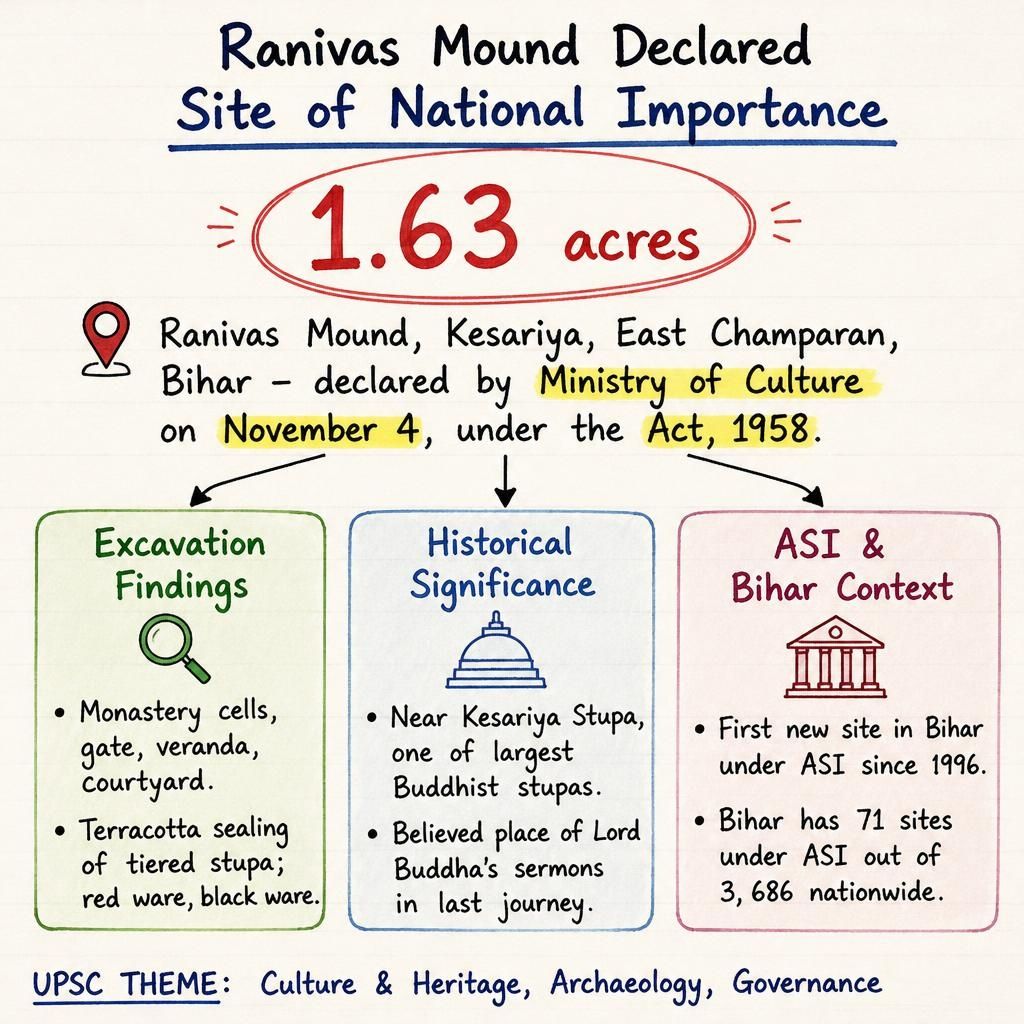
- The Ranivas Mound in Kesariya, East Champaran district, Bihar, has been declared an archaeological site of national importance by the central government.
- The Ministry of Culture issued a gazette notification on November 4, formalizing this declaration under the Ancient Monuments and Archaeological Sites and Remains Act, 1958.
- This site spans 1.63 acres and is owned by the Bihar government.
- This is the first new site in Bihar to be brought under the ambit of the Archaeological Survey of India (ASI) since 1996.
- With this addition, Bihar now has 71 sites under the care of the ASI, out of a total of 3,686 such sites nationwide.
Ranivas Mound.jpg
Detailed Insights:
- The declaration of Ranivas Mound as a site of national importance follows a recommendation sent to ASI headquarters in 2021.
- The ASI Patna Circle had previously conducted excavations at the mound, revealing structures like monastery cells, a gate, a pillared veranda, and a courtyard.
- Significant findings from the excavation include a terracotta sealing depicting a tiered stupa with an inscription, and pottery including red ware and some black ware.
- The Ranivas Mound is located near the Kesariya Stupa, which is considered one of the largest Buddhist stupas in the world, dating back to the Mauryan period.
- The Kesariya Stupa is historically significant as it is believed to be a place where Lord Buddha delivered sermons during his last journey.
- The ASI is responsible for the conservation, preservation, and maintenance of centrally protected monuments and sites across India.
- The Patna Circle of the ASI, one of India's oldest regional circles, governs centrally protected sites in Bihar, including the Nalanda University ruins, a UNESCO World Heritage Site.
Key Concepts Involved:
- Ancient Monuments and Archaeological Sites and Remains Act, 1958 (AMASR Act): A central law for the preservation of ancient and historical monuments and archaeological sites of national importance, regulating excavations and protecting artifacts.
- Archaeological Survey of India (ASI): The premier organization under the Ministry of Culture responsible for archaeological research, protection of cultural heritage, and maintenance of protected monuments in India.
- Monument of National Importance: An archaeological site or monument declared by the Central Government under the AMASR Act to be of national significance, bringing it under central protection and ASI management.

SuperKalam is your personal mentor for UPSC preparation, guiding you at every step of the exam journey.
Download the App


STUDY RESOURCES
CONTACT US
ⓒ Snapstack Technologies Private Limited