GS 2: GovernanceGS 3: Science & TechnologyGS 3: Internal SecurityPrelimsGS 3: Storage, Transport and Marketing of Agricultural Produce
How supermarkets became targets of cyberattacks, Pg13
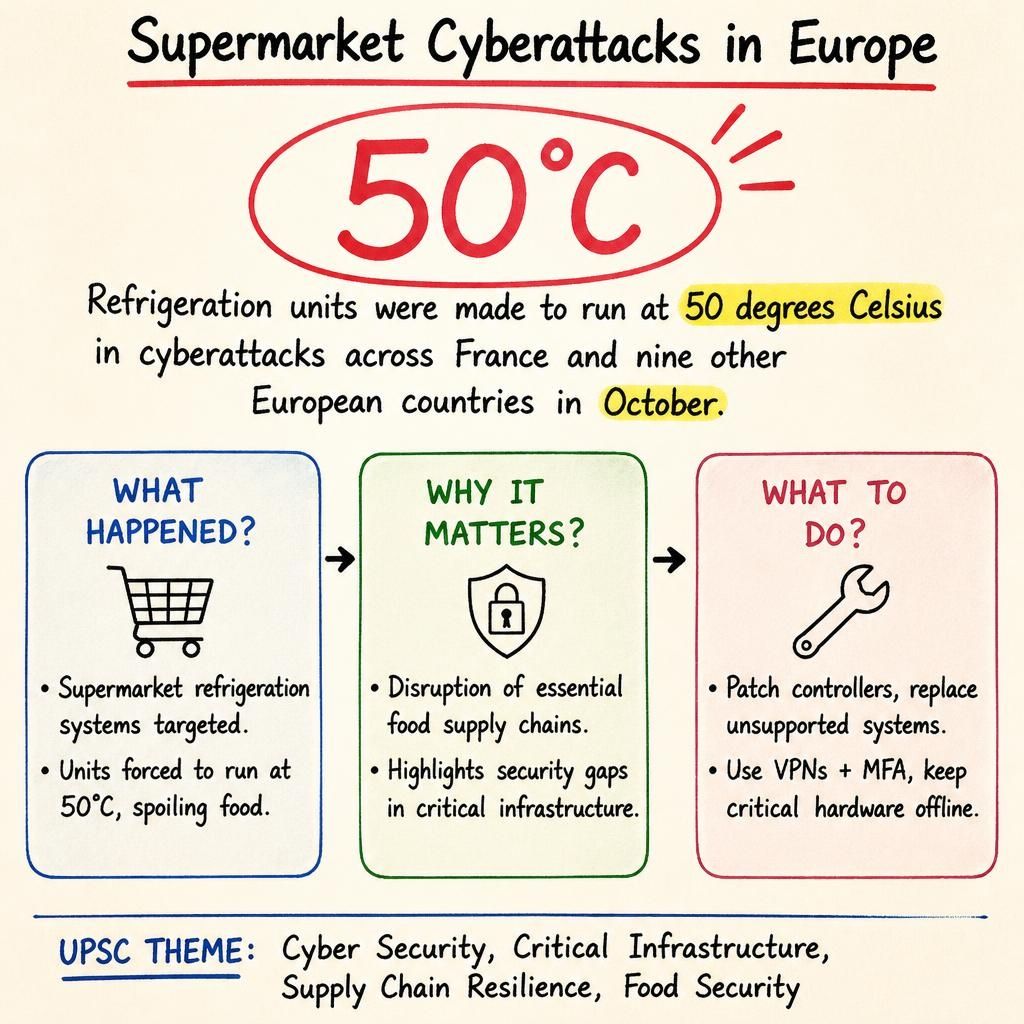
Unusual cyberattacks targeting European supermarket refrigeration systems caused massive food spoilage, highlighting critical infrastructure vulnerabilities and supply chain risks.
Practice MCQs
855 Students attempted
Key Highlights:
- Supermarket refrigeration systems across France and nine other European countries were targeted by cyberattacks in October.
- The attacks caused refrigeration units to run at 50 degrees Celsius, spoiling food and emptying shelves.
- Unlike typical cyberattacks, no ransom was demanded, nor was any customer data stolen, indicating a motive of disruption rather than profit.
- Systems from Danish engineering firm Danfoss were reportedly targeted, exploiting vulnerabilities in older software and internet-connected controllers.
- The incident highlights the vulnerability of supply chains and the need to redefine critical infrastructure to include essential services like food retail.
Cyberattack.jpg
Detailed Insights:
- The cyberattacks affected major supermarket chains including Intermarche, Carrefour, Spar, and Delhaize, as well as some Ikea restaurants.
- The attackers exploited the "forced defrost" function in central controllers, extending the defrost cycle and raising temperatures.
- Many modern refrigeration controllers are connected to the internet for remote maintenance, creating a significant security vulnerability.
- Older control systems, designed for reliability rather than internet security, often remain in service for decades, outliving software support cycles.
- Researchers had disclosed vulnerabilities in Danfoss web interfaces in August, two months prior to the attacks, particularly in units running older software.
- The incident underscores that the objective was likely to test societal resilience by disrupting everyday supply chains and causing public anxiety.
- For countries like India, with growing Internet of Things (IoT) adoption in retail, assessing the security of remote links to controllers is crucial.
- Recommended fixes include promptly patching controllers, replacing unsupported systems, taking critical hardware off the public internet, and securing remote access with VPNs and Multi-Factor Authentication (MFA).
- Regulators are urged to consider mandatory security standards for operational technology in food retail, similar to other critical sectors.
Key Concepts Involved:
- Critical Infrastructure: Systems and assets vital to a country's functioning, whose incapacitation would have a debilitating effect on security, national economic security, national public health or safety.
- Internet of Things (IoT): A network of physical objects embedded with sensors, software, and other technologies for connecting and exchanging data over the internet.
- Ransomware: A type of malicious software that encrypts a victim's files, demanding a payment (ransom) to restore access.
- Multi-Factor Authentication (MFA): A security system that requires more than one method of authentication from independent categories of credentials to verify the user's identity.

SuperKalam is your personal mentor for UPSC preparation, guiding you at every step of the exam journey.
Download the App


STUDY RESOURCES
CONTACT US
ⓒ Snapstack Technologies Private Limited