GS 2: GovernanceGS 2: PolityGS 2: Social JusticePrelimsGS 2: Government policies and interventions for development in various sectors
Parent Income Not Sole Factor: SC On Creamy Layer In OBC, Pg1
Supreme Court reaffirms parental income not sole criterion for OBC creamy layer, impacting 100+ CSE candidates and future selections.
Practice MCQs
847 Students attempted
Key Highlights:
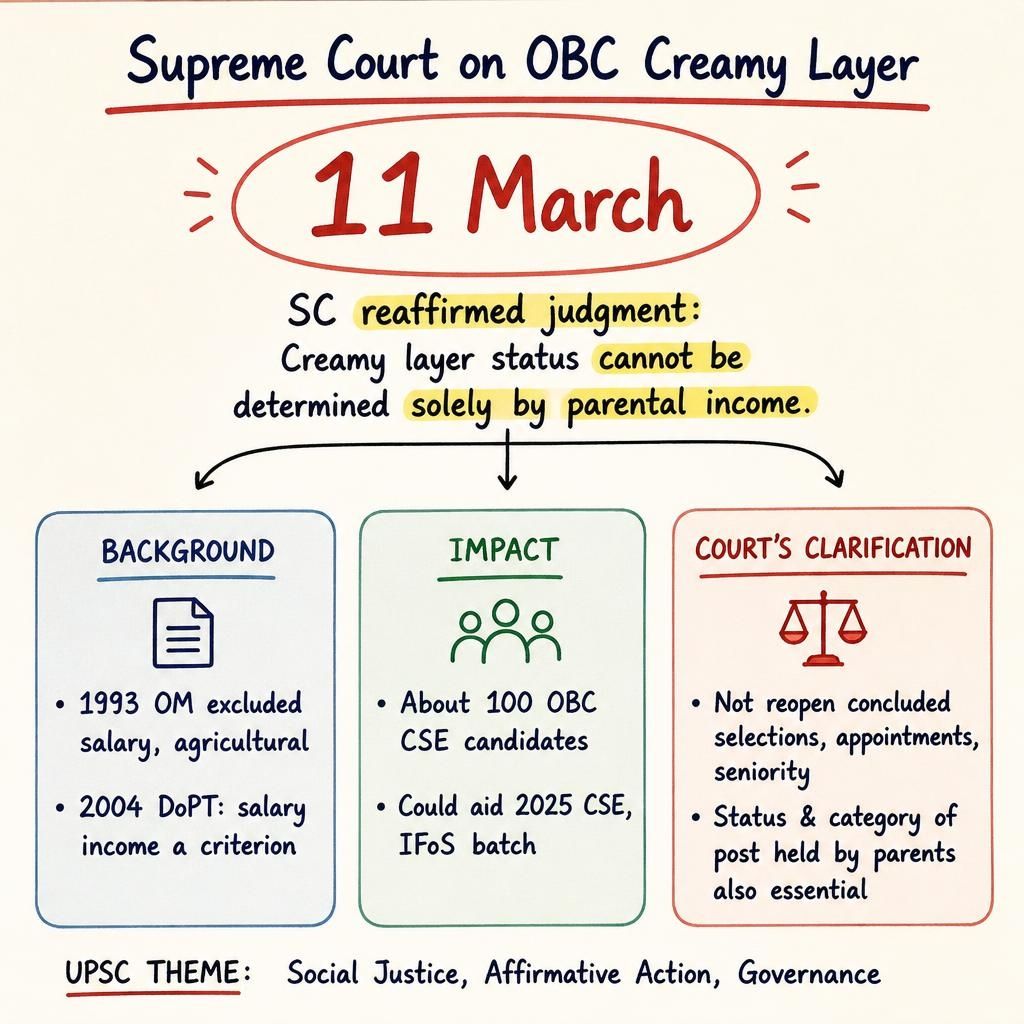
- The Supreme Court reaffirmed its March 11 judgment that Other Backward Classes (OBCs) creamy layer status cannot be determined solely by parental income.
- The Centre had sought clarification on the applicability of the March 11 verdict, especially for Civil Services Examination (CSE) candidates.
- The issue stems from a 2004 Department of Personnel and Training (DoPT) clarification regarding a 1993 Official Memorandum (OM) on creamy layer criteria.
- The ruling impacts approximately 100 OBC candidates whose CSE selections were rejected since 2016 due to creamy layer classification.
- The decision could facilitate service allocation for the 2025 batch of CSE and Indian Forest Service Examination candidates.
OBC Creamy Layer.jpg
Detailed Insights:
- The 1993 OM initially excluded income from salary and agricultural sources when determining OBC creamy layer status.
- The 2004 DoPT clarification stated that salary income of employees in public sector undertakings (PSUs) and the private sector would be a criterion for creamy layer.
- This 2004 clarification was rigorously applied from CSE-2015, leading to rejections of OBC candidates.
- The Supreme Court found no convincing justification to defer the implementation of its March 11 judgment.
- The court clarified that its judgment would not reopen already concluded selections, appointments, or seniority.
- The ruling emphasizes that the status and category of the post held by parents are also essential factors, not just income.
Key Concepts Involved:
- Creamy Layer: The economically and socially advanced section within Other Backward Classes (OBCs), excluded from reservation benefits.
- Other Backward Classes (OBCs): Socially and educationally disadvantaged communities in India eligible for reservation in public employment and education.
- Department of Personnel and Training (DoPT): The nodal agency of the Government of India for personnel management, training, and service matters for central government employees.

SuperKalam is your personal mentor for UPSC preparation, guiding you at every step of the exam journey.
Download the App


STUDY RESOURCES
CONTACT US
ⓒ Snapstack Technologies Private Limited