GS 2: GovernanceGS 3: Environment & EcologyPrelimsGS 3: Conservation, Pollution and DegradationGS 2: Government policies and interventions for development in various sectors
Grap-III Imposed in NCR, Pg1
NCR air quality plunges to 'severe', triggering GRAP Stage-III with BS-III/IV vehicle ban, hybrid learning, and remote work advisories amid farm fires.
Practice MCQs
847 Students attempted
Key Highlights:
- GRAP Stage-III has been implemented across the National Capital Region (NCR) with immediate effect due to deteriorating air quality.
- The decision was made by the CAQM Sub-Committee on GRAP following an emergency review on Friday evening.
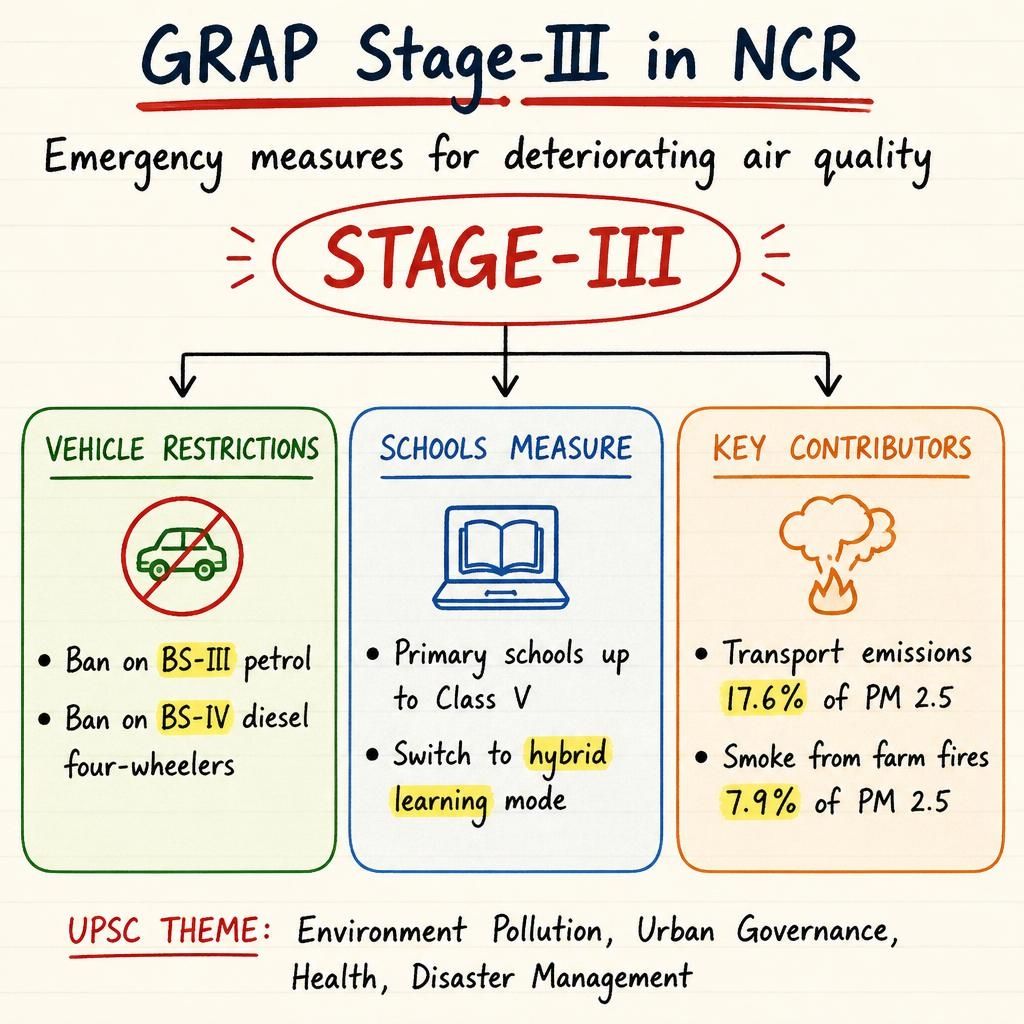
- Measures include a ban on private BS-III petrol and BS-IV diesel four-wheelers in Delhi and high-density NCR districts.
- Primary schools up to Class V in Delhi-NCR are mandated to switch to hybrid learning mode.
- Unfavourable weather conditions, such as stagnant winds and potential temperature inversion, are contributing to poor dispersion of pollutants.
- Transport emissions were the largest contributor to PM 2.5 at 17.6%, followed by smoke from farm fires at 7.9%, according to IITM's Decision Support System.
- Central Indian states like Madhya Pradesh (1,220 fires) and Rajasthan (1,097 fires) have emerged as significant sources of farm fires this season.
GRAP Stage III.jpg
Detailed Insights:
- The implementation of GRAP Stage-III aims to prevent air quality from further deteriorating into the 'severe' category.
- The Commission for Air Quality Management (CAQM) monitors air quality and enforces emergency measures based on pollution levels and meteorological forecasts.
- Restrictions on specific vehicle categories target a major source of vehicular emissions, which are a primary contributor to urban air pollution.
- Mandating hybrid learning for primary school children is a protective measure, as young children are particularly vulnerable to the health impacts of air pollution.
- Temperature inversion creates a 'lid' over the city, trapping heavy baseline emissions, farm fumes, and Diwali smoke near the surface.
- The timing of Diwali in November, coinciding with colder temperatures, can exacerbate pollution by hindering the dissipation of firecracker emissions.
- While farm fires in Punjab and Haryana have shown a reduction compared to previous years, the rise in central India indicates a shifting geographic baseline for this pollution source.
- The Indian Institute of Tropical Meteorology (IITM) provides crucial data through its Decision Support System to identify pollution sources for targeted interventions.
Key Concepts Involved:
- Graded Response Action Plan (GRAP): A set of emergency measures implemented in Delhi-NCR to combat air pollution based on its severity.
- Commission for Air Quality Management (CAQM): A statutory body responsible for coordinating and directing action against air pollution in the National Capital Region.
- PM 2.5 & PM 10: Fine particulate matter in the air, with diameters less than 2.5 and 10 micrometers respectively, posing significant health risks.
- Temperature Inversion: A meteorological phenomenon where a layer of warm air traps cooler air and pollutants near the ground, preventing their dispersion.

SuperKalam is your personal mentor for UPSC preparation, guiding you at every step of the exam journey.
Download the App


STUDY RESOURCES
CONTACT US
ⓒ Snapstack Technologies Private Limited