GS 2: GovernanceGS 3: EconomyPrelimsGS 3: Inclusive GrowthGS 3: Indian Economy, Planning, Mobilization of Resources, Growth, Development and Employment
India’s unemployment data dilemma, Pg7
India's unemployment data faces credibility issues due to informal sector dominance and seasonal fluctuations, despite new measurement efforts.
Practice MCQs
833 Students attempted
Key Highlights:
- India faces a dilemma in accurately measuring unemployment, particularly with the new monthly Periodic Labour Force Survey (PLFS) data.
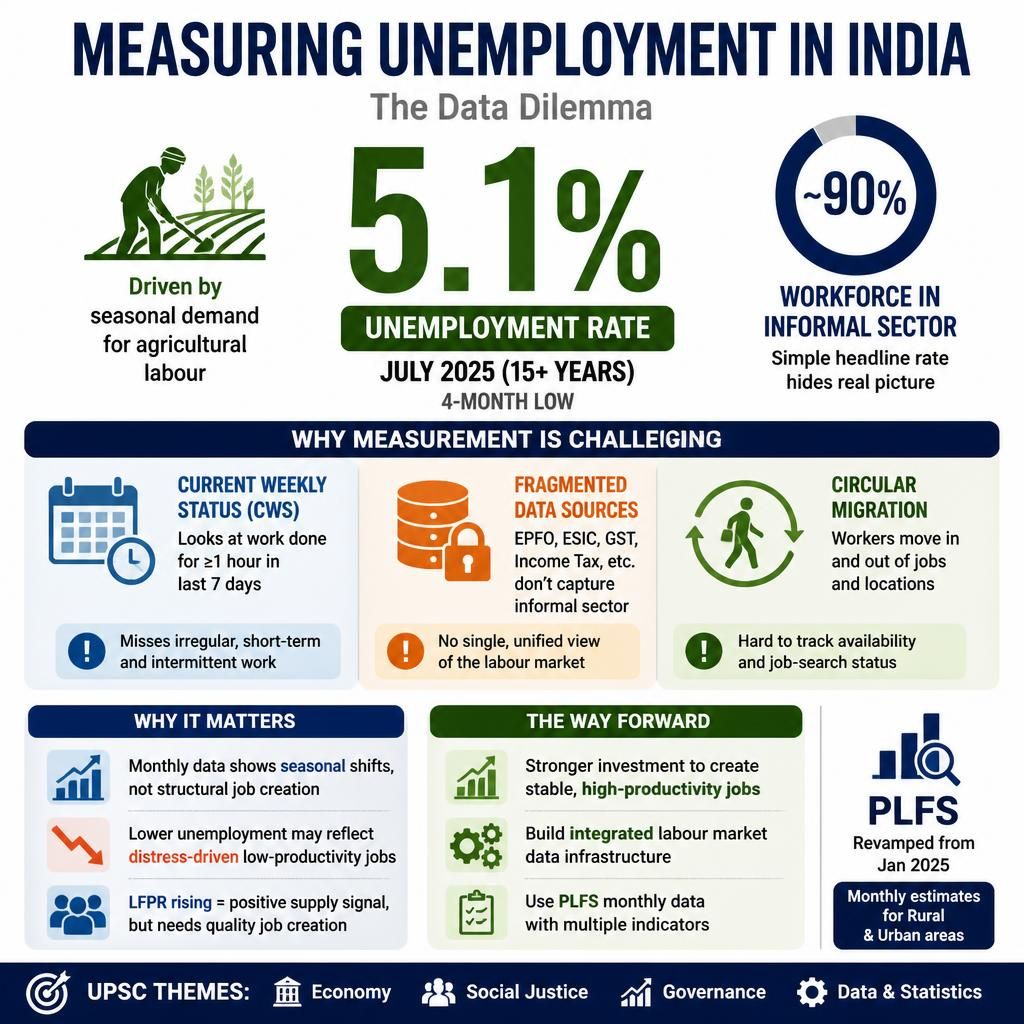
- The latest PLFS indicated a four-month low unemployment rate of 5.1% in July for those aged 15 and above, primarily driven by increased seasonal demand for agricultural labor.
- The Current Weekly Status (CWS) approach, which assesses activity over the preceding seven days, struggles to capture the nuances of India's predominantly informal job market.
- India's move to monthly unemployment indicators is economically desirable but faces credibility challenges due to fragmented databases and the prevalence of circular migration.
- Approximately 90% of India's workforce operates in the informal sector, making a simple headline unemployment rate an incomplete measure of labor market health.
Unemployment.jpg
Detailed Insights:
- The Current Weekly Status (CWS) method defines a person's activity status based on their engagement in economic activity for at least one hour during the seven days preceding the survey.
- Measuring unemployment in India is complex due to the informal nature of jobs, which often lack formal contracts, regular payments, and social security benefits.
- Unlike advanced economies with mature labor markets, India's data sources like EPFO and ESIC payrolls, GST information, and income tax records remain fragmented and do not fully capture the informal sector.
- The International Labour Organization (ILO) defines unemployment as being without work, available for work, and actively seeking employment.
- The monthly unemployment data primarily reflects seasonal fluctuations in sectors like agriculture and construction, rather than structural improvements or expansion in formal sector jobs.
- A decline in unemployment might indicate distress-driven entry into low-productivity jobs, rather than genuine employment creation.
- The increase in the Labour Force Participation Rate (LFPR) is a positive supply-side signal, but sustainable employment recovery requires stronger investment and the creation of stable, high-productivity jobs.
- The revamped PLFS, launched in 2017 and further enhanced from January 2025, aims to provide more frequent and comprehensive labor market data, including monthly estimates for rural and urban areas.
Key Concepts Involved:
- Current Weekly Status (CWS): An approach to measure employment and unemployment based on a person's activity status during the seven days preceding the survey.
- Periodic Labour Force Survey (PLFS): India's primary official survey for estimating key employment and unemployment indicators, conducted by the National Statistical Office.
- International Labour Organization (ILO): A United Nations agency that sets international labor standards and provides guidelines for measuring employment and unemployment.
- Labour Force Participation Rate (LFPR): The percentage of the working-age population (15+ years) that is either employed or actively seeking employment.
- Informal Sector: Economic activities that are not regulated or protected by the state, characterized by a lack of formal contracts, social security, and often low productivity.

SuperKalam is your personal mentor for UPSC preparation, guiding you at every step of the exam journey.
Download the App


STUDY RESOURCES
CONTACT US
ⓒ Snapstack Technologies Private Limited