GS 3: EconomyPrelimsGS 3: Indian Economy, Planning, Mobilization of Resources, Growth, Development and EmploymentGS 2: Government policies and interventions for development in various sectorsGS 2: Statutory, Regulatory and Quasi Judicial Bodies
Does inflation targeting work in India?, Pg8
A decade of inflation targeting by RBI questioned due to flat Phillips curve and misaligned public expectations, potentially causing stagflation.
Practice MCQs
833 Students attempted
Key Highlights:
- India has completed a decade of Inflation Targeting (IT) as a formal policy framework of the Reserve Bank of India (RBI).
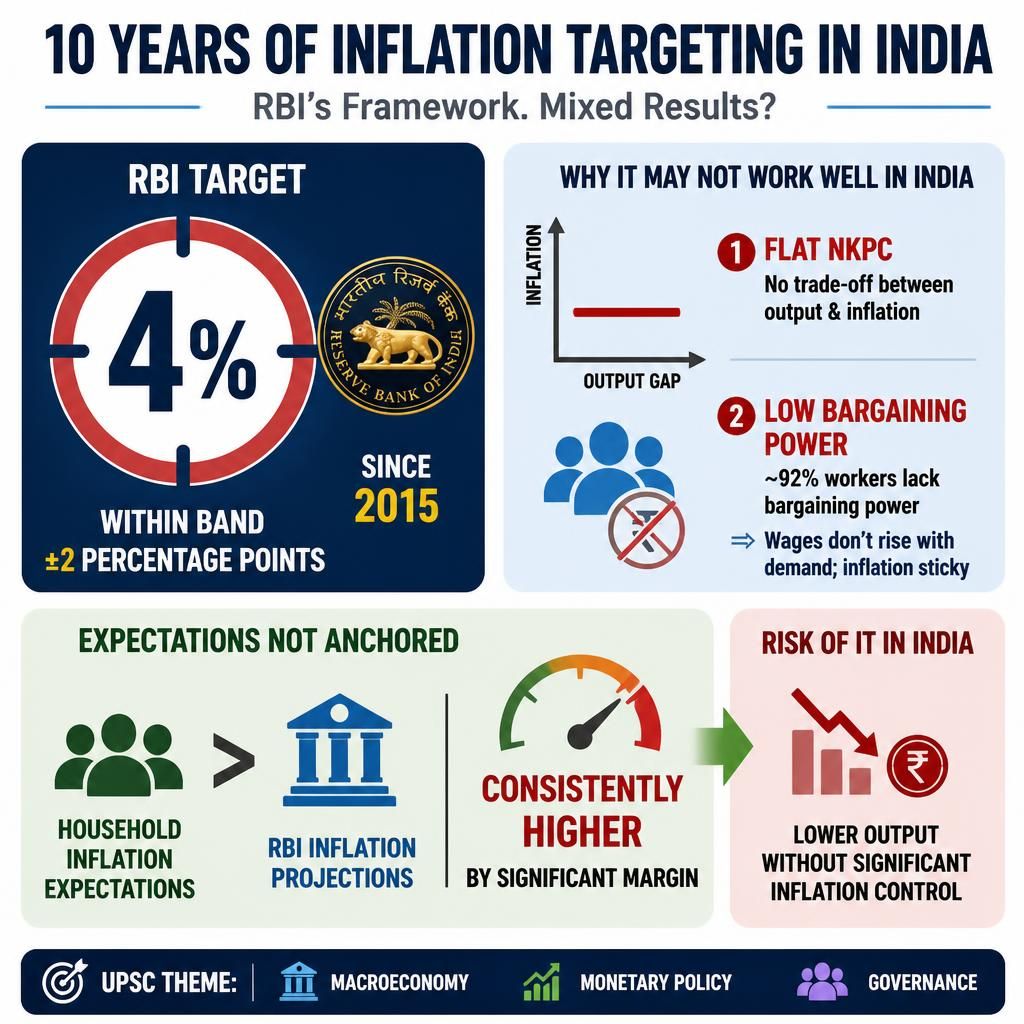
- Under this framework, the RBI aims to contain inflation at 4% within a band of (+/-) 2 percentage points.
- The article argues that IT may not be effective in India due to a flat New Keynesian Phillips Curve (NKPC).
- Public inflation expectations in India are consistently higher than the RBI's projections.
Inflation Targeting.jpg
Detailed Insights:
- The RBI attempts to control inflation by adjusting the repo rate to manage demand and by influencing public inflationary expectations.
- The New Keynesian Phillips Curve (NKPC) theoretically describes a relationship where rising output leads to increased inflation.
- The article's academic work suggests India's NKPC is flat, implying no significant trade-off between output and inflation.
- A flat NKPC is attributed to the lack of bargaining power among a large majority of Indian workers (around 92%).
- If the NKPC is flat and expectations are not anchored, IT could lead to lower output without effectively controlling inflation.
- Indian household inflation expectations, surveyed by the RBI, consistently exceed the RBI's own projections by a significant margin.
Key Concepts Involved:
- Inflation Targeting (IT): A monetary policy framework where the central bank sets a specific inflation rate as its primary goal.
- Repo Rate: The interest rate at which the Reserve Bank of India lends money to commercial banks.
- New Keynesian Phillips Curve (NKPC): An economic model illustrating the short-run inverse relationship between the rate of unemployment (or output gap) and the rate of inflation.
- Index of Industrial Production (IIP): An indicator that measures the changes in the volume of production in industrial sectors.

SuperKalam is your personal mentor for UPSC preparation, guiding you at every step of the exam journey.
Download the App


STUDY RESOURCES
CONTACT US
ⓒ Snapstack Technologies Private Limited