GS 2: GovernanceGS 3: Environment & EcologyPrelimsGS 3: Infrastructure: Energy, Ports, Roads, Airports, Railways etc.GS 3: Conservation, Pollution and Degradation
Cabinet Approved Cost For GOBARdhan Scheme, Pg10
Cabinet approves GOBARdhan scheme with ₹23,731 crore outlay to boost biogas production and circular bioenergy from 2026-27 to 2035-36.
Practice MCQs
826 Students attempted
Key Highlights:
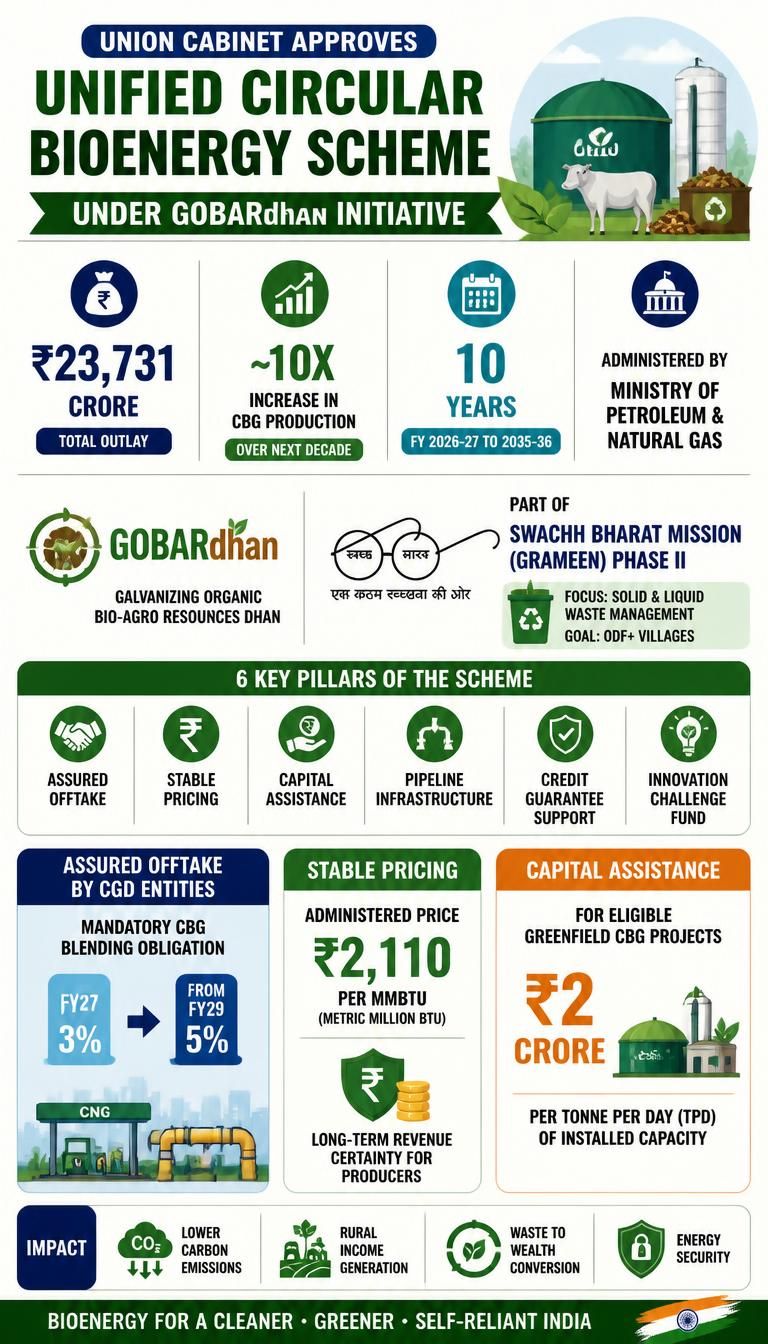
- The Union Cabinet has approved a unified circular bioenergy scheme under the GOBARdhan initiative with an outlay of ₹23,731 crore.
- The scheme aims to significantly boost Compressed Biogas (CBG) production in India, targeting a nearly ten-fold increase over the next decade.
- It will be implemented for a period of ten years, from the financial year 2026-27 to 2035-36.
- The Ministry of Petroleum and Natural Gas will administer this scheme, integrating the entire CBG value chain.
Gobardhan.jpg
Detailed Insights:
- The full form of GOBARdhan is Galvanizing Organic Bio-Agro Resources Dhan, emphasizing the conversion of organic waste into valuable resources.
- This initiative is a crucial part of the Swachh Bharat Mission (Grameen) Phase II, focusing on Solid and Liquid Waste Management and achieving ODF-plus status in villages.
- The scheme is structured around six key pillars: assured offtake, stable pricing, capital assistance, pipeline infrastructure, credit guarantee support, and an innovation challenge fund.
- City Gas Distribution (CGD) entities will procure CBG to meet mandatory blending obligations, starting at 3% in FY27 and rising to 5% from FY29 onwards.
- An administered price of ₹2,110 per Metric Million British Thermal Unit (MMBTU) has been fixed for CBG, providing long-term revenue certainty for producers.
- Eligible greenfield CBG projects will receive capital assistance of up to ₹2 crore per tonne per day (TPD) of installed capacity.
- The scheme utilizes diverse feedstocks such as agricultural residue, cattle dung, municipal organic waste, and press mud to produce CBG and organic manure.
- It aims to strengthen India's energy security, reduce reliance on imported fossil fuels, create 1.5 lakh jobs, and foster a vibrant circular bioeconomy.
Key Concepts Involved:
- GOBARdhan Scheme: A government initiative to convert organic waste, particularly cattle dung and agricultural residue, into biogas, Compressed Biogas (CBG), and organic manure.
- Compressed Biogas (CBG): A purified form of biogas, primarily methane, which is chemically identical to natural gas and can be used as a clean, renewable fuel.
- Circular Bioeconomy: An economic model that focuses on using renewable biological resources and transforming organic waste streams into value-added products, materials, and bioenergy, thereby closing resource loops.

SuperKalam is your personal mentor for UPSC preparation, guiding you at every step of the exam journey.
Download the App


STUDY RESOURCES
CONTACT US
ⓒ Snapstack Technologies Private Limited