GS 2: GovernanceGS 2: PolityGS 3: Science & TechnologyGS 2: Social JusticePrelims
Removing the odds between safety and freedom, Pg12
Landmark Supreme Court ruling recognizes internet access as fundamental right for children, urging balance between online freedom and safety measures.
Practice MCQs
840 Students attempted
Key Highlights:
- The Supreme Court, in Just Rights for Children Alliance v. S. Harish (2026), recognized internet access as a fundamental right for children.
- The ruling emphasized that internet access is crucial for children's knowledge, creativity, and self-expression.
- The court clarified that safety and freedom are not inherently at odds, and protecting children does not necessitate restricting their freedom.
- Internet access is considered an essential component of the right to freedom of speech and expression under Article 19(1)(a) of the Constitution.
- The judgment advocates for "authority-liberty coordination" to balance state authority and citizens' rights for democratic governance.
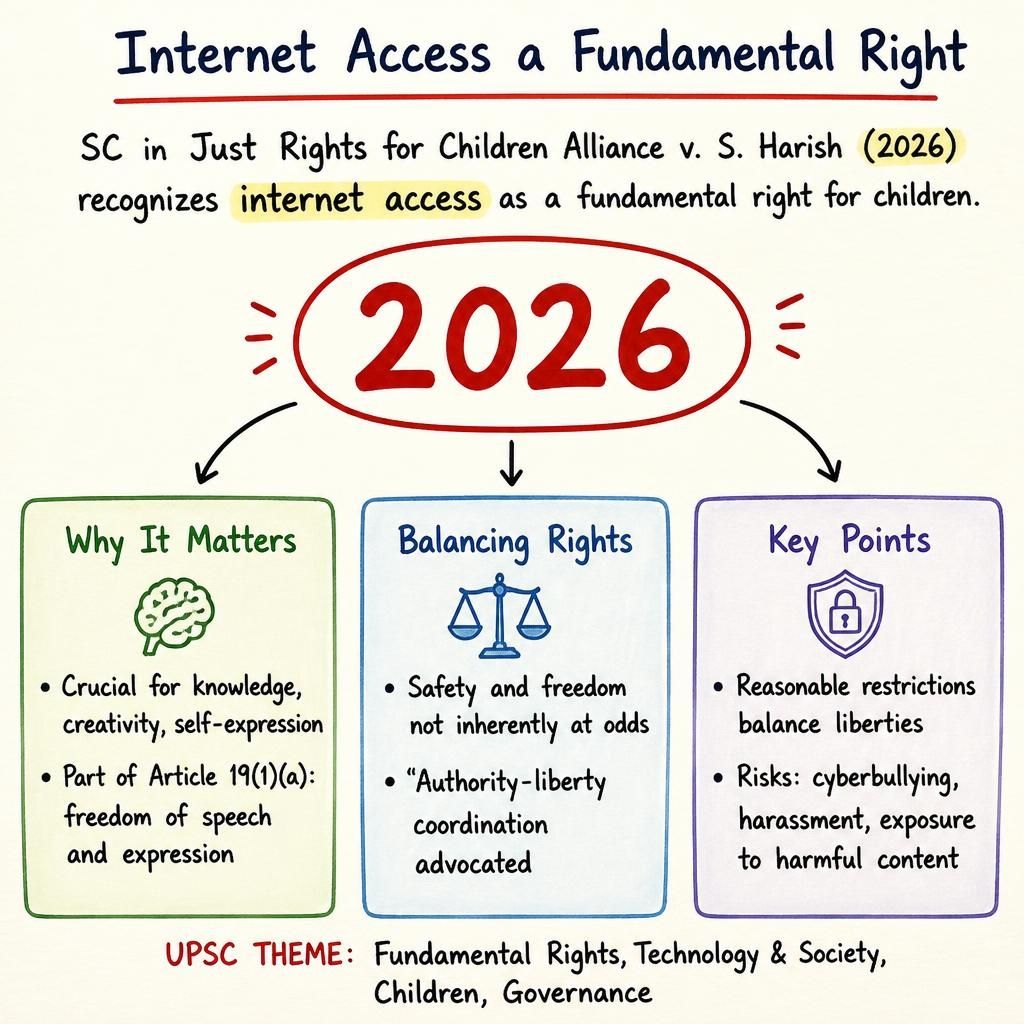
Internet Access as a Fundamental Right.jpg
Detailed Insights:
- The ruling reinforces democratic principles by ensuring that children can explore the digital world safely while exercising their fundamental rights.
- Reasonable restrictions are deemed important to balance individual liberties with societal interests, preventing both dictatorial tendencies and anarchy.
- Digital technologies are seen as crucial for capability enhancement and transformation, aligning with theories by Amartya Sen and Joseph Stiglitz.
- Internet access is presented as a tool for learning, skill development, and global connection for children, not merely a privilege.
- Some countries like Australia, Brazil, China, Indonesia, Malaysia, and UAE have implemented screen-time limits or guardian linking for children's social media use.
- Indian states like Andhra Pradesh and Karnataka are considering similar screen-time curbs to promote responsible internet use.
- The Supreme Court previously held in Anuradha Bhasin v. Union of India (2020) that internet access for speech, expression, trade, and business is protected under Articles 19(1)(a) and 19(1)(g).
- In Pragya Prasun v. Union of India (2025), the court ruled that excluding persons with disabilities from digital KYC violates Article 21, recognizing digital access as part of the right to life.
- The court also cited Cricket Association of Bengal (1995), affirming that Article 19(1)(a) includes the right to know and to receive and impart information.
- Risks for children online include cyberbullying, harassment, privacy violations, and fraud, necessitating a convergent approach from stakeholders.
Key Concepts Involved:
- Fundamental Right: A right recognized by the constitution as requiring a high degree of protection from government encroachment.
- Article 19(1)(a): Guarantees freedom of speech and expression to all citizens.
- Article 21: Guarantees protection of life and personal liberty.
- Reasonable Restrictions: Limitations imposed by the state on fundamental rights in the interest of public order, morality, etc.
- Authority-liberty coordination: Balancing state authority and individual liberties for the smooth functioning of democratic governance.

SuperKalam is your personal mentor for UPSC preparation, guiding you at every step of the exam journey.
Download the App


STUDY RESOURCES
CONTACT US
ⓒ Snapstack Technologies Private Limited